Get Full Government Meeting Transcripts, Videos, & Alerts Forever!
Get email alerts on the Regional Transportation Plan topic
No spam. Unsubscribe anytime.
CAMPO board reviews RTP outreach, survey results and $884 million 25-year funding estimate
Summary
The CAMPO board received an update on the regional transportation plan (RTP) and the coordinated human services plan, reviewed survey and stakeholder outreach results, and discussed project prioritization, a draft timeline and an estimated $884 million in available funding across the CAMPO region over the 25-year planning window.
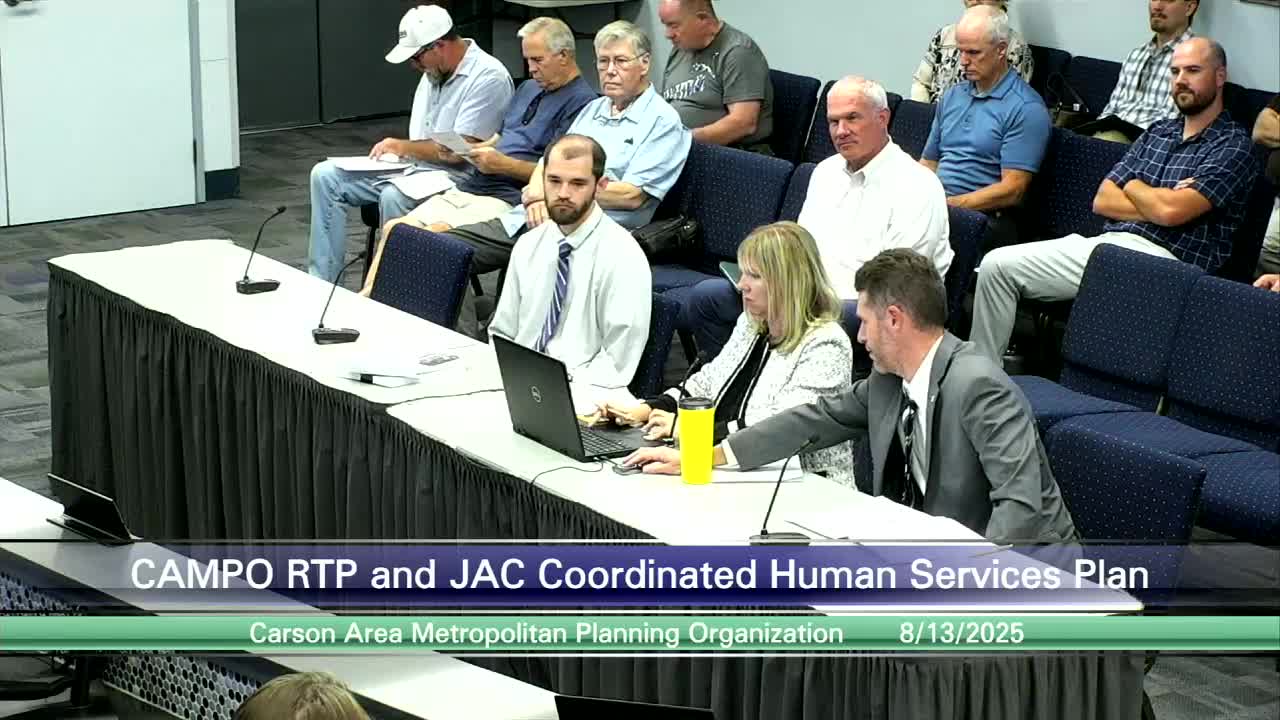
The CAMPO board met on Wednesday, Aug. 13, and received a staff briefing on the regional transportation plan (RTP) update and the coordinated human services plan, including outreach results, draft priorities and a preliminary 25-year funding estimate of about $884,000,000 for projects in the CAMPO planning area.
The update and public survey results were presented by Kelly Norman, senior transportation planner; Marcus Myers, transit coordinator for Jump Around Carson (JAC); and Chris Martinovich, CAMPO transportation manager. Norman told the board that “overall, growth projections within the CAMPO area are relatively low,” while congestion is increasing on major connections such as U.S. 50 and U.S. 395. Norman said survey participation totaled 267 respondents and that staff will hold a public meeting in late September, present a draft for a 30-day public comment period in November, and aim to present a final RTP in January.
Why it matters: the RTP sets the region’s list of regionally significant projects, prioritization criteria and a funding plan that local and state partners use to seek and allocate federal, state and local dollars. Martinovich said the draft funding projection is intended to show which projects can realistically be funded and which will remain unfunded without additional revenue.
Key findings and next steps - Outreach and survey: Staff reported stakeholder outreach in June and a follow-up public survey (May–August) with 267 responses. The survey showed that 90% of respondents live within the CAMPO area; about 29% work 2–5 miles away and 25% commute 6–30 miles. Respondents prioritized reliability (42%), safety (37%), efficiency and accessibility when asked about transportation system goals.
- Transit and coordinated human services: Marcus Myers described the coordinated human services plan as “a locally developed strategy that identifies the transportation needs of specific populations like seniors, individuals with disabilities and people with low incomes.” Survey and stakeholder feedback indicated barriers to transit use: 42% said the bus does not go where they need, 37% said travel times are too long, 30% said service is not available when needed and 23% said they do not know what services are available.
- Funding and prioritization: Chris Martinovich reviewed available funding sources (federal programs, state and local funds, motor fuel taxes and local sales taxes) and said staff applied conservative revenue-growth assumptions. He reported an estimated available funding pool of about $884 million for the 25-year RTP window (2025–2050) across Carson City, Lyon County, Douglas County and NDOT facilities in the CAMPO region. Martinovich described a project-prioritization approach using six goal areas (safety, quality of life, mobility, prosperity, adaptability and preservation), with projects scored against criteria within each goal area and weighted for the final prioritized list.
Board comments and public input Board members asked about outreach to federal land management agencies and other state partners; Chair Novak reminded staff that federal land agencies are required stakeholders for some planning elements. Commissioner Casanelli asked whether private development projects are being considered; staff confirmed that the RTP review will include applicable private development projects that affect regional connectivity. Commissioners clarified that scoring will be broken out by funding eligibility (for example, separate treatments for transit vs. road/highway funding sources) rather than a single undifferentiated priority list.
Public comment: Carson City resident Mark Costa urged clear public weighting of RTP goals and asked that the public meeting date be posted early so residents can attend. Costa also recommended that the RTP incorporate adaptability criteria for new infrastructure technologies.
What’s next: staff will finalize outreach materials, hold a public meeting in late September, present a draft RTP for 30-day public comment in November and aim to deliver a final RTP to the board in January. Project lists submitted by agencies will be scored against the six goal areas, and prioritized projects will be returned to the board and the public for review.