Get Full Government Meeting Transcripts, Videos, & Alerts Forever!
Get email alerts on the K 12 Education Budget topic
No spam. Unsubscribe anytime.
Issaquah School Board holds public hearing on 2025–26 budget; trustees hear updates on levies, electric buses and equity-based budgeting
Summary
At a public hearing Aug. 7, Issaquah School District finance staff presented the 2025–26 budget overview, citing a projected 346-student enrollment decline, a $46.3 million projected ending fund balance, ongoing bargaining uncertainty and plans for local levy and capital spending including a new high school and electric-bus rollout.
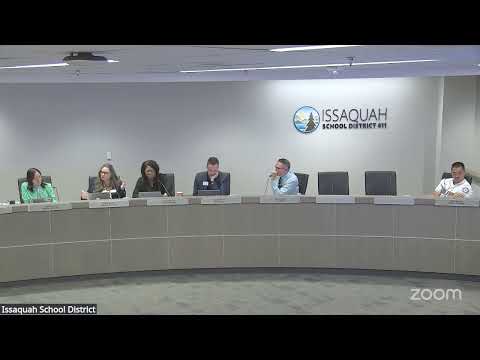
The Issaquah School District Board of Directors on Aug. 7 held a public hearing on the district’s proposed 2025–26 budget, hearing a detailed presentation from finance staff and asking questions about enrollment, special education costs, local levies, capital projects and an electric-bus pilot.
District Chief of Finance and Operations Martin Tierney and Executive Director of Finance and Budget Mariah Vanasick led the presentation, which outlined revenue and expenditure drivers and next steps before a formal budget resolution is scheduled for a future meeting.
The hearing matters because the district depends on a mix of state, local and federal revenue — and on voter-approved levies — to cover recurring costs. Finance staff said the district is projecting a 346-student drop next year, which translates into roughly $4 million less in state revenue and contributes to persistent funding gaps between state funding and actual local costs.
Tierney and Vanasick told the board the district projects last year’s ending fund balance at $5.8 million and a projected ending fund balance for 2025–26 of about $46.3 million, which the presenters characterized as the budget’s working projection; the ratio of fund balance to budgeted expenditures falls from about 13% to 11% under their estimate. Vanasick summarized enrollment risk bluntly: “Enrollment is the lifeblood to funding,” she said.
Key budget drivers and numbers cited by staff included: a projected $9.5 million gap between state funding and actual costs for certain programs, roughly $1.4 million in additional state funding tied to a special-education multiplier increase, an estimated $860,000 gain from a $47 per-student materials and supplies increase, and a $4 million increase in local levy capacity tied to state adjustments in levy rules. Staff said roughly 70% of the district’s revenues come from the state, 16.6% from the local educational programs and operations (EP&O) levy, and about 2.1% from federal funds.
Board members pressed for details about several items. Director Mullins praised the district’s annual budget guide as a source of transparency and asked for clarification about the new high school financing; he said “dollars are there” for the project and urged accuracy in public messages about the work. Director Coyne reminded the public that the hearing was the time to comment and asked how the budget guide is distributed; staff said notices were published in the local newspaper and materials are posted on the district website and available at the administration building.
Special education was a focus in board questions. Director Gallagher asked why special-services expenditures increased even though special-education enrollment in the presentation was stable at about 2,016 students. Vanasick and Tierney said much of the higher spending reflects salary and staffing cost growth year to year and one-time curriculum-related staffing changes in prior years; staff said they would follow up with more detailed line-item analysis.
The board also discussed the district’s equity-based budgeting work, which staff described as a set of internal processes to target additional resources — such as MTSS specialists, social workers and paraeducator support — to higher-need buildings without removing base resources from other schools. “We look at what supports we have currently, what is still areas that we could address, and then also the recent supports that were given, what were the impact of those?” Vanasick said.
Capital and transportation spending were highlighted. Tierney noted the district has activated a capital projects oversight committee and said the new high school project will dominate future capital-year budgeting. On transportation, staff reported the district received a Department of Ecology electric-bus grant that funded three large electric buses and three small non-electric buses in the last procurement cycle, and that the district is installing charging infrastructure at the Plateau transportation facility adjacent to Pine Lake Middle School. “The charging infrastructure is going in this week and next week,” said Jason Morris, executive director of operations. He added the site is designed to be expandable; “it’s easily expandable out to up to 16 charging stations.” Morris said the initial plan is to run plateau routes and recharge midday, then expand routes as confidence and experience grow.
Staff noted a number of uncertainties that could affect the final budget, including ongoing collective-bargaining negotiations with the Issaquah Education Association and federal program funding levels that remain subject to change. Tierney told the board that the district is planning a two- to four-year strategic response and building scenario plans to reduce budget uncertainty.
Next steps: staff said a resolution for possible action on the 2025–26 budget will appear on a future board meeting agenda. The board closed the public hearing with no public commenters and returned to regular business.
Votes at the meeting included a routine approval of the consent agenda. A board member moved to approve the consent agenda; a second was given and the chair called for the ayes. The motion carried with the chair declaring the ayes have it; the record did not include roll-call votes by name.