Get Full Government Meeting Transcripts, Videos, & Alerts Forever!
Get email alerts on the Wildlife Management topic
No spam. Unsubscribe anytime.
Panel reviews access‑deer population control, processing and regulatory barriers in Maui County
Summary
A multi‑agency panel briefed the committee on options to manage Maui County’s excessive axis (fallow) deer population, highlighting ecological damage, public safety and potential food‑industry opportunities but also regulatory and infrastructure bottlenecks for commercial processing and donation.
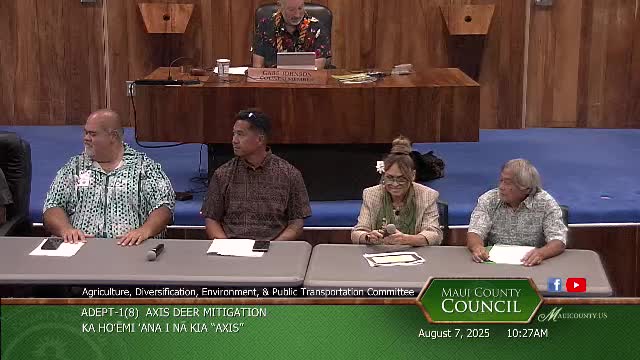
A large panel of state, county and community experts outlined the scale and complexity of Maui County’s axis‑deer challenge at an Aug. 7 committee briefing, emphasizing that population pressures damage native ecosystems, increase erosion and contribute to mud‑flood risk while also presenting potential local‑food and value‑added opportunities.
Why it matters: Panelists stressed that effective long‑term management requires removing a large annual share of the herd. Speakers described a combination of tactics — fencing, targeted removals, expanded harvest and processing capacity, and community‑based programs — as the only realistic route to reduce numbers and protect watersheds and agriculture.
Arizona State University researcher Carly Wyman summarized regulatory barriers to commercial venison. At the federal level, the Federal Meat Inspection Act defines “amenable” species and treats game such as deer as non‑amenable, meaning processors must pay for voluntary FSIS (USDA Food Safety and Inspection Service) inspections when products enter interstate commerce. Wyman and others said voluntary inspections are costly and USDA inspector availability is limited; she estimated mobile processing trailers cost roughly $250,000 to equip (higher with chill/waste systems) while retrofitting fixed facilities could run into the millions.
Wyman also summarized the Federal Humane Methods of Slaughter Act and Federal Food, Drug and Cosmetic Act (current good manufacturing practices), and cited state rules and a dormant Hawaii meat inspection program that would, if re‑funded, allow state‑level inspection for intrastate sales. She noted that Hawaii revised state law in 2023 to allow donation of game meat under defined, food‑safety conditions (HB 1382) but that implementation questions remain.
Local case studies: Pulama L?nai’s conservation and harvesting program was presented as an example of an integrated approach. Jonathan Sprague and Keiki Pua Danzel described L?nai’s fencing, monitoring and hunting programs, combined with on‑island processing and community distribution. Pulama said it typically harvests hundreds of deer per year for local use and donation, maintains fences to protect cultural and marine resources, operates a mobile processing unit and performs helicopter and camera surveys for population monitoring.
Private industry example: Jake Muse, CEO of Maui Nui Venison, described a scaling, island‑based venison business that processes harvested deer into consumer and community products on Maui. Muse said his firm currently operates multiple mobile processing units that move among sites and that the company has reinvested revenues into expanding processing capacity; he reported several thousand deer processed there in recent years and said direct‑to‑community channels reduce the need for interstate inspection.
Policy and program ideas discussed: Panelists and council members discussed options including reinstating a state meat‑inspection program, state or county subsidies for voluntary FSIS inspection, mobile slaughter units, “Hunters for the Hungry” donation programs (in operation in many states), targeted incentives for landowners to allow harvest on private property, and investments in cold‑storage and aggregation centers. Presenters emphasized that reducing population growth requires sustained annual removal rates (models cited show 30% annual removal needed to reduce population under common reproductive assumptions).
Community and cultural context: Moloka‘i community advocate Laurie Buchanan urged recognition of cultural practices and local subsistence uses while calling for a transparent, locally led plan. Pulama Lanai and DLNR representatives stressed partnership with community hunters, state agencies and federal programs to scale harvest and protect resources.
Next steps: Panelists generally urged pragmatic steps to expand processing and donation capacity, improve funding for inspection and mobile units and coordinate interagency responses. The committee heard the briefing and deferred further formal action; members asked staff to collect details on available funding programs, processing capacity and potential pilot projects.