Get Full Government Meeting Transcripts, Videos, & Alerts Forever!
Get email alerts on the Code Enforcement topic
No spam. Unsubscribe anytime.
Charlotte County magistrate orders fines, abatement liens and compliance deadlines across dozens of property cases
Summary
At an Aug. 6 Charlotte County Code Enforcement Special Magistrate hearing, the magistrate found multiple properties in violation of county codes, imposing fines, abatement cost liens and deadlines for compliance; several owners were given time to get permits or remove hazards while the county reserved the right to abate and place liens.
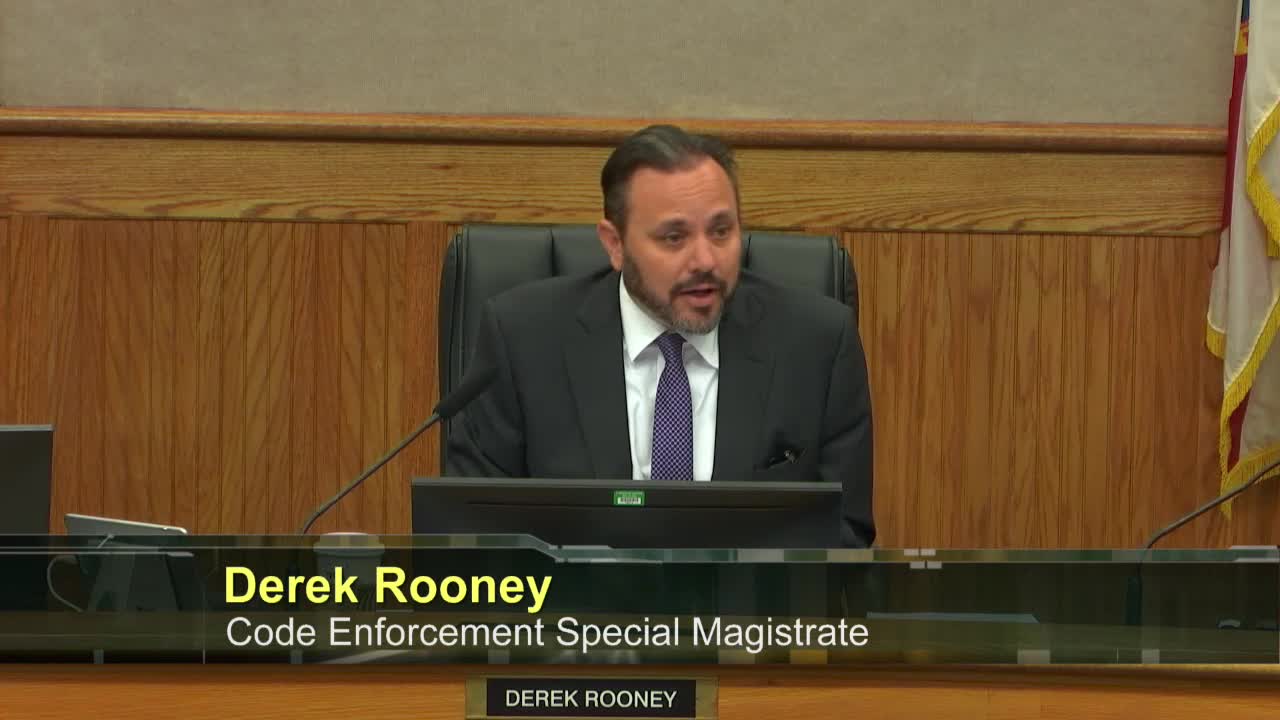
Charlotte County’s special magistrate hearing on Aug. 6 resulted in findings of violation, civil fines and abatement liens on a range of residential and vacant properties, the magistrate said, with multiple owners given short deadlines to correct conditions or face daily fines and possible county abatement.
The magistrate opened the session by explaining the process and burden of proof: “The county has the burden of proof here,” and said owners would have the opportunity to rebut testimony or request additional time to comply. County code officers then presented evidence, including photographs and permit histories, across more than 30 cases that spanned expired permits, junklike conditions, fire‑damaged structures, unpermitted clearing and unresolved Department of Health septic requirements.
Why it matters: Code‑enforcement rulings carry immediate financial consequences (daily fines and abatement costs that become liens) and can affect the marketability of properties. In several cases the magistrate emphasized that the county’s goal is compliance, not punishment, but warned that abatement by the county — and the resulting liens — would occur if owners did not act.
Votes at a glance (selected case outcomes): - COD20-302692 (111 Via Madonna, Englewood) — Owner: John Good. Outcome: Magistrate entered order for recovery of abatement/demolition costs totaling $50,528.42 and found the condition remained after prior order. (County testimony: property was demolished/abatement performed; owner asked for time on adjacent lots.) - COD24-01425 (11441 Wilmington Blvd., Port Charlotte) — Owners: Dennis A. Olney and Stacy Olney. Outcome: Magistrate entered lien for abatement costs of $17,640.94 and a one‑day ANC fine of $120 after county testimony that abatement occurred and violations remained on the lot in question. - COD23-02082 (1120 Martha Place, Englewood) — Owner: Karen Martin. Outcome: Magistrate found the property noncompliant, assessed the first ANC fine ($120) and allowed fines to accrue until full compliance; staff were requested to re‑inspect and itemize specific outstanding repairs. - COD23-01065 (15475 Mango Dr., Punta Gorda) — Owners: Elmer Toth and Amilka Ayala Reyes. Outcome: First ANC ($70) imposed; magistrate noted recent personal hardship (owner reported husband’s death) and allowed the practical reinspection window (~90 days) while fines can continue. - COD22-02016 (Land & Lawn LLC, Cook Brown Road) — Owner/Agent: Land and Lawn LLC / Ryan Dugan. Outcome: Magistrate found violations remained and set a compliance window; case remains subject to fines and county abatement if not resolved (site plan/engineering and permitting outstanding; bankruptcy and tax/agency issues discussed by counsel). - COD25-00635 (1346 Pocket Terrace, Port Charlotte) — Owner: Richard Andrews. Outcome: Magistrate granted a 90‑day period for the owner to obtain permits and pursue building approvals (owner reported survey and engineering timelines); a two‑year cease‑and‑desist was entered and county abatement cost was reserved if removal becomes necessary. - COD25-00887/COD23-03068 and similar (fire‑damaged structures) — Multiple properties (examples: 3538 Pine Tree St.; 157 Barr Dr.; 1527 Ibis Dr.) were found unsafe and in violation; owners were ordered to obtain permits or secure/demolish structures within compliance windows (typically 30–60 days); magistrate warned that the county could abate dangerous structures and record lienable costs. - DOH‑referrals (DOH25‑0003 at 2410 Whisperlow; DOH25‑0005 at 2452 Auburn Blvd.) — Septic/pump‑out violations: Magistrate found violations and gave owners 30 days to provide pump‑out receipts/permit payments to the Florida Department of Health before $50/day fines accrue.
What the magistrate emphasized: For cases where a property was already ordered into compliance previously and the cure period had lapsed, the magistrate said the county must impose fines or enter abatement costs when the county’s evidence shows noncompliance. Conversely, when owners demonstrated active efforts (permits in progress, scheduling, finance plans) the magistrate sometimes extended time to allow permits/repairs to proceed, with continuing fines accruing until final compliance.
Examples of owner statements and officer testimony: Gary RotoHorse, a certified county code compliance officer, testified in multiple cases about inspections and the absence of required permits or connections (for example, lack of mandatory water connection leading to a $4,520 90‑day fine recommendation). John Good, a respondent in the Via Madonna matter, told the magistrate he was “finishing emptying out the two manufactured homes” and asked for weeks to complete the work; the magistrate nevertheless entered the abatement cost recovery order.
Next steps and follow‑ups: In several matters staff were directed to re‑inspect after set periods (examples: 15, 30, 60 and 90 days depending on the violation) and to provide itemized lists where needed so owners could pursue permit applications or abatement relief. The magistrate closed the docket and indicated the court would return in September for the next scheduled session.
A note on process and remedies: The magistrate repeatedly reminded respondents that they may challenge the magistrate’s orders in circuit court within 30 days after a decision, and that abatement costs and daily fines become liens against properties if not resolved. The county has a lien‑relief program that owners may use to seek reduction of fines after bringing properties into compliance.
Ending: The hearing produced a mix of immediate orders (fines, liens, cease‑and‑desist orders) and conditional continuances tied to permit progress or extraordinary hardship; property owners who intend to avoid county abatement were directed to coordinate promptly with county officers and the building department and to return with evidence of permit activity when the properties are re‑inspected.