Get Full Government Meeting Transcripts, Videos, & Alerts Forever!
Get email alerts on the School Zone Speed Enforcement topic
No spam. Unsubscribe anytime.
Wellington to activate automated speed detection at 11 school zones Aug. 11; 30‑day warning period set
Summary
Wellington will begin automated speed detection enforcement at 11 public school zones on Aug. 11, village staff and the vendor said at a council workshop on Aug. 5.
Wellington will begin automated speed detection enforcement at 11 public school zones on Aug. 11, village staff and the vendor said at a council workshop on Aug. 5. The village will mail warning notices for 30 days, then begin issuing notices of violation on Sept. 15; those notices will be payable or contestable through an online hearing process.
The program aims to reduce high speeds observed in school zones. A speed study presented to council staff found 543 speeding detections across two school zones during a 14‑day period in mid‑to‑late May, including 424 vehicles recorded between 31–40 mph, 108 between 41–60 mph and 11 over 60 mph, presenters said.
Genoptic, the vendor, described the evidence package that will accompany each potential violation: a still overview image with date/time and speed overlay, a license‑plate image, and a 10‑second video clip. "Every potential violation will have an evidence package, for us internally to review twice and then for the code enforcement to review and approve," a Genoptic representative said. After two internal reviews the code enforcement reviewer may approve (triggering notice generation) or reject (case closed).
The village described the notice and payment timeline: notices of violation issued after the 30‑day warning window give recipients 30 days to pay or contest; if neither occurs, the matter could move, after an additional 60 days, to a Uniform Traffic Citation (UTC) for PBSO to process. "If they opt in to pay, then the case is closed. If they contest, then it goes into the hearing process," the vendor said.
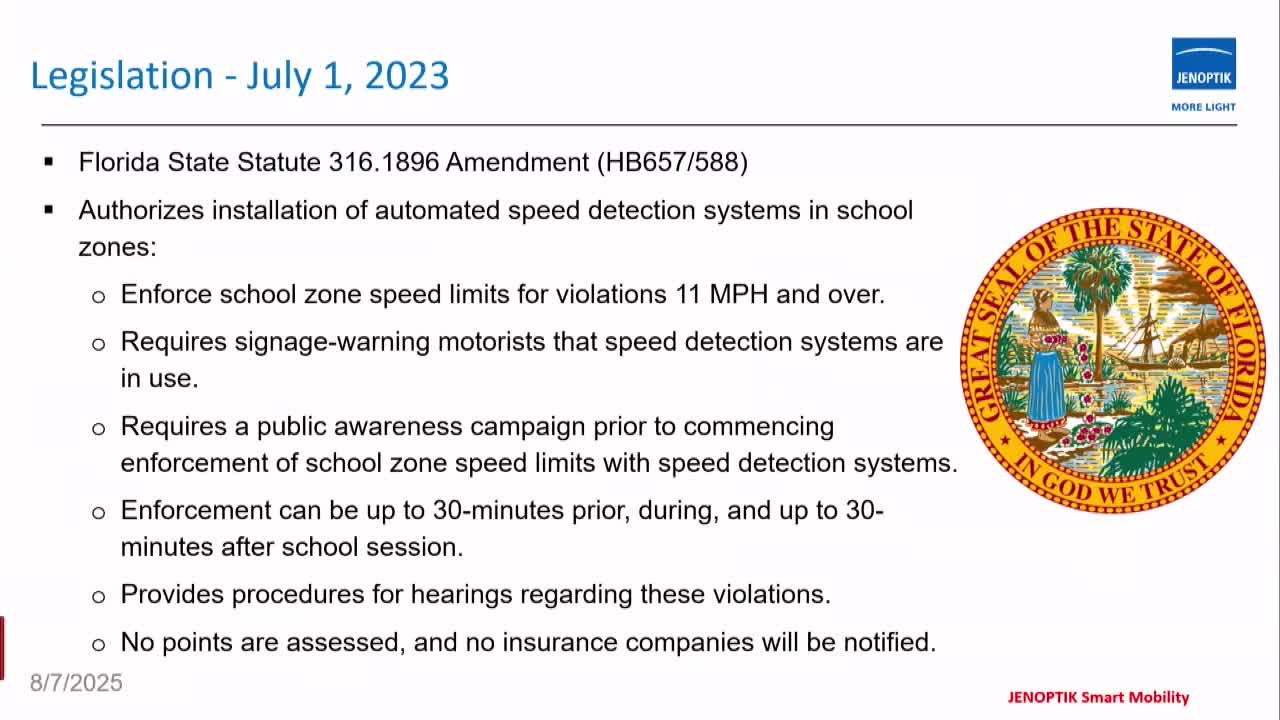
The law that authorizes automated enforcement requires public awareness activity 30 days before a program goes live; staff said a public awareness campaign began July 11 and will include a program website, flyers to principals and PTAs, QR codes on printed material, monthly newsletters and social media postings. "Any potential violators that are cited during that 30 day warning period, they will receive a warning notice in the mail," the Genoptic representative said.
Signage and camera placement: staff said photo‑enforcement signage is being installed per state law, with signs required 100 feet from camera enforcement locations. The village plans at least 20 signs to meet state requirements immediately and up to 75 signs overall; snipe and A‑frame signs will supplement permanent signs. Mobile cameras are already deployed to allow the program to start while permanent infrastructure is completed.
Employee and municipal vehicles: the village will flag government vehicles with a designated process and handle potential violations as employment matters rather than issuing notices directly to drivers where the registered owner is the municipality. "Ultimately, the way the violations are set up, since initially they're not a uniform traffic citation, they're a notice of violation, they would be the responsibility of the village or the respective local government that they do that the employees work for," a village staff member said. Councilmembers expressed interest in ensuring that an employee who actually drove a municipal vehicle could be held accountable administratively.
Systems and integration risks: staff and vendor outlined technical integration steps and a known interoperability issue the village is monitoring: Genoptic's system (IHS) must interoperate with PBSO's UTC system (Inlets) and the county's FUSES platform for evidence sharing and UTC issuance. Genoptic has been engaging the clerk's office and PBSO to exchange credentials and protocol versions; staff said they expect the systems to be ready by late November, and noted the calendar gaps created by the 30‑day warning and payment windows likely delay any UTC issuance until late November or December.
Enforcement scope and coordination with PBSO: village staff emphasized the cameras are not intended to replace in‑person law enforcement. PBSO can still stop drivers in real time; staff said if both a camera violation and a PBSO UTC are issued for the same incident, the camera violation would typically be dropped and the driver would be handled through PBSO.
Other operational details: evidence packages will be subject to two internal reviews before code enforcement sees them; the notice of violation will include a PIN and citation number allowing a recipient to view the evidence online. Payment options include trafficcitations.com, mail, phone (subject to a convenience fee typically 4.5% for card payments), and an in‑person kiosk the village will provide. Staff said village vehicles will be flagged so notices initially go to the agency and be handled administratively.
Why it matters: Council members framed the program as a safety measure targeted at high speeds during arrival and dismissal. Presenters said the speed study showed most detections occurred during morning drop‑off and afternoon pickup, supporting a school‑zone enforcement schedule aligned with beacon/flasher times at each school.
Next steps and monitoring: the village will start the 30‑day warning period on Aug. 11 and staff said they will reconvene to review initial results and any operational hurdles, particularly the data flows with PBSO. Staff also invited council members to visit the vendor's call center and the kiosk operation once the system is live.