Get Full Government Meeting Transcripts, Videos, & Alerts Forever!
Get email alerts on the Urban Forest Master Plan topic
No spam. Unsubscribe anytime.
Fairfax planning commission hears update on city's first Urban Forest Master Plan
Summary
Consultants and city staff outlined preliminary goals, objectives and early data from Phase 1 of the Urban Forest Master Plan, emphasizing tree equity, centralized management and data-driven targets; the plan is expected to return to the commission in late 2025 for endorsement before council consideration.
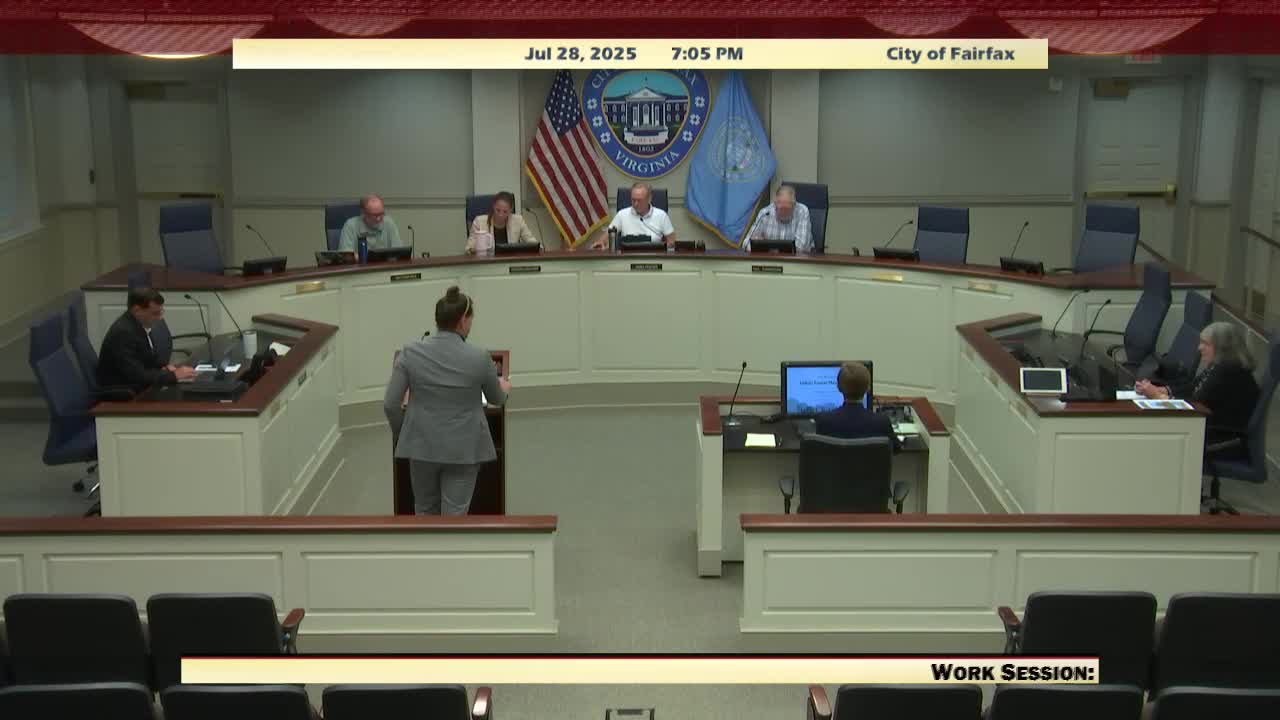
Fairfax Planning Commission members received an update July 28 on the city's first Urban Forest Master Plan, a two-phase effort that consultants and staff said will set 20-year goals and implementation actions for tree canopy, planting, protection and community stewardship.
"This effort will create the first ever urban forest master plan for the City of Fairfax," consultant Garrett Wolf, the engagement lead for the project, told the commission. He said Phase 1 focused on outreach and a review of current conditions and that Phase 2 will produce the full plan and an implementation schedule.
City staff and the consultant framed the plan around three preliminary goals: build and maintain a resilient and equitable urban forest, increase the city's capacity to care for public trees, and strengthen community support and involvement. Anna Stafford, a city planning staff member who led the presentation of the State of the Urban Forest review, described six draft objectives that support those goals, including stronger tree-protection policies, a long-term planting program, creation of a centralized urban forestry division and improved data collection.
Staff presented data used to inform the recommendations. According to the presentation, 2023 land-cover imagery showed Fairfax with 37.86% tree canopy coverage; 76% of the citywide tree canopy is privately owned; and 61% of plantable area is on single-detached residential parcels. The project team reported 83 public survey responses and more than 100 stakeholder interviews during Phase 1, and said the project engagement webpage recorded about 2,000 unique visits.
The commission and the consultant discussed how to use canopy-change data to attribute loss or gain to specific development projects, stream-restoration work or natural change. Commission chair and members urged combining aerial imagery with ground truthing and more precise indicators such as canopy-over-impervious-surface to assess impacts on urban heat and stormwater. Commissioner Matt Rice suggested using near-infrared imagery and narrower, parcel- or project-level analysis to separate the effects of major developments such as Boulevard 6 from other causes of canopy change.
Staff described current responsibilities for urban-forest work as divided among three city departments: public works (right-of-way and street trees), parks and recreation (park and trail trees and volunteer programs) and community development (land-development review, permits and long-range policy). Stafford said those groups together amount to roughly three full-time equivalents dedicated to tree work and described the current practice of using provisions in the zoning ordinance, the public facilities manual and Chapter 38 of the City Code to regulate tree removal and preservation.
Commissioners pressed staff on enforcement and on whether the plan would produce requirements strong enough to survive development pressures. The consultant and staff said one of the project's draft objectives is to strengthen tree-protection policy and to explore adopting locally allowed state code provisions to increase public-tree protections and penalties, improve implementation processes and create incentives for preservation and planting across both public and private property.
Staff and consultants said the team will continue outreach and refine objectives based on feedback. The presentation said public meeting No. 3 (June 11) drew roughly 100 voters who ranked implementation strategies; the project team will hold a final public meeting in late fall and plans to present a final draft to the Planning Commission in November or December for endorsement before the plan goes to City Council for possible adoption.
"We anticipate coming back to the Planning Commission in November or early December with the final draft for your endorsement as we prepare to present it to City Council," Garrett Wolf said.
The commission's discussion also touched on operational questions raised by residents: how to report hazardous trees on private property that threaten public ways; whether the city can recoup replacement costs when a public tree is damaged; and how the city's agreements with utilities limit municipal pruning of trees near power lines. Staff advised that trees posing an imminent hazard adjacent to public infrastructure can be reported to code enforcement for inspection under Chapter 38; staff may require owners to act and, in some cases, the city can perform work and charge the property owner. Stafford said statutory limits constrain how much a locality can charge for tree replacement and that utility pruning policy is governed by separate agreements and state practice.
Why it matters: The master plan will guide how the city manages living infrastructure that affects heat, stormwater, public health and neighborhood character. The plan's emphasis on data, centralized management and community engagement is intended to translate canopy goals into enforceable policy and operational practice.
What's next: Staff and the consultant will refine objectives and the implementation plan through the fall, hold one more public meeting and return to the commission late this year with a draft for endorsement before submittal to City Council for adoption.