Get Full Government Meeting Transcripts, Videos, & Alerts Forever!
Get email alerts on the Law Safety Justice Budget topic
No spam. Unsubscribe anytime.
Hennepin County law, safety and justice budget: higher property-tax request, expanded civil legal services and an evolving public defender structure
Summary
County staff told the Administration Operations and Budget Committee the Law, Safety and Justice line of business would seek a 2026 operating budget of about $473.6 million and a property-tax request of about $410.5 million, with major increases driven by sheriff and corrections costs and a continued expansion of adult representation services.
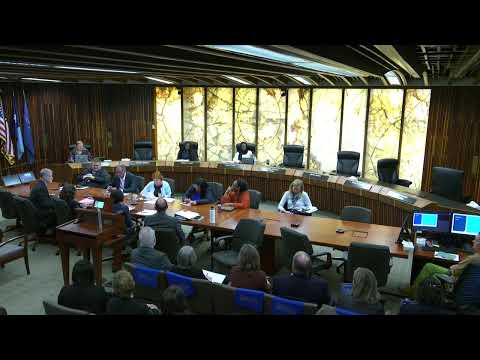
Hennepin County presented the Law, Safety and Justice portion of its 2026 proposed budget at an Oct. 1 Administration Operations and Budget Committee hearing, emphasizing disparity-elimination priorities, early intervention strategies and structural changes in indigent defense support.
"This reflects not only the need in our community, but also the county's continued investment in residents," Assistant County Administrator for Law, Safety and Justice Chella Guzman Viegert told commissioners as she outlined the proposed line-of-business numbers and key program shifts.
The Law, Safety and Justice line of business proposes an overall operating budget of roughly $473,600,000 for 2026, a 4.7% increase over the 2025 adjusted budget, Guzman Viegert said. The line's property-tax request is about $410,500,000, a roughly 9% increase from the prior year; Guzman Viegert said much of the property-tax increase is driven by departmental requests from the sheriff's office and community corrections and rehabilitation.
Adult Representation Services (ARS), the county's civil legal services program, drew extended attention as a growth area. Guzman Viegert said ARS's initial 2018 budget had been about $1.5 million with two employees; for 2026 the county proposes a $21,000,000 ARS budget with 115 full-time positions. Guzman Viegert also said ARS caseloads have risen substantially in recent years as the county expanded access to representation in child-protection, eviction, guardianship and other civil matters.
Department of Community Corrections and Rehabilitation (DOCCR) officials said they expect a near $5.8 million increase in their operating budget, driven in part by higher personal-services costs and an approximately $1.6 million increase in medical-related expenditures tied to residents in county facilities. Staff described increases in voluntary pretrial services and embedded behavioral-health social workers: Guzman Viegert said five social workers are embedded at the adult correctional facility and four at the juvenile detention center to coordinate assessments and link residents to community services at release.
One structural change highlighted in the presentation is the fourth-district Public Defender transition: Guzman Viegert said the state Board of Public Defense will assume primary financial responsibility for the Fourth District Public Defender, reducing the county's role to costs for 18 remaining county-employed staff in that office. Guzman Viegert said the transition was made possible after a cutover in April to a state-supported technology platform that unified public defender operations.
Guzman Viegert and DOCCR leadership described program changes aimed at early intervention. The county is shifting from a one-day DWI post-sentence program to using SBIRT (screening, brief intervention, referral to treatment) earlier in the case process; Guzman Viegert said social workers and behavioral-health staff will do earlier screening to connect people to appropriate treatment sooner.
Commissioners asked for follow-up detail on several items: shifts in contract funding and how the county will communicate changes to providers and residents; the true costs of annexing and how annexing affects jail and medical costs; workforce-pathway alignment for Community Productive Day and whether the county will expand access to non-justice-involved residents; and whether federal/state funding changes affect programs such as ARS. County staff said they would provide follow-up memos and data, including a consolidated annexing cost accounting and an analysis of Community Productive Day's structure and funding options.
Ending: Guzman Viegert thanked the board for its direction and emphasized the county's focus on disparity elimination, supports for early engagement and service alignment across departments. Commissioners scheduled a follow-up hearing on the Sheriff's Office and County Attorney budgets for Oct. 6.