Get Full Government Meeting Transcripts, Videos, & Alerts Forever!
Get email alerts on the Education Finance topic
No spam. Unsubscribe anytime.
Gwinnett schools outline five‑year capital plan as E‑SPLOST continuation appears on Nov. 4 ballot
Summary
Gwinnett County Public Schools presented its updated five‑year capital plan to the Snellville mayor and council, explaining that a continuation of the 1‑cent education SPLOST on the Nov. 4 ballot would fund school safety, facilities, buses and technology.
Gwinnett County Public Schools Interim Chief Operations Officer Patrick Burke told the Snellville mayor and council on Oct. 13 that the district’s updated five‑year capital plan relies on a vote this November to continue the existing 1‑cent education special purpose local option sales tax (E‑SPLOST).
Burke said the plan covers renovations, safety and security upgrades, transportation and classroom technology and that the countywide referendum — on the Nov. 4 ballot — would continue the current E‑SPLOST for another five years if voters approve it.
Burke said the district’s capital plan funds routine building renewals such as roof and HVAC replacement, technology and classroom equipment, safety systems including vestibules and cameras, and bus fleet replacement. “Every 5 years, Gwinnett County Public Schools updates its capital plan,” he said. He told the council that the system includes about 142 schools and about 180,000 students and that the five‑year program is projected to generate roughly $1.43 billion (the referendum language lists about $1.47 billion).
Why it matters: Gwinnett is one of Georgia’s largest school systems. Continuation of the E‑SPLOST would create a dedicated revenue stream restricted to capital projects and not available for recurring operational costs such as teacher salaries, district officials said.
What the district told the council
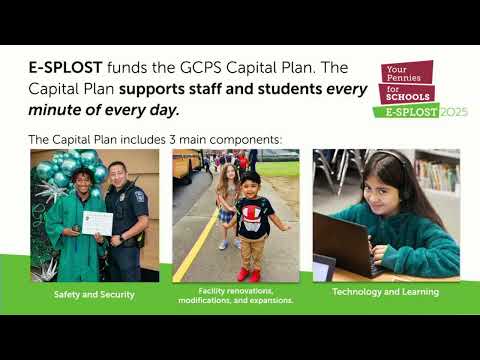
Burke described three main buckets of spending: safety and security, facilities (renovations, modifications, expansions) and technology and learning. In safety he cited investments such as vestibules, visitor check‑in systems and weapons detection systems the district has been piloting. In transportation he said the district has purchased about 100 new buses a year since February 2018 with SPLOST dollars and that newer buses include air conditioning, backup cameras and illuminated stop arms.
On facilities Burke said SPLOST dollars fund smaller but necessary items — lighting, carpet, field and turf replacements — as well as classroom and Career, Technical and Agricultural Education expansions to meet program demand. He said the district has cluster‑level lists showing planned roofing, HVAC and field projects and that more detail is available on the district website and by email to capitalplangcpsk12@org (as provided by the presenter).
Council questions and public engagement
A council member asked how many schools and students would be affected; Burke answered that the district’s 142 schools and roughly 180,000 students are covered by the plan. Burke encouraged voters to review materials on the district website and noted that early voting begins the day after the presentation.
Next steps
The ballot question on Nov. 4 would continue the district’s existing 1‑cent E‑SPLOST for five years if approved by voters; the district and city officials provided no further action by the Snellville council during the meeting.
Ending
Burke made his presentation to the council and answered questions; no vote by the Snellville council on the referendum was recorded at the meeting.