Get Full Government Meeting Transcripts, Videos, & Alerts Forever!
Get email alerts on the Public Works Budget topic
No spam. Unsubscribe anytime.
Hennepin County public works budget emphasizes waste management, transit investments and tree planting
Summary
Hennepin County presented its proposed 2026 Public Works budget — part of a $3.09 billion county proposal — highlighting funding shifts for solid waste processing, ongoing road and transit projects, and expanded tree-planting and accessibility work.
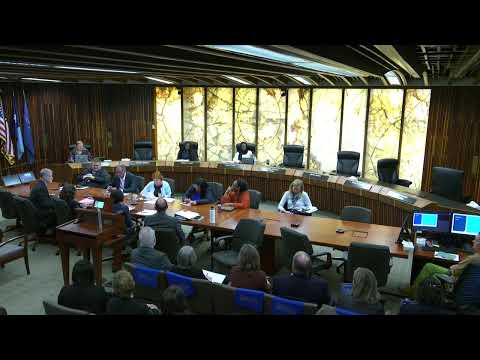
Hennepin County officials presented the Public Works line of business portion of the county's proposed 2026 budget at an Oct. 1 Administration Operations and Budget Committee hearing, detailing a portion of the county's $3,090,000,000 overall proposed spending plan and explanations for changes to operating funds.
Assistant County Administrator for Public Works Lisa Cerny told commissioners that "Public works provides strong and resilient infrastructure that serves as a critical foundation for a healthy and thriving community," and reviewed service metrics and budget drivers for 2026. The county projects an overall operating increase of about $6,900,000 in the Public Works operating budget, while the division is also absorbing higher construction, materials and personnel costs.
The nut of the proposal is that solid waste processing and household hazardous waste are the main drivers of the net change: Cerny said the county is planning for a $5,500,000 increase in costs tied to processing waste and household hazardous waste. She said those costs are expected to be covered through tip fees and other solid-waste revenues rather than additional property tax. County CFO Joe Matthews explained that about 90% of Public Works revenue is non-property-tax; roughly 10% (about $23,000,000) is funded by property tax and is seen as critical to operations.
Public Works highlighted recent and ongoing work: the county manages about 2,200 lane miles of roadway, reported about 1,000 long-term infrastructure improvements in the prior year (including curb-ramp, pedestrian-signal and bikeway projects) and said it had served 143,788 residents through county drop sites and events for household hazardous waste and hard-to-recycle materials in 2024.
Cerny listed climate and equity priorities embedded in the proposal: accelerating "zero waste" actions, expanding organics recycling participation, electrifying and "rightsizing" the county fleet, and planting more trees. She said the county is more than halfway toward a goal of 1,000,000 trees and described a federal forestry grant that is funding removal of disease-affected trees for lower-income residents and a 2:1 replacement planting ratio.
Several commissioners pressed staff for program details and next steps. Commissioner Heather Edelson asked about business incentives and outreach to increase commercial organics recycling; Public Works waste program manager Dave McNary said staff provide grants and technical assistance to businesses and noted a financial incentive created by different tipping rates (McNary said the county charges $35 per ton for organics and $77 per ton for trash at its transfer station). McNary said the county measures progress by four metrics developed for the intended closure of the HERC facility: a 75% recycling rate target, reduced per-capita waste generation, lower biogenic material in trash, and not landfilling more than in 2022.
Commissioners also asked about: fleet electrification and heavy-duty 0-emission technologies; accessibility and the county's Toward 0 Deaths safety plan; partnerships with cities to expand recycling access, especially for multifamily housing; and a Glen Lake wetland restoration project in Minnetonka. Rosemary Lavin described the Glen Lake project as a wetland restoration at a former county site that will produce wetland banking credits the county can sell for mitigation, and said staff are also restoring tree canopy and native plantings there. CFO Joe Matthews said project funding was adjusted to use enterprise (solid-waste) funds rather than property tax in order to reduce levy pressure and align restricted revenues with permissible uses.
On staffing, Public Works reported an error on one slide that the total FTE count should remain 511 and said there are no position increases proposed in FTEs for the line of business in 2026. Cerny also said the operating changes included a $200,000 shift of certain staff expenditures into capital accounting for transit work and a $900,000 increase in fleet internal-service costs tied to higher vehicle and vendor labor prices.
The county emphasized continued reliance on state and federal funding for road and bridge work and said a recent metro-area sales tax provides an opportunity to accelerate investments in aging infrastructure and multimodal projects, including support for Blue Line Extension and arterial bus rapid transit.
Ending: County staff said they would follow up with commissioners on specific requests, including a memo on examples of programs tried and adjusted, additional detail on business engagement for organics and recycling, and a more granular breakdown of safety interventions and performance metrics by urban/suburban/rural context. The Public Works presentation concluded before the meeting moved to the Law, Safety and Justice budget overview.