Get Full Government Meeting Transcripts, Videos, & Alerts Forever!
Get email alerts on the Public Gathering Ordinance topic
No spam. Unsubscribe anytime.
City Attorney presents draft public-gathering ordinance; council moves proposal toward public hearing
Summary
Marietta officials reviewed a draft ordinance to regulate public gatherings and protests citywide. The city attorney said the draft is modeled on a Tennessee ordinance defended in court; council voted to advance the item toward the agenda work session and the first public hearing in October.
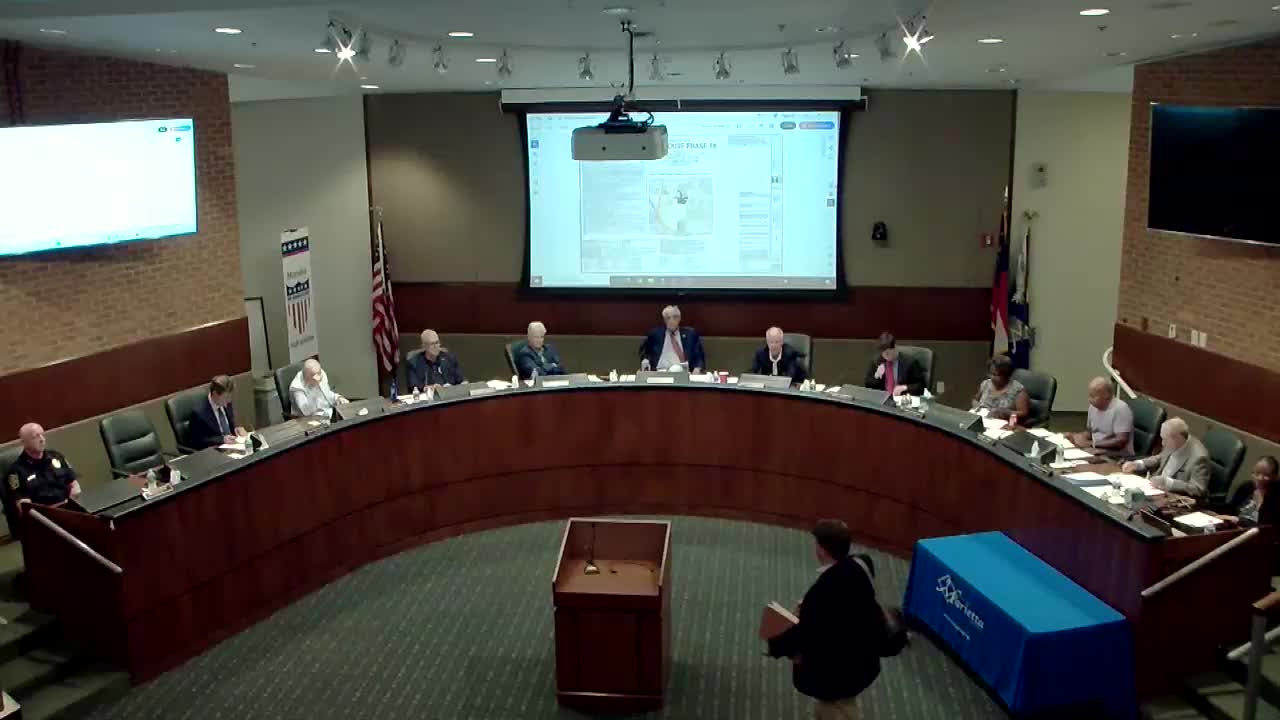
Marietta City Council reviewed a draft ordinance to regulate public gatherings, demonstrations and recurring public-expression events at a committee meeting after City Attorney Bill Pinto presented the document and solicited council feedback.
The ordinance would require a permit for gatherings that meet defined criteria, set content-neutral time, place and manner rules, and allow the city manager or designee to impose conditions on permits based on anticipated public-safety needs. Pinto said the draft draws on a model ordinance from Franklin, Tennessee, that has been litigated and defended, and that the draft is intended to give city staff clearer tools to handle recurring or unannounced demonstrations across the city—not only on Marietta Square.
The draft defines a “public gathering event” by a set of thresholds (including a minimum group size of five in the present draft) and lists exceptions. It includes an application process with supporting information the city may require, a framework for conditional approvals, grounds for denial and an appeal process. The draft also creates a revocation process for active events that become unsafe, a hold‑harmless requirement and criminal/infraction penalties for violations; Pinto said the draft currently refers to certain violations as a public nuisance under the ordinance.
Council members asked multiple questions about enforcement and civil‑liberties implications. Deputy Chief Swaddell and other police commenters asked for clarity about how the police department would be consulted about required services for an event (for example, whether toilets or police presence would be required for larger gatherings). Council members raised questions about whether a single person with a sign would be covered; Pinto said the draft attempts to preserve spontaneous, small‑scale speech (and that some such conduct would fall under exceptions), while capturing recurring, amplified or larger demonstrations for permits and conditions.
Pinto highlighted placeholder provisions intended to address recurring amplified activity on Marietta Square: the draft currently would disallow permits for amplification after dark in defined portions of the downtown historic district and for certain hours (a placeholder example was 5–7 p.m. on Bridal on Saturdays). He said those maps, hours and precise boundaries are draft language that council should refine.
On enforcement and mens rea, council discussed whether the ordinance should include a knowledge requirement (for example, first warning then citation) and how officers would notify participants of dispersal or permit requirements. Pinto said staff would consider language to address inadvertent violations and the practicality of enforcing organizer liability when groups lack a clear organizer.
Council voted to move the ordinance forward for further committee review and to place it on the agenda work session so the city can schedule the first public hearing (the city attorney noted the process requires two public hearings). The committee directed staff to refine the draft language, coordinate with police and municipal court on enforcement language and return with revisions and proposed maps.
The vote in committee moved the draft forward to the agenda work session and toward an initial public hearing; the committee record shows one recorded opposition during the motion to advance, and otherwise the motion carried.