Get Full Government Meeting Transcripts, Videos, & Alerts Forever!
Get email alerts on the Tourism Marketing Funding topic
No spam. Unsubscribe anytime.
Tourism leaders push Georgia to sharply increase marketing budget, cite strong ROI
Summary
Tourism officials and industry leaders told a state Senate study committee in Savannah that Georgia's tourism marketing is underfunded and urged a substantial increase in sustained state funding, pointing to case studies and internal ROI calculations showing marketing can quickly generate jobs and tax revenue.
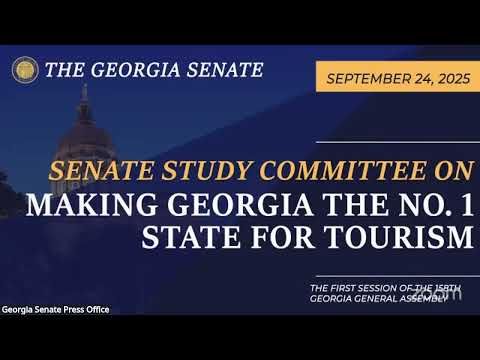
Leaders of Visit Savannah and statewide tourism groups told a Georgia Senate study committee in Savannah on Thursday that the state's tourism marketing budget is far below peer states and should be increased substantially to capture more visitors and tax revenue.
Joe Marinelli, president and CEO of Visit Savannah, said Georgia's current state tourism budget "is less than $12,000,000 annually," and argued that amount is insufficient to run a national campaign or match competitors. "With the right level of funding, the right long term commitment, and a bold campaign, Georgia can and will be a national leader in tourism," Marinelli said.
Why it matters: Tourism leaders told the committee the return on marketing investment (ROI) can be measured quickly, that visitor spending produces immediate sales and hotel-tax revenue, and that increased state marketing could grow jobs and taxable sales across Georgia communities.
Marketing shortfall and the ask
Marinelli and other presenters compared Georgia's budget unfavorably with other states: California at roughly $186 million and Florida around $80 million in annual tourism marketing spend, while Georgia remains in the low tens of millions. Marinelli recommended a multi-year funding plan: "Let's start with the first year by just simply doubling it and then doubling it again," he said, and later urged a five-year goal of tripling commitment.
Michael Owens, president and CEO of the Tourism Leadership Council, told the committee he favors a much larger target for the state brand: "Where should we be spending? $50,000,000. That's my answer." Owens said that budget level would help Georgia regain market share other states have taken.
Evidence and case studies
Presenters cited case studies where marketing campaigns produced measurable returns. Marinelli pointed to Michigan and West Virginia as examples where significant marketing investment produced net tax revenue that, in independent studies, exceeded campaign costs. He said Visit Savannah's 2024 targeted media spend of about $1.3 million generated roughly $519 million in visitor spending, an ROI he summarized as "$394 for every dollar that we spent." The committee heard these figures as evidence that well-targeted marketing can pay for itself.
Debate over funding source: hotel fee and overage
Committee members and witnesses also discussed the existing hotel-motel fee created under House Bill 170 and whether some of the fee's overage should be redirected to statewide marketing. Owens noted that the bill anticipated generating roughly $150 million annually; that revenue has varied, and presenters said the fee produced about $218 million in the most recent year discussed. Owens and others cautioned that relying solely on hotel guests to fund marketing raises equity questions because visitor spending benefits broader sectors beyond lodging. "Why only tag hotel customers for that? I think it's inequitable," Owens said.
Others on the panel said redirecting a portion of the overage to marketing or product development could be a politically viable option. No formal proposal or vote was taken during the hearing; senators said the committee will analyze options and return with recommendations.
What panelists recommended beyond money
Speakers emphasized that funding must be sustained and paired with strategic planning: a nationally recognizable creative campaign, international sales where appropriate, and investment in product development and visitor infrastructure so marketing dollars have attractions to promote.
Next steps
The Senate study committee created by Senate Resolution 323 is collecting testimony through a series of regional meetings. Panelists asked the committee to factor measurable ROI, workforce implications, and regional differences into any funding recommendation. Committee members said they will seek more analysis on potential funding mechanisms and expected state revenue impacts before reporting back to colleagues.