Get Full Government Meeting Transcripts, Videos, & Alerts Forever!
Get email alerts on the Healthcare Finance topic
No spam. Unsubscribe anytime.
Health & Hospital Corporation outlines multi-year plan after state funding cuts
Summary
Marion County Health and Hospital Corporation officials told the Municipal Corporations Committee they face multi‑million-dollar revenue losses in 2026, have proposed transfers to stabilize Eskenazi Health operations, and are pursuing $450 million in multi‑year run‑rate improvements to reach a 240‑day cash target.
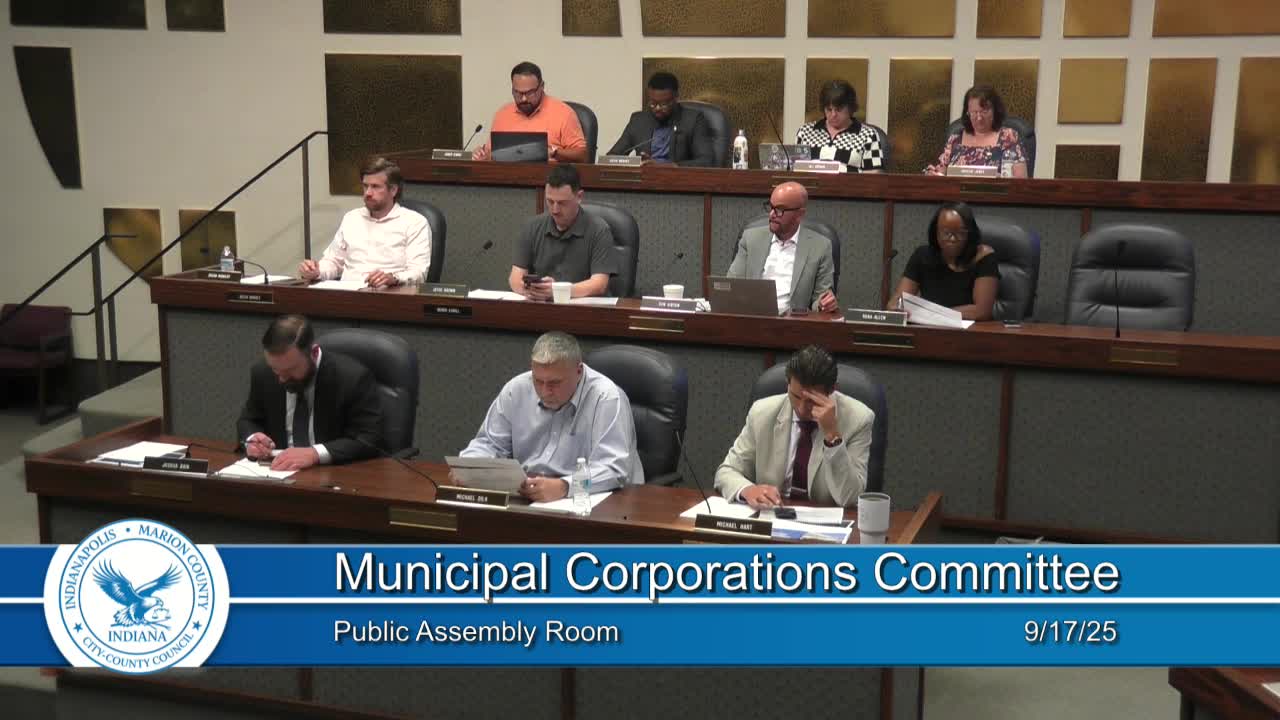
Paul Babcock, president and CEO of the Marion County Health and Hospital Corporation (HHC), and CFO James Simpson presented the corporation’s 2026 budget to the Municipal Corporations Committee on Sept. 17, describing multi‑year financial pressures and a plan to improve operations and preserve cash.
Simpson told the committee that both HHC’s general fund and Eskenazi Health fund project roughly $25 million deficits in 2026 and that the corporation is pursuing run‑rate improvements totaling roughly $450 million over five years to reach a target of 240 days’ cash on hand. He said HHC identified $86 million of run‑rate improvements in the 2026 budget and has annual targets for divisional improvements.
Why it matters: HHC runs Marion County’s public health department, Eskenazi Health hospital services and long‑term care operations; its budgets and transfers affect the county’s health safety net, capital investments and the availability of local services for uninsured and low‑income residents.
Major revenue and policy drivers - State cuts and timing changes: Simpson and Dr. Lisa Harris (CEO, Eskenazi Health) told the committee the state reduced Health First Indiana (HFI) funding drastically (from about $23M to approximately $6M in the HFI fund for 2026) and that changes to upper‑payment‑limit (UPL) and hospital disproportionate share (DISH) timing have reduced expected 2026 receipts. - HCI/HCI property tax credit: The corporation reported a loss of HCI funding (reported as about $38M statewide change affecting the system) and estimated an approximately $9M local impact tied to property‑tax credits distributed across taxing units. - Long‑term care UPL: HHC projected the long‑term‑care UPL at about $186M in 2026, of which long‑term care will use roughly $39–40M; HHC projects transferring approximately $147M back to the general fund after IGTs (intergovernmental transfers) of about $65M, leaving a net benefit in the general fund of roughly $82M before other considerations.
Stabilizing steps and commitments Babcock and Simpson described several board‑level decisions to stabilize Eskenazi operations in 2026, including: a $50,000,000 commitment from the general fund for Eskenazi capital improvements; transferring Eskenazi campus debt to the debt service fund (about $44,000,000); and a $25,000,000 HCI‑replacement transfer to offset state funding reductions. Simpson said the corporation expects to cut its general fund and Eskenazi fund deficits roughly in half by 2027 and return to balanced budgets in 2028 if run‑rate improvements continue and anticipated federal/state payments materialize.
Operational improvements and health services Dr. Lisa Harris described operational strategies to increase revenue and limit expense growth, including expanding specialty care and growing commercially insured patients, improving primary‑care capacity and mental‑health visits and screening for social drivers of health. Dr. Dan O’Donnell (IMS) described growing EMS run volumes, workforce development programs that recruit and train EMTs and paramedics, and mobile integrated health efforts to reduce 911 use for frequent callers. Dr. Virginia Kane summarized public‑health priorities including immunizations, maternal and infant health and inspections enforcement.
Council discussion and next steps Committee members asked for more frequent reporting and site visits. Several councilors praised HHC’s workforce training and community programs while also pressing for clarity on assumptions about state‑level changes (the so‑called Big Beautiful Bill/OBBBA impacts) and the corporation’s dependence on long‑term care transfers. Simpson said 2026 cash‑on‑hand will drop to about 220 days in HHC’s projection without additional improvements, and the corporation is modeling scenarios to guard against worse outcomes.
Ending HHC asked for continued engagement as the state and federal policy landscape evolves; the committee chair asked staff to schedule deeper briefings and facility visits in 2026 so council members can inspect HHC programs and capital projects.