Get Full Government Meeting Transcripts, Videos, & Alerts Forever!
Get email alerts on the Airport topic
No spam. Unsubscribe anytime.
Georgetown leaders favor policy changes to speed airport development; council backs flexible fuel pricing and longer leases
Summary
Public works and airport staff sought council input on leasing terms, self-serve fuel pricing and a possible PUD update for Georgetown Executive Airport; council members generally supported allowing longer land leases and delegating limited fuel-price flexibility to the airport manager.
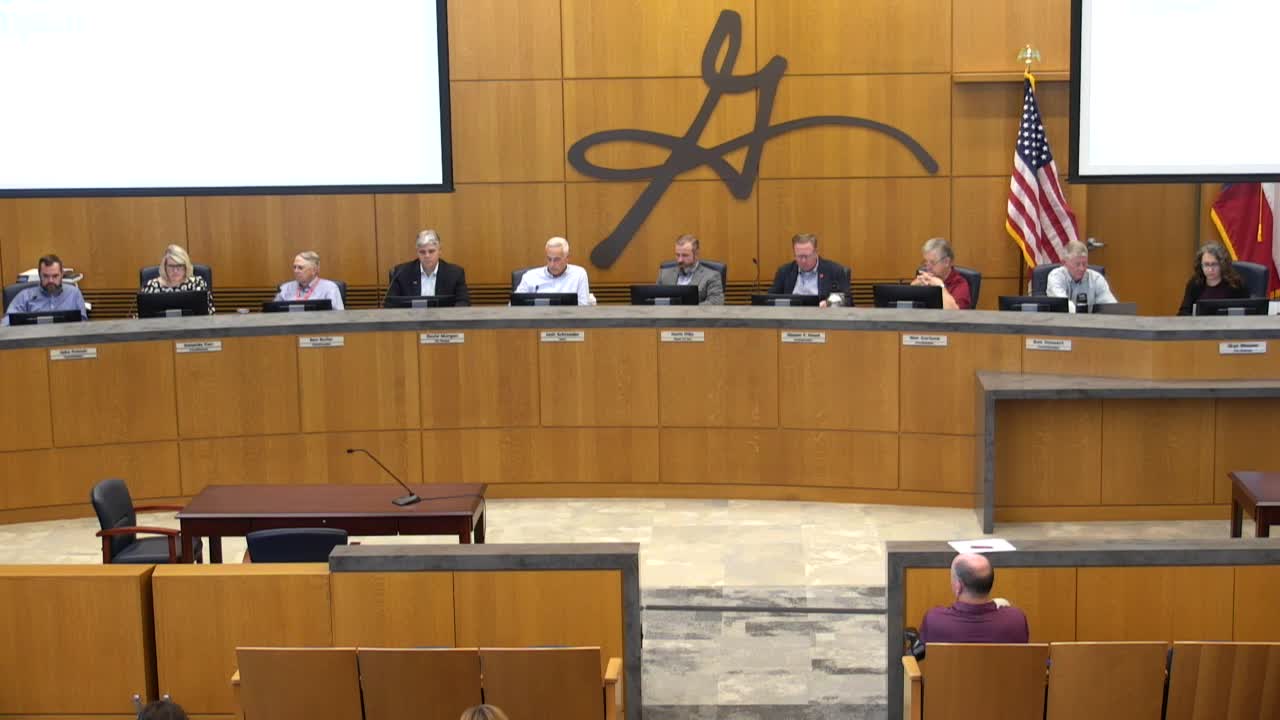
Eric Johnson, public works director, and Matthew Summerfield, airport manager, briefed the City Council on the Georgetown Executive Airport’s operations, capital program and draft policy changes aimed at encouraging private investment and modernizing airport administration.
The nut graf: Staff asked council for feedback on three linked items — (1) amending the city’s ordinance to permit longer land-lease terms in some cases, up to 50 years; (2) adopting a retail self‑serve fuel pricing policy that delegates modest daily price adjustments to the airport manager; and (3) pursuing a city-initiated update to the airport PUD to remove conflicts with federal aviation requirements and to better distinguish taxiways and roads.
Johnson and Summerfield described the airport as a FAA-designated “national reliever airport,” with roughly 333 based aircraft and an active FBO, Cutter Aviation. Summerfield noted the field’s role in medical flights, organ transport, EMS, flight training and business aviation, and described recent investments: fuel sales growth, a maintenance-building project expected to break ground within months, and terminal improvements planned in the coming 3–4 years.
On leases, staff said the current city ordinance limits lease terms to 30 years (20 years plus two 5‑year extensions). Texas law now permits up to 50‑year leases for certain transportation facilities; staff asked whether the council would allow up to 50 years in specific cases tied to amortization of tenant improvements. Johnson said developers and lenders have told staff that a 30‑year cap makes financing larger hangar developments difficult. “Conversion of LOIs to actual leases is largely contingent upon the length of the agreement versus rate of return,” Johnson said.
Council members expressed broad support for allowing longer-term leases where appropriate. Multiple councilmembers urged staff to move quickly to revise the ordinance and leasing policy to encourage private hangar construction and other investment; one councilmember said private financing will accelerate terminal and maintenance-facility upgrades without tapping tax revenue.
On self‑serve fuel pricing, staff proposed a retail markup model: keep the city’s cost-per-gallon base, set a retail margin (proposed 80¢ per gallon), add the existing 15¢ flowage fee, and delegate authority to the airport manager to adjust the retail margin up or down by 20% to respond to local market conditions. Under the example shown (a base cost of $3.68 plus retail margin), a retail price of about $4.63 per gallon was proposed, with a possible range of $4.47–$4.79 under manager discretion. Council members generally supported giving the manager limited flexibility to keep Georgetown competitive while avoiding direct competition with the FBO.
Staff also proposed a city‑initiated PUD update to resolve conflicts with federal regulations, clarify differences between taxiways and roads and enable a broader mix of aeronautical and compatible non‑aeronautical uses; developers and one speaker on the LOI list urged the council to open the PUD to remove barriers to feasible development. Johnson said the airport has several tracts available for development, including a 50‑acre and a 100‑acre tract; some tracts have LOIs and others are under contract.
Next steps and directions recorded at the workshop included staff returning with an ordinance package in October to: adopt self‑serve retail fuel pricing, propose ordinance revisions to permit longer land leases in eligible cases, update fee schedules (including hangar rates), and begin a city‑led PUD update. Councilmembers also asked staff to accelerate hangar‑rate analysis and to bring a complete package soon so private investment can move forward.
Ending: Johnson told council the airport’s real-estate portfolio currently generates about $1.3 million in annual revenue and that unlocking additional private investment was the key to funding larger capital needs such as terminal reconstruction and a maintenance facility.