Get Full Government Meeting Transcripts, Videos, & Alerts Forever!
Get email alerts on the Firearm Violence Data topic
No spam. Unsubscribe anytime.
DPH presents heat maps showing concentrated firearm homicides; rolls out safe-storage distribution and evaluator contract
Summary
The Connecticut Department of Public Health on a recent commission call released new county- and city-level analysis of firearm homicides and suicides from 2020–2023, announced progress on a statewide safe-storage rollout and said the Yale School of Public Health will serve as the evaluator for the agency's community-based grants.
The Connecticut Department of Public Health on a recent commission call released new county- and city-level analysis of firearm homicides and suicides from 2020–2023, announced progress on a statewide safe-storage rollout and said the Yale School of Public Health will serve as the evaluator for the agency's community-based grants.
DPH staff said the office has distributed 840 firearm safes and 948 cable locks to date and is working on a formal firearm safe distribution plan. "At this time, we've, distributed 840 safes and 948 cable locks," DPH staff said during the presentation. The agency said distribution channels under consideration include community-based organizations (CBOs), housing outreach, mobile health vans, schools, events, gun shops, pharmacies and veteran centers, and that it will track where distributed safes go and use a short survey developed with the evaluator to gather user data.
The plan and the data analysis grew out of two summer internship projects. Interns LaVar and Kasim presented heat maps built from DPH data covering firearm homicides and firearm suicides between 2020 and 2023. "Firearm homicides in Connecticut are not evenly distributed, and they are highly concentrated and predictable," LaVar said, reporting that 550 firearm homicides occurred statewide over the four‑year period and that 2021 was the deadliest year (232 homicides). LaVar and DPH staff highlighted four cities—Hartford (137 firearm homicides), New Haven (92), Bridgeport (67) and Waterbury (48)—which together accounted for more than 60% of firearm homicides in that period.
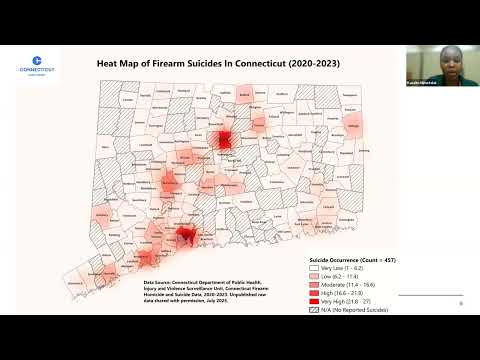
Kasim presented the suicide heat map, which the presenters said showed a wider geographic spread than homicides while still revealing local concentrations. DPH staff reported 457 firearm suicides from 2020–2023. The agency told the commission it will explore overlaying these maps with other data — for example, occupation or veteran status — in follow-up analyses.
DPH emphasized that its messaging will differ by intent: homicide‑focused outreach will emphasize community and family protection, while suicide prevention messaging will stress that "secure storage saves lives, especially for those who are in crisis," and will rely on trusted messengers in impacted communities.
On evaluation and grants, DPH said the Yale School of Public Health is the contracted evaluator that will study the community-based organizations funded through the department's Request for Applications (RFA). The department said six proposals were selected in response to an RFA implementing a public‑health approach to gun violence and that chosen proposals will be announced once contracts are fully executed. DPH staff told the commission Yale will present preliminary evaluation plans in October.
Commissioners and staff discussed data sources and quality during the presentation. Nina, epidemiologist with DPH's Injury and Violence Surveillance Unit, summarized the datasets DPH uses, including hospital discharge data (CHIME), the state syndromic surveillance system for near‑real‑time emergency department and urgent care encounters, the Connecticut Violent Death Reporting System and CDC WONDER for national comparisons. Nina and other staff cautioned that 2023 increases seen in some nonfatal firearm visit counts reflect, in part, improved chart review and coding that moved cases previously labeled "unspecified" into weapon‑specific categories rather than only a sudden change in incidence.
Outside partners presented data tools in the same meeting. Carrie (ARMS/CHIP) demonstrated an ARMS violent‑mortality dashboard available at arms.chip.uconn.edu that maps suicides and homicides by victim residence and injury location for 2020–2024; she noted the dashboard allows users to filter by manner of death, gun‑relevance, year and other demographics. DPH staff also showed a Power BI demo of an internal DPH violence and injury dashboard that DPH said will go live to the public after final data checks, with a target timeframe discussed for late summer 2025.
DPH staff said they will continue to track distributed safes and cable locks, work with Yale on a short pickup survey, and prioritize outreach in cities with the highest burden. The department also said it funds 18 community‑based organizations through existing programs and will use data to focus future investments.
The meeting included routine procedural votes (approval of May minutes and adjournment) and updates from subcommittees and grantees; no new statutory or regulatory actions were taken during the session.
Looking ahead, DPH said it will present more detailed evaluation plans from Yale in October and will continue to refine dashboards and distribution metrics as additional contract and chart‑review work finalizes the 2024 and 2025 datasets.