Georgetown budget report: revenues generally tracking, water impact fees top budgeted expectations
Loading...
Summary
City budget staff presented the third-quarter fiscal update showing most major funds running near projections; water impact fees exceeded expectations while development permit revenues fell and some grant revenue remains unreceived.
Myra Cantu, the city’s budget manager, presented the City of Georgetown’s third-quarter fiscal-year report, saying the city’s three largest funds — the general fund, electric fund and water fund — were generally tracking near projections but with important variances.
Cantu told the council the FY25 general fund revenue budget totaled $110.9 million and that year-to-date actuals were about 73% of budget and 71% of projections. “Sales tax is trending at 7.51% over the previous year,” she said. She added staff revised the sales-tax projection to be about 5% over budget to reflect recent collections and a two-month reporting lag.
The nut graf: The update showed mixed results by revenue source. Impact fees and irrigation charges in the water fund came in substantially above budget, while development permit revenue has slowed; staff said unreceived grant revenue and timing of franchise-fee remittances also affected year-to-date totals.
Cantu highlighted several figures the council and public should know: property-tax collections were near 90% of budget but are subject to year-end reconciliations; sales tax year-to-date is up roughly 7.5% compared with the same period last year; franchise fees were slightly down (about 0.6%) because of timing for receipts such as an Atmos payment.
On the general-fund expense side, total expenditures were about $115.5 million in the adopted budget, with public safety (police and fire) the largest share. Personnel costs were running near 71.6% of budget with expected vacancy savings and some market/merit adjustments; operations were roughly 36–37% of general-fund expenses.
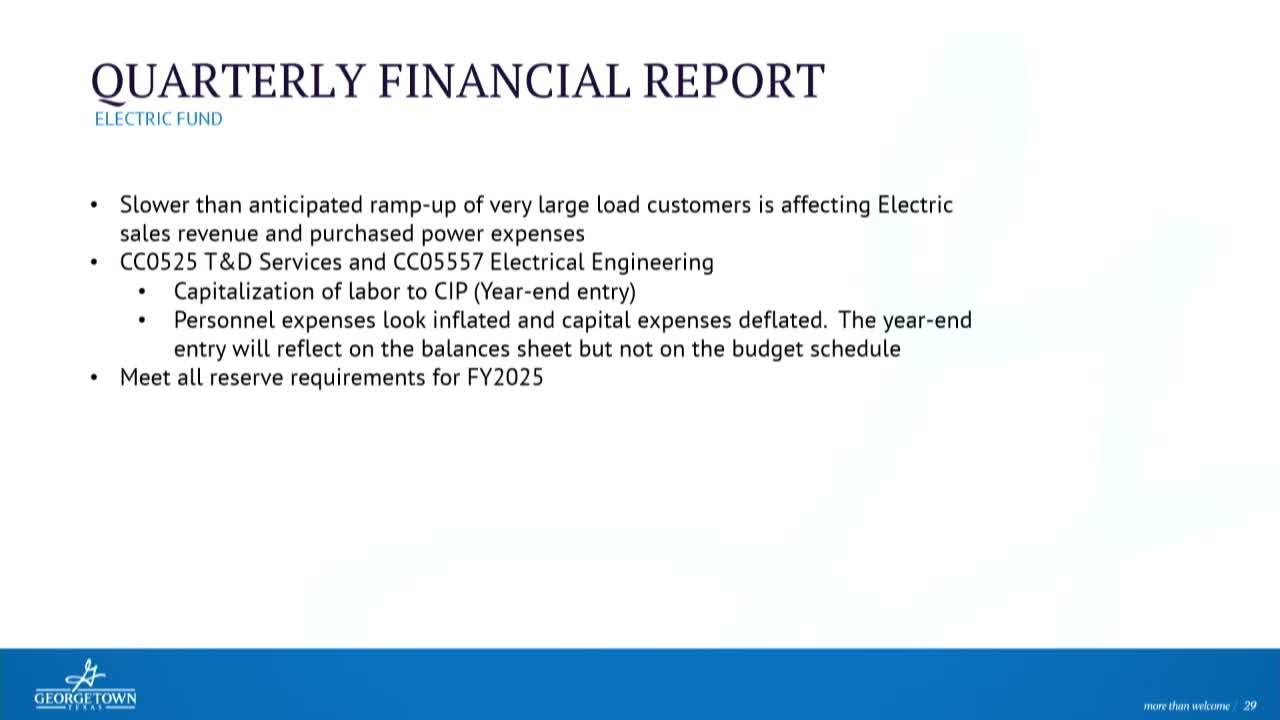
For the electric fund, Cantu reported a revenue budget of about $160.1 million and operating revenue at roughly 69–72% of budget depending on the metric; electric retail sales were up 7.9% year over year and staff said mid‑year budget amendments have kept projections and budget closely aligned. She noted some operating cost centers (transmission and distribution, electrical engineering) appeared over 100% in the current actuals because labor capitalization entries occur at year end and will adjust final figures.
On the water side, the fund’s revenue total was reported at $273.9 million with operating revenues at about 81% of budget. Cantu said impact-fee receipts were well above expectations: the city budgeted $29.5 million in impact fees and had collected about $37.4 million to date (about 126% of budget). Irrigation charges were at about 108% of budget, and overall operating revenue for water was outpacing last year’s third quarter.
Council questions addressed one unreceived line item: a $10 million grant referenced in the water revenue budget. Cantu and staff said they would follow up on the grant’s status. Councilmembers also asked about construction timing for a Florence-area waterline project and whether that revenue would arrive this fiscal year; staff said design is underway and revenue may carry over to the next year.
Ending: Cantu said staff will continue to monitor receipts and departmental projections monthly and roll forward any unspent multi‑year capital budgets into FY26, and council members asked staff to return with follow-up detail on the $10 million grant and planned timelines for large regional water projects.