Get Full Government Meeting Transcripts, Videos, & Alerts Forever!
Get email alerts on the Accessory Dwelling Units topic
No spam. Unsubscribe anytime.
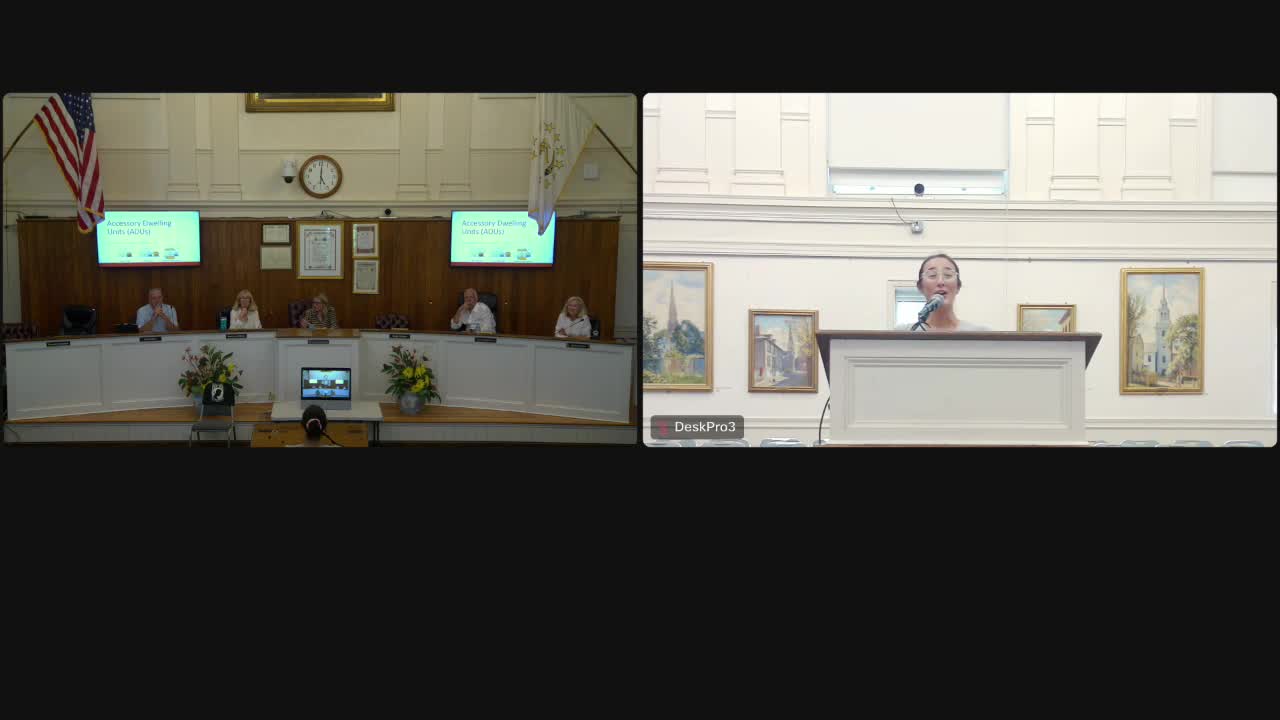
Newport staff brief commission on ADU rules, limits and review roles
Summary
City zoning staff explained Rhode Island's ADU law and how Newport applied it, covering lot-size limits, unit size caps, parking, flood elevation checks and when historic-district review applies.
Nick Armour, the city's zoning officer, told the Newport Historic District Commission on Aug. 12 that state law and a city ordinance allow accessory dwelling units, but with specific local limits and review steps.
Armour said Rhode Island's recent change to ADU law removed the family-relationship requirement and that Newport adopted a local chapter (Newport Zoning Code, chapter 17.79) after the state. Under the local code, new-construction ADUs are permitted only on residential lots of at least 20,000 square feet; smaller residential lots must rely on conversion of an existing structure. Unit-size limits are 900 square feet (studio/one-bedroom) or 1,200 square feet (two-bedroom), or, if smaller, 60% of the principal structure's floor area. The city requires one on-site parking space per ADU; short-term rentals remain prohibited by state law and local code.
The zoning officer also described operational rules that affect HDC review. He and Jill, the city preservation planner, told commissioners that whether applicants call a proposal an ADU or a generic accessory building, the commission's historic-district review follows the same standards for siting, scale, massing and materials. Jill reminded commissioners that HDC should focus on exterior compatibility; interior floor plans (whether the space is used as an ADU) are generally a zoning/programmatic question.
Armour said the city has interpreted the state rule about ownership to mean ADUs must be on lots and structures under single, undivided ownership (which likely excludes condominiums), and that ADUs cannot be used for short-term rentals and must be long-term (30 days or more). He described operational details staff are using to limit wasted hearings: building officials now screen proposed projects for flood-zone compliance before they go to zoning or HDC so that applicants are not required to return later because a structure must be raised to meet FEMA base flood elevation requirements.
Staff and commissioners discussed recurring issues: many ADU proposals are conversions of garages or carriage houses rather than new detached construction; a technical loophole allows an owner to build a non-kitchenized guesthouse and then apply for a permit to convert it to an ADU after final inspection; and demolition thresholds (more than 50% exterior wall/roof replacement) turn a project into new construction that must meet current zoning setbacks and lot coverage (which often pushes projects to the zoning board for variances). Armour said the council had recently limited maximum accessory-structure heights to effectively two stories in most residential districts and had allowed a small (up to 100-square-foot) footprint expansion solely to create an independent ingress/egress for an ADU.
Jill and commissioners discussed how HDC findings should be recorded. Jill said staff are updating staff reports and workflow steps to provide clearer findings for approving or denying accessory-structure and ADU proposals, and she urged commissioners to cite the specific HDC standards they are applying when making decisions.
Jill and Armour encouraged applicants to consult zoning and building staff before coming to HDC so staff can resolve parking, flood-elevation or other zoning triggers and reduce the number of projects that must return with corrections.
Why it matters: ADUs are a small but growing part of Newport's strategy to add housing units while preserving the city's historic fabric. Commissioners must weigh the city's ADU allowances against HDC's standards for compatibility, and staff highlighted the operational steps the city is taking to coordinate flood, zoning and HDC reviews to avoid wasted hearings and unexpected design changes.