Get Full Government Meeting Transcripts, Videos, & Alerts Forever!
Get email alerts on the Sheriff Budget topic
No spam. Unsubscribe anytime.
Indian River County commissioners agree to advertise $6 million increase for sheriff's budget after workshop discussion
Summary
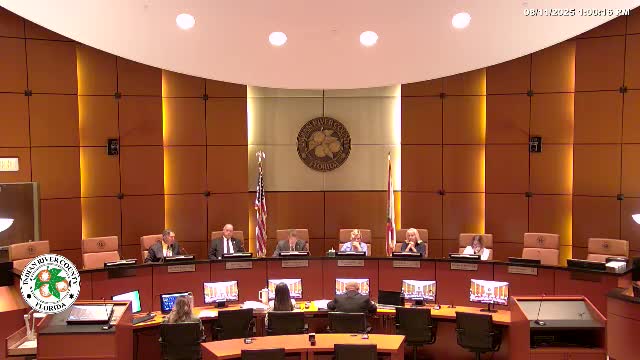
At an Aug. 11 continuation of the Indian River County budget workshop, commissioners reached a consensus to advertise a tentative budget that includes roughly $6 million in additional funding for the Sheriff's Office while reducing or delaying other county services; no formal vote was taken.
The Indian River County Board of County Commissioners on Aug. 11 reached a consensus to advertise a tentative fiscal year 2025–26 budget that includes roughly $6,000,000 in additional funding for the Indian River County Sheriff's Office, County Administrator John Tkhanich told the board during a continuation of the budget workshop.
The decision follows weeks of negotiations and public comment after Sheriff Eric Flowers submitted a revised supplemental request for additional operating funds. In a letter read into the record, Flowers wrote, “As the priority of government is public safety, I have every confidence the budget for Indian River County Sheriff's Office will be approved as submitted.” The sheriff also asked that, if cuts are made, the county provide a written accounting of what items are not funded in accordance with Florida statute 30.49.
The consensus came after a lengthy presentation by County Administrator John Tkhanich and Office of Management and Budget staff explaining revenue limits and trade-offs. Tkhanich told the board the county expects approximately $8,681,310 of new general fund revenue from growth in the tax roll, and that fully meeting the sheriff’s supplemental request would require diverting recurring money away from other county services.
Why it matters: Commissioners said they support law enforcement but must balance public safety with other statutory obligations and services paid from the general fund. Commissioners and staff warned that funding the sheriff’s entire supplemental request — which Flowers described in correspondence as a reduction from an earlier higher figure — would require cuts or deferrals to parks and recreation, road maintenance, animal services, court-related programs and other county functions, some of which commissioners called essential to public safety and quality of life.
Discussion highlights and budget trade-offs
Tkhanich reviewed the county’s budget context, saying the sheriff’s revised request was still an increase over the prior year and that the sheriff’s budget represents roughly 52.3% of the county’s general fund in the administrator’s presentation. He outlined proposed reductions elsewhere to create room for the sheriff’s request, including removing a full-time foreman in public works, a full-time staff assistant in conservation lands, reductions to the Humane Society contract, postponing a facilities master plan by doing it in-house, and scaling back some recreation and road-crew leadership positions.
Commissioners cited prior increases to the sheriff’s budget in recent years and disputed some public claims made during earlier meetings about deputies’ personal financial hardship. Chairman Joseph Fletcher said deputies “deserve the increase” but said the board must rely on documented payroll and vacancy data rather than anecdote. Several commissioners asked whether the sheriff had met with each commissioner individually; multiple commissioners said the sheriff had met with only a subset of the board.
Tkhanich and budget staff presented salary scenarios used to calculate the requested funding: an across-the-board example of $9,000 for sworn deputies and $3,500 for civilian employees (with benefit multipliers applied) produced a multi‑million dollar increase in salaries and related benefits. Staff said the roughly $6 million number reflected a package that would provide meaningful raises while staying within the county’s revenue constraints.
Public comment and related issues
Two public speakers addressed commissioners. Miguel David Aduran, describing himself as an international consultant, urged attention to water and sewer infrastructure and offered technical assistance. Retired Captain Tony Consolo, a 50‑year county resident and former Indian River County Sheriff's Department captain, urged support for law enforcement and questioned some public comments that had been raised at prior meetings; Consolo also suggested specific budget items that could be deferred or re-scheduled.
Other fiscal context cited during the meeting included an estimated $500 million range for countywide costs of a septic-to-sewer mandate in areas where central sewer must be extended, and a rough per-household septic upgrade estimate of $15,000–$20,000 if central sewer is not available and homeowners must replace systems.
Decision and next steps
No formal vote occurred at the workshop. The board directed County Administrator John Tkhanich to advertise the tentative budget with the administrator’s recommendation (approximately $6,000,000 in additional funding for the sheriff), with commissioners indicating an acceptable range up to about $7,000,000 but settling on the administrator’s figure for advertising purposes. Tkhanich confirmed the preliminary budget hearing to set the tentative millage rate is scheduled for Sept. 10, 2025, at 5:01 p.m., and the final budget hearing is Sept. 17, 2025, at 5:01 p.m., both in the county commission chambers.
Because the sheriff had indicated in correspondence that only a fully funded request would satisfy him, commissioners acknowledged the advertised number might be challenged, but they said today’s consensus represented a balance between addressing deputy pay and preserving recurring county services.
Ending
The board closed the workshop after the consensus direction to staff. The tentative budget will be published for the two required September hearings, where the board may adjust funding levels before final adoption.