Get Full Government Meeting Transcripts, Videos, & Alerts Forever!
Get email alerts on the Budget Finance Audit topic
No spam. Unsubscribe anytime.
Auditors give Easly City an unmodified opinion, note repeated reconciliation weaknesses
Summary
External auditors presented Easly City’s fiscal 2024 audit to the council, issuing an unmodified opinion while flagging repeated material weaknesses in bank reconciliations and some court fine accounting; the presentation summarized fund balances, revenues, expenditures, capital assets and debt.
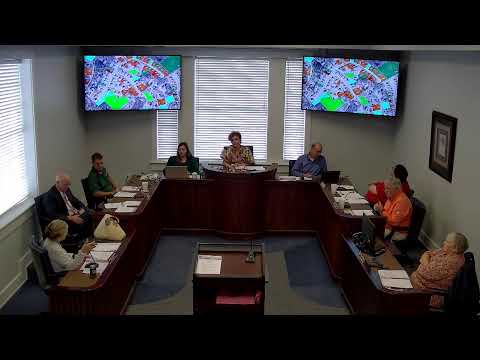
Ken Meadows, an auditor with Green, Finney, Cali and LLP, told the Easly City Council during its work session that the firm issued an unmodified opinion on the city’s fiscal 2024 financial statements after completing the audit in June.
Meadows said the auditors’ role is to provide “reasonable assurance” that the financial statements are materially correct and clarified that the audit is not a forensic fraud investigation: “We're not here to find fraud. That's not the purpose of this audit,” he said.
Meadows gave council members a high-level tour of key figures. The general fund balance decreased about $3.4 million in fiscal 2024 to about $10.3 million, of which $1.9 million were nonspendable prepaids and about $900,000 were assigned for future capital outlay, leaving an unassigned fund balance of about $7.5 million. That unassigned balance represented roughly 33% of actual fiscal 2024 expenditures and about 36% of the fiscal 2025 budgeted expenditures, which the auditor characterized as a healthy cushion compared with Government Finance Officers Association guidance.
General fund revenues were about $18.6 million in fiscal 2024. Meadows said the largest revenue components were licenses, permits and fees (about $6 million), local option sales tax (about $4.5 million) and property taxes (about $3.8 million). Overall general fund revenues rose about $1.4 million, or 8.2%, from the prior year, driven mainly by higher property tax receipts and increases in permits and sales tax.
General fund expenditures totaled about $22.7 million, with public safety accounting for about $9 million and general government about $4.8 million. Expenditures rose about $3.8 million, or roughly 20% from the prior year; the auditor said much of the increase in general government spending reflected ARPA-related expenditures that were not previously budgeted.
Meadows reviewed other funds: the grants fund had receipts and expenditures of about $573,000 and a year-end balance of about $181,000; the TIF fund rose modestly to about $117,000; the hospitality tax fund held about $4.1 million (including about $600,000 of unspent bond proceeds and $429,000 reserved for debt service); and the impact-fees fund increased to roughly $2.0 million, restricted for fire, police, parks, recreation and transportation.
The stormwater proprietary fund had net position of about $3.3 million (mostly invested in capital assets) and operating income of about $145,000. On the government-wide statement of net position, the auditors reported approximately $61 million in assets, including about $16.6 million in cash and investments and about $40.7 million in capital assets. Total long-term obligations were about $15.9 million in debt, with an OPEB (other postemployment benefits) liability of about $5.7 million and an allocated share of state pension underfunding of about $12 million (an accounting allocation, the auditor said, rather than a bill the city will directly pay).
The auditors identified a material weakness and a compliance finding that largely repeat issues from the prior year: several bank reconciliations were not completed in a timely way at June 30, 2024, and certain court fines required additional follow-up. Meadows said the reconciliations and court fine matters had been addressed in the months before the presentation, and the city was current as of his last review. The firm did not perform a federal single audit because the city did not have sufficient federal expenditures to require one this year.
Council members asked follow-up questions about a prior $80,000 cash balance adjustment, interfund transfers (including grants and hospitality tax transfers to the general fund), and the nature of audit adjustments. Meadows explained adjustments fall into categories such as audit entries (corrections the auditors consider necessary) and non-audit or closing entries (assistance to management to close the year-end books).
The audit presentation concluded with Meadows advising the council that, overall, the city’s financial statements were materially correct and the city was in sound financial condition as of June 30, 2024. No formal council action was recorded on the audit during the session.