Get Full Government Meeting Transcripts, Videos, & Alerts Forever!
Get email alerts on the Climate Resilience topic
No spam. Unsubscribe anytime.
Lake County hears results of CHARM resilience planning; NIH funds four-year intervention study
Summary
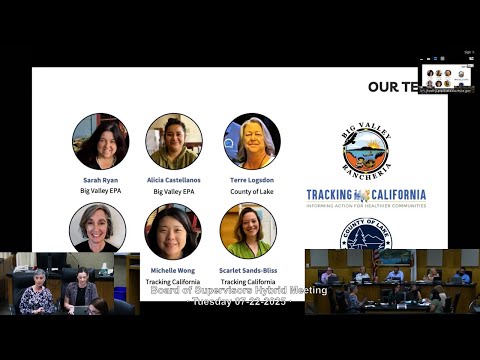
Tracking California and tribal partners on Wednesday summarized Phase 1 findings from the Community Health Adaptation and Resilience Mobilization (CHARM) Lake County project, showed a web-based “Roadmap” of resources and strategies for extreme heat and cyanobacteria events, and said the project has received a four-year continuation grant from the National Institutes of Health to study interventions in the county.
Tracking California and tribal partners on Wednesday summarized Phase 1 findings from the Community Health Adaptation and Resilience Mobilization (CHARM) Lake County project, showed a web-based “Roadmap” of resources and strategies for extreme heat and cyanobacteria events, and said the project has received a four-year continuation grant from the National Institutes of Health to study interventions in the county.
"We have been awarded a 4 year continuation grant by NIH," said Scarlett Sands Bliss, research data analyst with Tracking California, during the presentation to the Lake County Board of Supervisors. The project team said Phase 1 was a two-year planning effort that produced a publicly navigable Roadmap website, an inventory of local and external resources, and extensive community interviews and survey results to inform Phase 2 design.
The Roadmap groups material by natural hazard (for example extreme heat), by vulnerable population, and by practical strategies, presenters said. Susan Palaioconos, of Tracking California's leadership team, described the Roadmap as “a distillation of all of the work that we've done over the past 2 years” and said the site will be updated continuously to share resources and community testimony collected during the project.
Phase 1 methods and outputs: presenters said they collected more than 200 survey responses that appear to come from Clear Lake residents (the team estimated the survey took about 45 minutes to complete on average), conducted roughly one-hour one-on-one interviews with at-risk community members, held 13 working-group meetings, and compiled an inventory of state, federal and peer programs and data sources to share with local organizations. Scarlett Sands Bliss said the project amassed over 60 hours of interview recordings and that the Roadmap includes short excerpts of those testimonies.
Focus areas and partnerships: the project prioritized extreme heat and harmful cyanobacterial blooms (commonly called harmful algal blooms or HABs) and worked in partnership with the Big Valley Band of Pomo Indians, local behavioral health peer support centers, Community Organizations Active in Disaster (COAD), and multiple county, tribal and nonprofit partners. "This has been a great project because it's an opportunity to really dive deep into our most vulnerable communities in Lake County," said Sarah Ryan of the Big Valley Band of Pomo Indians, who also highlighted tabletop exercises the team ran to simulate overlapping emergencies such as cyanobacteria blooms, wildfires, evacuations and heat waves.
Phase 2: intervention study and priority groups: presenters said Phase 2 will be an NIH-funded, four-year intervention study that will work with resilience centers and community-based organizations. The team identified four priority at-risk groups for the intervention: seniors, people experiencing homelessness, tribal members and outdoor workers. Project staff said Phase 2 aims to build on existing trusted sites and programs rather than create new stand-alone services, and to increase access to alerts, emergency planning, and resilience-center supports.
Local concerns and follow-up: Supervisor Sabatier objected to a wording in the Roadmap that described "exposure to Clear Lake" as a risk, saying it casts an overly broad negative impression of the lake. "If it said exposure to HABs, I would completely understand," Sabatier said, and the Tracking California team replied that they would revise the phrasing and welcome feedback. A public commenter identified as Betsy urged the project to prefer the term "cyanobacteria" or "harmful bacterial blooms" over the broader phrase "harmful algal blooms," saying the latter is confusing for the public and can harm economic messaging.
Monitoring and local work: presenters emphasized the importance of ongoing local monitoring and communication, noting in particular monitoring efforts led by Big Valley. Michelle Wong, a Tracking California team member, and Sarah Ryan both described local monitoring and communications as central to community reliance on timely information about water safety and heat.
Next steps and resources: the team said the Roadmap website is designed to be a living resource that county agencies, tribes and community organizations can cite or use in grant applications. The team will add a feedback link and contact information to encourage corrections and additional resource submissions. Presenters asked county staff and partners to use the Roadmap to support resilience-center planning, transportation planning during emergencies, coordination and training, and improved data and monitoring.
No formal board action or vote was recorded during the presentation; the item was presented for information and discussion.