
ALDOT: bridge program progress, IIJA bridge formula ranking and planned bridge-prioritization training
Get AI-powered insights, summaries, and transcripts
Subscribe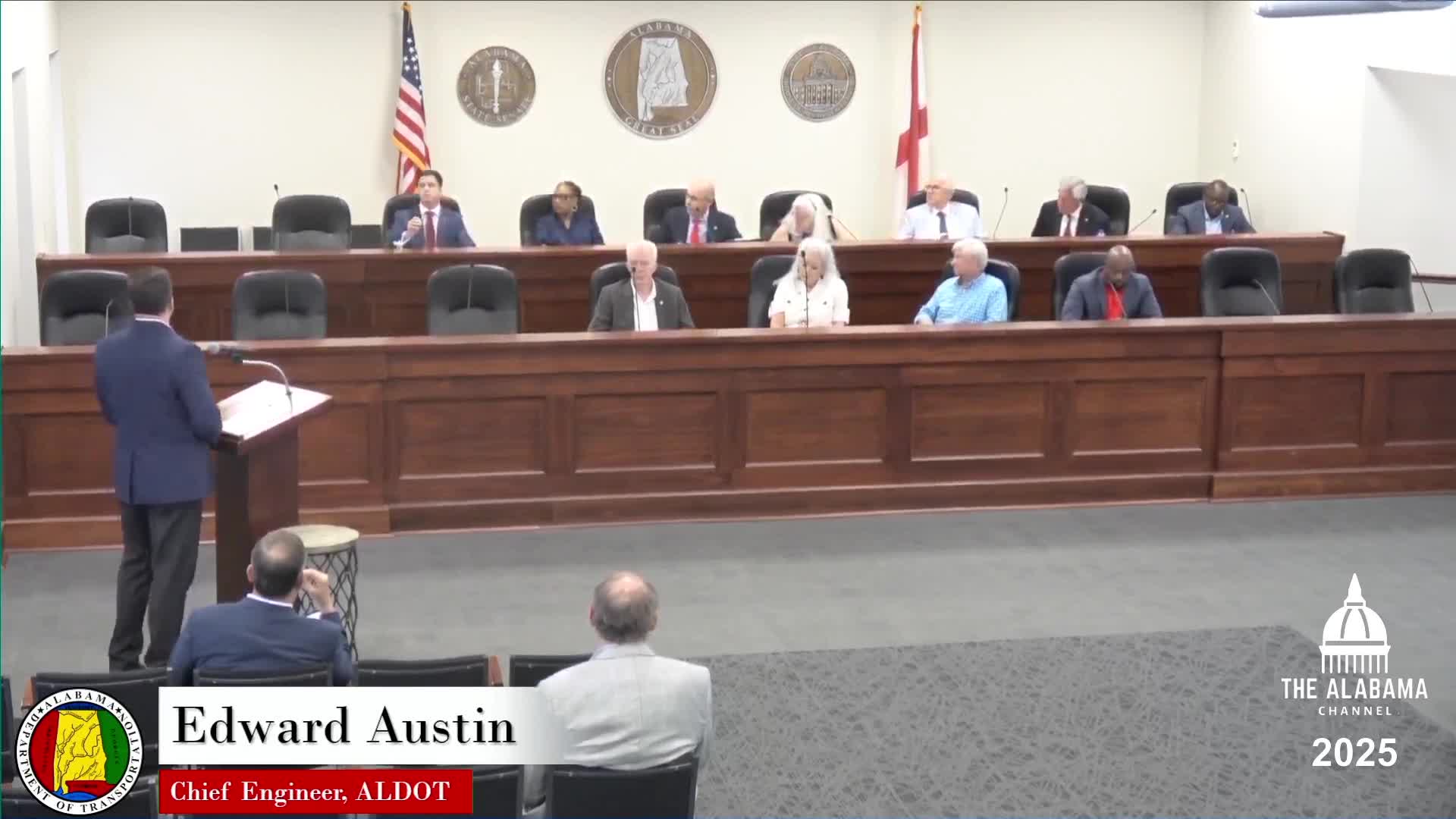
Summary
ALDOT staff briefed lawmakers on bridge replacement and condition, said Alabama ranked among the top states with bridges in fair or poor condition under the IIJA bridge formula, and offered a detailed training on ALDOT’s bridge project prioritization.
Ed Austin, chief engineer at the Alabama Department of Transportation, told the Joint Transportation Oversight Committee that the IIJA-established bridge formula — which targets funds based on bridge condition rather than population — identified Alabama as relatively high in bridges rated fair or poor under that metric.
Austin said Alabama historically prioritized bridges through earlier state funding efforts (he cited a 1992 five-cent gas tax that spurred bridge work), and that the state’s inventory of bridges previously rated structurally deficient has decreased substantially over decades. He told the committee that ALDOT typically advances roughly 15 bridge projects a year under the Rebuild Alabama bridge program, but that the new bridge formula targets fair/poor-condition bridges specifically and makes Alabama eligible for additional formula funds.
“The bridge formula program that was established through IIJA doesn’t look at population. It looks at those bridges that you have that were in fair or poor condition,” Austin said. “Unfortunately … we were deemed in the top 20, in fact in the top 15 across the country of bridges that were in fair and poor condition.”
Austin said the department will provide a deeper update in a bridge-focused training session the committee requested; he recalled a prior training delivered to committee chairs and offered to schedule a new session with bridge-section staff who handle inventory and prioritization. Committee members asked for updated counts of bridges rated in poor condition and progress since the last inventory; Austin said he did not have the up-to-date numeric breakdown in the meeting but committed to providing the current figures at the training.
Committee discussion also touched on how ALDOT classifies projects under Rebuild Alabama: “system enhancement” generally covers added lanes and capacity (example: four-laning projects), while “economic development” priority targets counties lacking a four‑lane connection to an interstate. Austin said the department uses Rebuild Alabama criteria to prioritize projects addressing capacity and connectivity, noting examples such as four‑laning to Cherokee County and work on U.S. 82 toward Gordo.
Why it matters: the IIJA bridge formula and Rebuild Alabama programming determine which bridges receive federal and state resources for replacement or rehabilitation; an accurate, current inventory affects Alabama’s eligibility for targeted federal bridge funds and local project scheduling.
ALDOT committed to return with a dedicated bridge-prioritization presentation, including updated counts of fair/poor bridges and the criteria used to classify projects under Rebuild Alabama.