Get Full Government Meeting Transcripts, Videos, & Alerts Forever!
Get email alerts on the Ethnic Studies Curriculum topic
No spam. Unsubscribe anytime.
MVLA trustees hear hours of public comment and teacher input as board weighs whether ethnic studies should remain a yearlong graduation requirement
Summary
At a Oct. 13 board study session, dozens of students, teachers, parents and community members urged trustees either to keep ethnic studies as a two‑semester required freshman course or to make it shorter or elective; the board narrowed options for formal consideration but took no final vote.
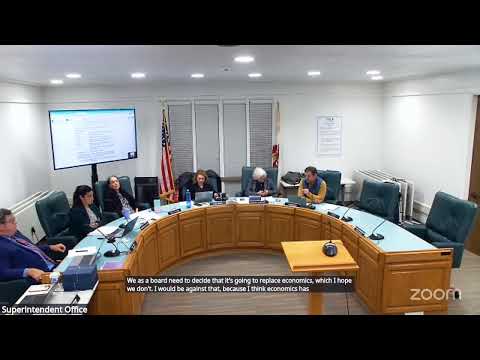
The Mountain View‑Los Altos Union High School District Board of Trustees conducted a study session Oct. 13 to consider whether ninth‑grade ethnic studies should remain a yearlong, required course, a semester requirement or an elective; the board did not take a final vote but narrowed the options it will consider at a future meeting.
The meeting opened with a 5‑0 approval of the day's agenda. Dozens of public commenters then addressed the trustees during an extended public‑comment period, followed by a multihour staff and board discussion that the board characterized as narrowing the range of options for future action.
Why it matters: Ethnic studies affects every MVLA freshman's schedule and the district's social‑studies sequence, local teachers' assignments and, trustees were told, students' readiness for later AP courses and college admissions pathways. Speakers emphasized three crosscutting concerns: academic rigor and measurable outcomes; representation and the course's effects on student identity and school climate; and operational consequences such as staffing, scheduling and alignment with UC/CSU “a‑g” requirements.
Most public comments supported keeping ethnic studies as a yearlong, heterogeneous freshman course. Ethnic‑studies teachers and many current and former students described the yearlong structure as necessary to build trust, teach academic skills and promote cross‑group understanding. “Ethnic studies is a class where students have the time and professional coaching to learn a variety of key skills needed for academic success,” said Sofia Carmano, who identified herself as a teacher at Mountain View with 19 years’ experience. Teacher leaders pointed to increases in AP enrollment and district assessment metrics: one speaker said AP World History exam participation rose from 64 students three years ago to 187 last year, and another cited district SBAC gains in ELA (+7.5 points) and math (+16.9 points).
Other speakers — including parents and some students — urged the board to shorten the course to one semester or make it an elective, citing district survey results, concerns about instructional balance and classroom materials, and a desire to preserve a dedicated world‑history sequence. “If ethnic study truly adds value, students can still choose it,” said one parent, arguing that world history provides foundational context for later coursework.
Trustees and staff framed several practical constraints. Board members noted that adding or removing a yearlong required course affects total social‑studies credits (the state minimum cited in the discussion is 30 credits) and the district’s own graduation requirement calculations, which currently show either 35 or 40 social‑studies credits depending on the option. Associate Superintendent Terry Faught and ethnic‑studies teachers said that redesigning course length or pairing ethnic studies with another semester of social studies would require a clear process and time for curriculum development and community input.
Board discussion produced a narrowed set of options the trustees expect to consider at a future meeting: retain a yearlong ethnic‑studies graduation requirement (with possible revisions); make ethnic studies a required semester course (reducing total social‑studies credits to 35); or require ethnic studies as a semester while adding a separate semester of social studies so total credits remain 40. Trustees said they would rule out options that entirely eliminate ethnic studies as a required course from further consideration in the near term.
Trustees and staff also discussed how to interpret and use district survey data. Several board members and staff cautioned that one survey item (whether the course should be a yearlong requirement) was asked only of ethnic‑studies students and therefore lacks the same statistical control as other items. Trustee Peter noted that the ethnic‑studies course was developed after a multi‑meeting process beginning in 2021 and that state policy on ethnic‑studies requirements could change; he reported contacting the California Department of Education about possible future mandates.
Speakers raised content and classroom‑practice concerns on both sides. Emil Levy, who identified himself as a licensed behavioral therapist and parent, said materials such as a “wheel of power” in one class asked students to disclose personal attributes and called for greater parent control over sensitive materials: “In this wheel of power, a kid, 15 years old is required…to identify themselves and put themselves finger pointing of how their identity looks.” Several parents and commenters said they saw insufficient academic rigor in some lessons and asked that the district restore world history as a required course. Teachers and student supporters countered that the yearlong course intentionally sequences units to build literacy, argumentation and civic skills over time and that truncating the sequence would undermine those outcomes.
No final policy decision was made. Board members asked district staff and teachers to return with clearer proposals and timelines, and several trustees said they wanted options that preserved staffing stability while addressing concerns about academic rigor and student experience. Board members signaled they would bring formal options — and possible draft curriculum or sample semester courses — to a subsequent meeting for action.
For now, ethnic studies remains part of MVLA’s social‑studies sequence under review; the board asked staff to prepare the next materials and to work with teachers on possible revisions or alternative semester course proposals before the next formal vote.
Votes at a glance: At the start of the meeting the board approved the meeting agenda by voice vote; motion moved by Catherine, seconded by Theda, outcome recorded as 5‑0.
Speakers quoted in this article spoke at public comment or in the board discussion; the board did not make a final policy change during this session.
Ending note: Trustees set a follow‑up timeline and asked staff to return with specific curriculum and scheduling options; a date for any formal vote was not set during the Oct. 13 study session.