
Uvalde CISD leaders outline data-driven plan to improve student outcomes after TEA letter grade
Get AI-powered insights, summaries, and transcripts
Subscribe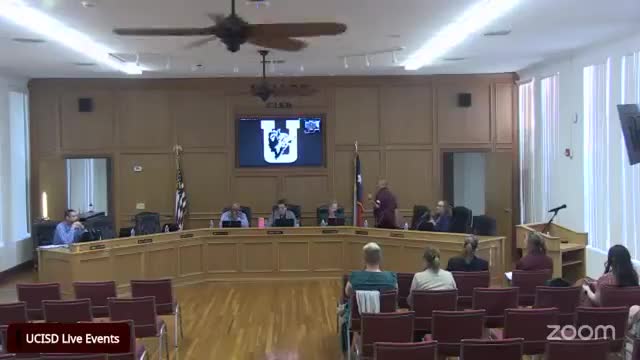
Summary
District leaders presented accountability data showing a forced F rating under Texas Education Agency rules, explained why the district's mathematical score differs from the letter grade, and described aligned campus plans, MTSS supports, coaching cycles and targeted steps to raise student achievement and CCMR rates.
At a special meeting of the Uvalde Consolidated Independent School District Board of Trustees, district administrators reviewed state accountability results, student screening data and the district's strategy for raising academic performance after Texas Education Agency ratings showed the district as an F.
Superintendent Colas opened the presentation saying the meeting was convened to go "specifically go over our academic standing, some historical data ... and how we will measure improvement." The district's instructional leadership team gave a layered briefing on accountability rules, campus improvement plans and classroom-level supports intended to shift outcomes "by design," not chance.
The presentation explained why the district's letter grade and the district's internal mathematical score differ. District data lead Miss Dahlberg said the district's calculated score for 2025 is 61.474 but that TEA's accountability rules include a "forced-F" policy: if three of four domains (student achievement; school progress; relative performance/academic growth; closing the gaps) are rated F, TEA assigns an overall F regardless of the numeric average. "Our district is a 61.474 this year," Dahlberg said, and "the forced F" provision produced the F letter grade under state rules.
Why it matters
The TEA framework determines campus and district letter grades and triggers additional state oversight, planning and, in some cases, turnaround requirements. District staff said the forced-F rule and changes to reporting timelines in recent years compressed the window for interpreting state data and required the district to accelerate planning and progress monitoring.
What the district presented
- Campus and district plans: Each campus has a campus improvement plan tied to the state domains. Presenters described different focal points by campus (for example: Batesville on Tier 1 instruction and domain 1 student achievement; MJH on domain 2 school progress and MTSS; Dalton focused on early literacy; UDLA on domain 3 closing gaps and TELPAS). Administrators said these campus plans feed into smaller, more specific turnaround or targeted improvement plans that identify the 2'3 strategies expected to move the needle.
- Instructional coherence and materials: District leaders emphasized adoption and implementation of high-quality instructional materials (HQIM), identified in the presentation as the district's adopted bluebonnet materials, so that "all students, no matter what teacher, no matter what campus, are having equal access to on-grade-level rigor." Staff said ensuring consistent use of HQIM across classrooms is intended to reduce gaps created when teachers use widely varying materials.
- MTSS and behavior supports: The district is retooling its multi-tiered system of supports (MTSS) to make tiered academic and behavioral interventions clearer and more actionable for teachers. Staff said tier 2 strategies include targeted small-group instruction, check-in/check-out and school-based social-skills groups; tier 3 options include more intensive, often individualized interventions and, where appropriate, specialized special-education supports.
- Coaching and observation cycles: Curriculum leaders described an "observation-feedback" coaching cycle for teachers and instructional leaders, using a standard rubric, short walkthroughs and focused, actionable feedback ("glow and grow") and longer coaching cycles of several weeks for selected teachers. The district said it has started calibrating principals and instructional coaches so feedback across classrooms and campuses aligns.
- Teacher evaluation and student growth: The presentation included the district's analysis of teacher evaluation ratings against student-growth results used for the Teacher Incentive Allotment. One district leader said the scatterplot showed almost no correlation between formal evaluation ratings and measured student growth (reported r-squared around 0.0011 for 2023-24 data). Staff said the result prompted targeted calibration and additional observations and that preliminary 2024-25 submissions now look more favorable for meeting state TIA requirements.
- Universal screening and diagnostic data: District staff reported expanded use of universal screeners this fall across grades and cited numbers for early-literacy and STAR Renaissance screening in primary grades. Staff acknowledged technical and administration challenges early in the school year that depressed some beginning-of-year rates and said the district is extending testing windows and running targeted training so teachers can use the data in weekly PLCs.
- College, Career and Military Readiness (CCMR): The district reviewed CCMR tracking and the ways students earn CCMR credit (TSI test scores, AP exam scores, dual credit, industry-based certifications, military enlistment and associate degrees). A district specialist showed results from the CareerCraft tracker and said the district rose from 50 to 62 in an internal measure of seniors who met CCMR criteria from one year to the next, while noting differences in how outside entities report results to state repositories.
Board questions and concerns
Trustees and community-facing board members repeatedly pressed the presenters on two topics: how to limit additional burdens on teachers who are already "overworked," and how the district ensures that campus plans are implemented consistently rather than becoming separate initiatives that do not align. Presenters answered that campus improvement teams include teacher representatives and parent/community stakeholders, and they said district staff will attend and support those site-based meetings rather than requiring teachers to convene extra committees.
Formal action
The meeting concluded with a procedural motion to adjourn. The motion was made by Trustee Suarez and seconded by Trustee Rizzo and carried by voice vote.
Ending
District leaders framed the meeting as the start of a sustained, transparent monitoring cycle: continuing data collection, weekly PLC and coaching work at the campus level, and quarterly progress reviews with the board. Presenters asked the board to expect ongoing updates and to use newly compiled dashboards and digital materials the district will publish to make the data and plans available to trustees and campus stakeholders.
Votes at a glance
- Motion to adjourn: made by Trustee Suarez; seconded by Trustee Rizzo; outcome: approved by voice vote (motion carried).