Get Full Government Meeting Transcripts, Videos, & Alerts Forever!
Get email alerts on the Development Review topic
No spam. Unsubscribe anytime.
Consultants recommend 70+ changes to streamline City of Oshkosh development review
Summary
Matrix Consulting Group presented a development review study to the Oshkosh City Council identifying roughly 70 recommendations across management, process, technology and regulatory areas to speed permitting, improve customer service and increase consistency.
Aaron Bagherly, a consultant with Matrix Consulting Group, told the Oshkosh City Council that his firm’s development review study found strong service levels but identified about 70 recommendations to improve the city’s permitting and review process.
Bagherly said the final report (roughly 220 pages with appendices) highlights strengths — notably fast internal turnaround on individual review rounds — alongside gaps in technology use, standard operating procedures and cross‑discipline coordination that lengthen total permit timelines for applicants.
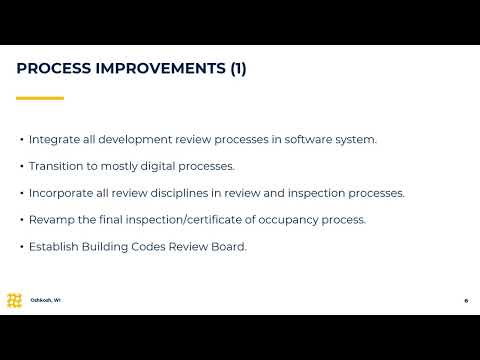
The report’s central recommendations include establishing an internal development leadership council to drive implementation; standardizing operating procedures and staff review timelines; increasing use of the city’s Evolv permitting system so data can be used for performance dashboards; tightening and clarifying the pre‑application process; conducting application completeness checks at intake and rejecting incomplete submissions; expanding online customer tools (a centralized development web page, application checklists and online meeting scheduling); and creating an appeals body such as a building code review board for disputed code interpretations.
“You do have very strong service levels,” Bagherly told council. He noted that commercial building review rounds are commonly turned around in 15 business days, which is positive, but the overall time from initial submission to permit can extend to months because applicants delay resubmittal after multiple review rounds.
Bagherly described uneven use of the Evolv permitting platform as a practical barrier: some reviewers use it extensively, while others do not, which prevents consistent reporting and leaves gaps when council or staff try to show when work stalled. He recommended configuring the system to generate alerts for dormant applications (for example, 30, 60 or 90 days) and to produce dashboards that show when staff returned reviews and when applicants refiled.
On pre‑application work, Bagherly said Oshkosh has “one of the most comprehensive pre‑application processes” his firm has seen and recommended narrowing thresholds so that some early reviews remain staff‑only rather than going to an appointed body such as the Planning Commission. He also urged application completeness checks at intake and stricter enforcement of resubmittal timelines to reduce repeated review cycles caused by incomplete initial submittals.
The report recommends modifying the city’s use of development agreements for routine items, so the city attorney’s office and applicants are not delayed on matters that could be handled by recorded easements or standard contract language.
On customer engagement, consultants urged a consolidated development landing page on the city website, short online checklists and scheduled online meetings with inspectors or planners to improve access for residents and design professionals who cannot visit City Hall during business hours. Bagherly said Wisconsin law constrains some possibilities for instant or over‑the‑counter permits, but recommended exploring subject‑to‑inspection instant approvals where state law permits.
Council members and staff welcomed the report but emphasized implementation priorities. Several council members said they want early “wins” and public transparency about progress; one suggested a red/green/yellow tracker on the city website to show which recommendations are completed, in progress or planned. City staff said they will return with an action plan and noted that budget requests — including for new licensing and permitting software — will shape what can be implemented and when.
City staff also cautioned that the report’s recommendations will be implemented alongside other department priorities and the city’s strategic plan. Rebecca (city staff) said the administration intends to bring back a prioritized action plan rather than try to implement every recommendation immediately.
The consultant and council debated sequencing: Bagherly recommended forming an internal development leadership council as a high‑priority next step to set mission, assign responsibilities, sequence changes (software, website, code updates) and report regularly to the city manager and council. Council members asked for the consultant and staff to collaborate on a prioritized implementation timeline showing short‑, medium‑ and long‑term items and approximate target dates.
Council discussion also touched on training for planning commissioners, possible biannual code and standards updates, and operational changes to make inspection and final certificate processes more consistent and inclusive of all review disciplines.
No formal motions or votes were recorded on the study during this meeting; council asked staff to return with an implementation plan and to include proposed budget items for software and other resources as part of upcoming budget work.
The consultant said Matrix will transition to a fee study phase this fall (phase 2) to examine permit fees and related financial policies, and the city plans to track progress publicly as implementation advances.