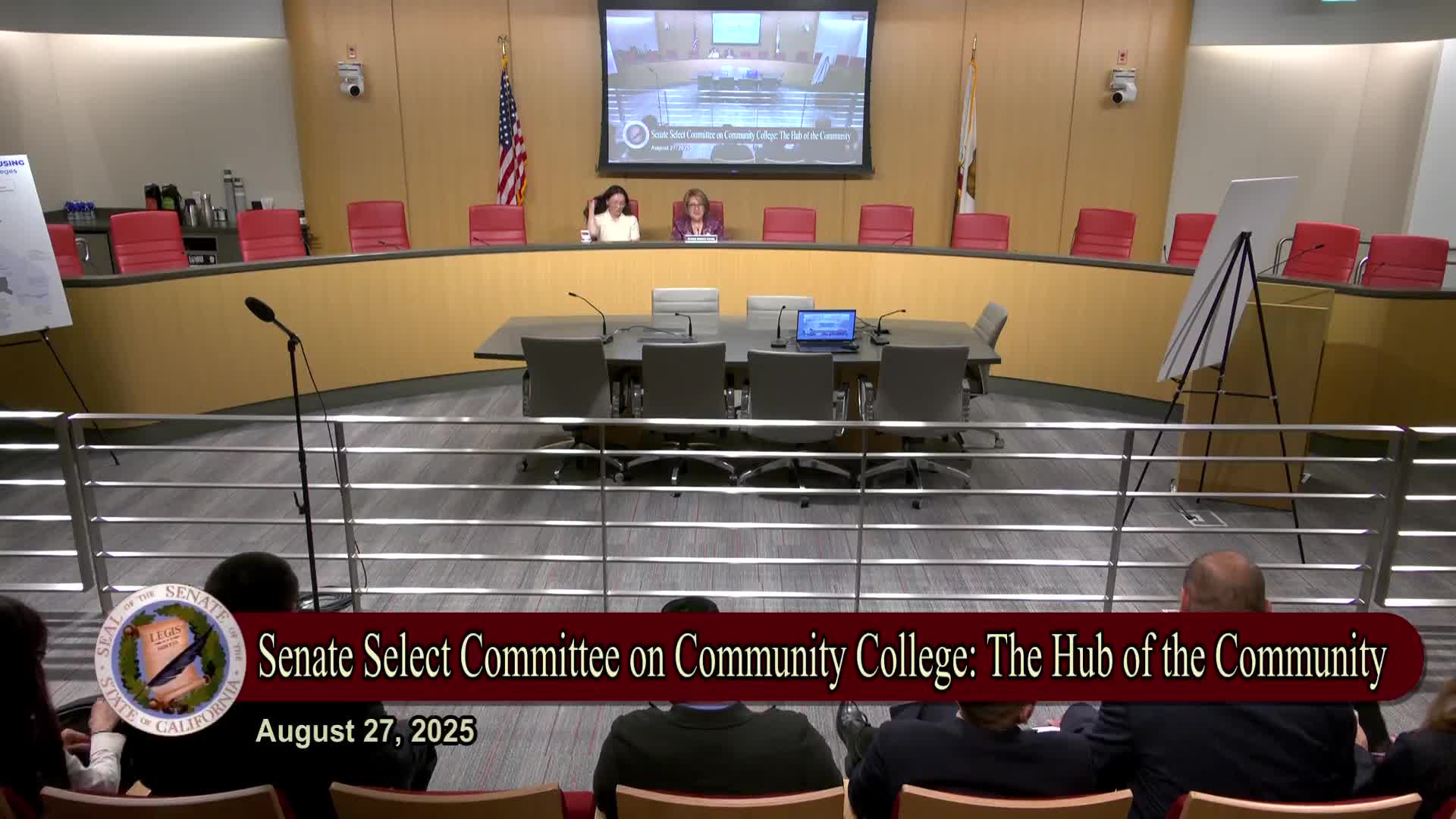
Senate hearing spotlights student housing gap, shovel‑ready projects seek state support
Loading...
Summary
A California State Senate select committee heard district leaders, the system chancellor and student advocates describe completed and planned community college housing projects, budget shortfalls and policy barriers; several districts urged additional state funding and rule changes to prioritize deeply affordable and family‑friendly units.
SACRAMENTO — Leaders from the California Community Colleges system, multiple community college districts and student advocates told a Senate select committee on community colleges that affordable on‑campus housing is essential to student success and that several shovel‑ready projects need more state support to preserve deep affordability.
The hearing, convened by Senator Eloise Gomez Reyes, gathered campus presidents and system officials to describe completed and in‑development housing and to press for expanded funding, streamlined permitting and program rules that reflect community college students’ needs. “Affordable housing is not a luxury. It’s a basic infrastructure,” California Community Colleges Chancellor Sonia Christian said.
Why it matters: witnesses said housing instability forces students to prioritize survival over studies and that many community college students — including working adults, parents and former foster youth — need housing types not always covered by programs designed for traditional dorms. Student testimony and district feasibility surveys showed high levels of housing insecurity, and district leaders said cost escalation in construction is threatening projects already in motion.
Most important details
Chancellor Sonia Christian told the committee the system has 13 completed housing projects and 14 under development and urged continued state investment. “With good living conditions, students have a greater chance of transferring to the university level or entering the workforce,” she said.
Sierra College: President Willie Duncan described a nearly complete on‑campus project intended as a core campus resource. “Our project is 3 stories with 3 wings, 354 beds,” Duncan said, and added the campus set rents at about 55 percent of the maximum allowable under the state program to deepen affordability. Sierra also established an endowment to fund a small number of rent‑free beds for students in acute need; the college currently has eight endowed beds and a goal to expand that number.
Los Angeles Community College District (LACCD): LACCD Chancellor (introduced in the hearing materials as Dr. Alberto Grama) said the district is pursuing a multi‑pronged approach, including converting existing buildings, leasing beds from nearby CSU/UC campuses and issuing requests for proposals for large on‑campus builds. He noted LACCD voters approved a $5.3 billion facilities measure that directs $500 million toward equitable and affordable housing for students and staff; LACCD staff also cited that about 23 percent of their students have experienced housing insecurity at some point.
San Bernardino Community College District: Jose Torres, executive vice chancellor, presented Legacy Village at Moreno Valley College as a mixed‑use, shovel‑ready public‑private partnership that would include student units and family workforce housing. Torres described the first phase as 230 student units (about 450 beds), 182 workforce family units and 80 units for youth and families, and said the district is requesting a $50,000,000 state investment to make 200 of those units truly affordable. Without that funding, he warned, the project risks being built at market rate prices that students cannot afford.
Financing and policy hurdles
Speakers emphasized two persistent constraints: construction cost escalation and local permitting rules. Multiple witnesses asked the Legislature to consider expanding state grant programs and to maintain or redirect existing bond or lease revenue resources to projects already approved but facing cost increases. Rebecca Killeen of the Community College Facility Coalition noted roughly $218 million in unallocated funds in the state lease revenue bond program that could be used to help projects at risk of cost overruns.
On zoning and permitting, witnesses pointed to AB 648 (cited in the hearing) and related proposals that would ease local permitting barriers for colleges developing housing on district land. Several participants said intersegmental projects with CSU or UC partners and public‑private partnerships (P3) are being used where state grants do not fully cover costs; Napa Valley, Cabrillo and other examples were cited as P3 or alternative‑financing models.
Students and equity
Student and community advocates urged policy changes to center students’ needs in program rules. Jeton Stevens of Public Advocates summarized coalition feedback: “Students want housing to be deeply affordable,” she said, and asked that eligibility and rent calculations be tied more closely to students’ incomes rather than area median income in high‑cost regions. Jasmine Garcia, a student trustee from San Bernardino, said her own housing insecurity forced her to pause college for 10 years: “It took me 10 years to finally get a place where I could come back to college,” she told the committee.
Policy recommendations offered at the hearing included expanding the affordable student housing grant program, prioritizing homeless and housing‑insecure students, removing or relaxing unit‑minimum requirements that exclude part‑time students, incentivizing family‑friendly units and improving data collection to measure housing impacts on student outcomes.
What’s next
No formal votes were taken at the hearing. District leaders asked the Legislature to consider additional budget allocations and program rule changes in future bills and budget cycles so shovel‑ready projects can proceed without shifting to market rents or losing supportive amenities. Several panelists invited senators to visit campuses and openings; Sierra College announced plans for a grand opening in December.
The hearing brought together system leaders, district officials and student advocates to press for a mix of immediate interventions (repurposing buildings and rapid rehousing) and longer‑term financing solutions (expanded grants, bond allocations and P3 structures) to address student housing shortfalls across California’s community college system.