Get Full Government Meeting Transcripts, Videos, & Alerts Forever!
Get email alerts on the Workforce Development Building Decarbonization topic
No spam. Unsubscribe anytime.
SF Environment expands contractor training, aims to scale heat-pump installations
Summary
San Francisco Environment described a two-track workforce strategy to prepare local contractors for building electrification, combining quarterly, in-person trainings with a targeted MWDBE (minority-, women-, disadvantaged-business) pathway tied to paid installation opportunities and prevailing-wage requirements.
San Francisco Environment on Aug. 25 outlined an expanded green workforce program to prepare local contractors for required appliance electrification and to create contracting opportunities for minority- and women-owned businesses.
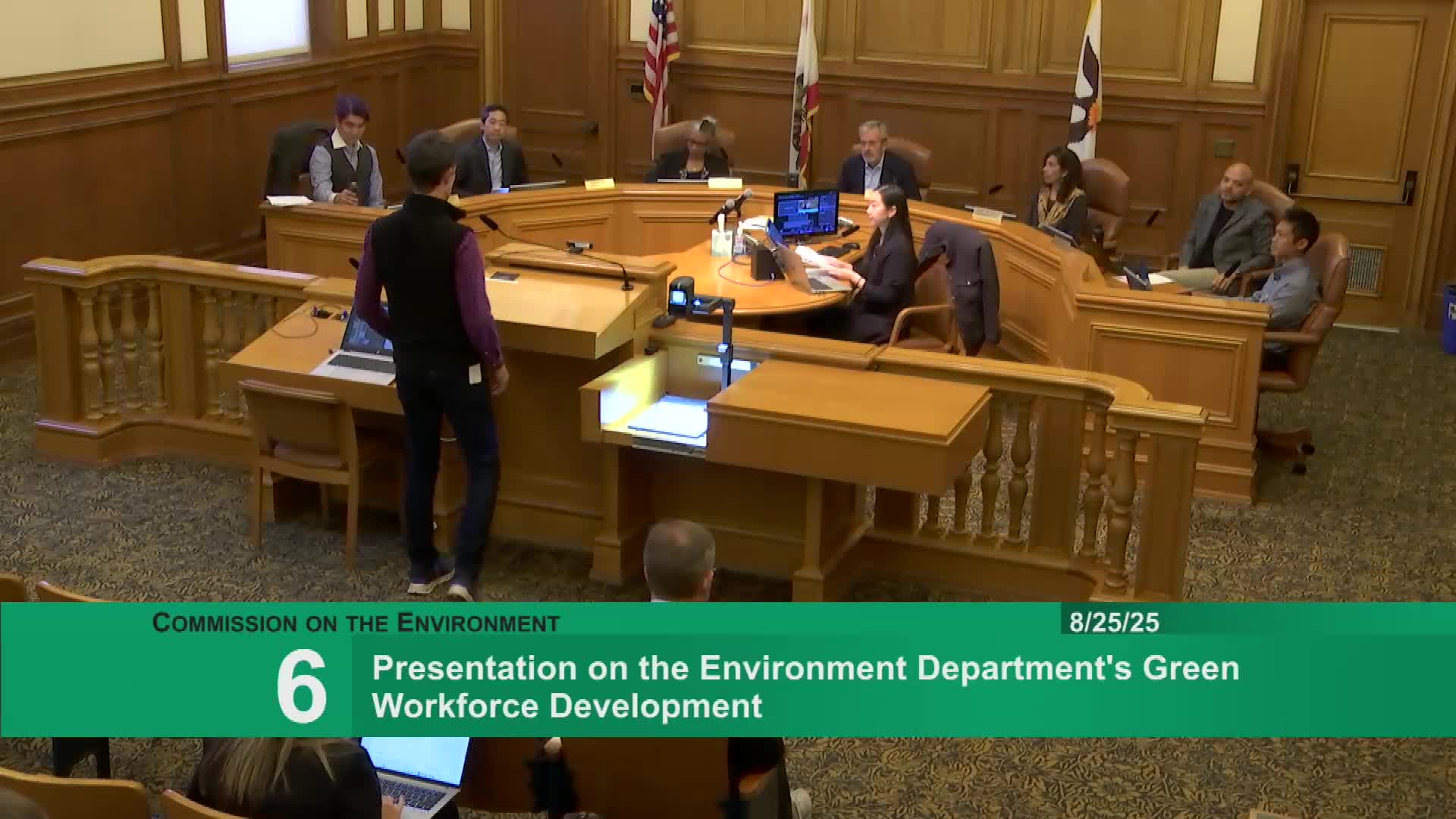
The department’s senior building decarbonization coordinator, Nick Kessner, told the Commission that the program pairs quarterly in-person contractor trainings with a targeted contractor pathway run in partnership with Emerald Cities Collaborative. "We want to equip every contractor that works in San Francisco with the knowledge and skills to install electric equipment," Kessner said.
The program has three workforce pillars tied to the Climate Action Plan’s building-decarbonization strategy: broad-based contractor training, targeted support for MWDBE contractors, and pairing training with a pipeline of paid work so newly trained contractors can gain experience. Kessner said the quarterly workshops are held locally after work hours, with plans for in-language sessions and stipends where funding allows.
Kessner described how the targeted pathway recruits MWDBE contractors for an extended eContractor Academy and then matches trainees to experienced electrification contractors through the department’s no-cost water heater direct-install program. Participants receive paid installations (Kessner said the program currently pays for five to 10 installs per trainee) so they gain on-the-job experience before operating independently.
Program metrics Kessner gave to the Commission: the department reported 25 completed heat-pump water-heater installations at the time of the presentation (he said the number was likely nearer 30), a wait list of about 40 installations, and a goal of 50–80 projects by year end including two to five whole-home retrofits. Kessner said the projects follow prevailing-wage requirements and that the department is exploring “high road” workforce standards as funding permits.
Commissioners asked about apprenticeship and youth pipelines; Kessner said the department is coordinating with the Office of Economic and Workforce Development (OEWD), City College, and CityBuild on possible collaborations, including a proposed mobile electrification hub and CityBuild-built training trailer. He said stipends have not yet been implemented but the department has discussed regional funding through networks such as the Bay Area Renewable Energy Network to support stipends and in-language trainings.
Kessner framed the effort as preparation for regulatory deadlines: Bay Area air-district rules will restrict residential-style gas water heaters beginning Jan. 1, 2027, and furnace phase-outs are scheduled for 2029. "One of the main things is we need contractors to feel comfortable installing these," he said, adding that wider contractor competency should reduce homeowner installation costs over time.
The presentation emphasized workforce equity and pairing training with paid work as essential to scaling electrification.
Looking ahead, Kessner said the department is expanding from water heaters to pilot furnace-to-heat-pump projects and seeks to increase funding to raise the program’s scale and workforce requirements.
The Commission received the presentation and posed follow-up questions; there were no formal actions on this item.