Get Full Government Meeting Transcripts, Videos, & Alerts Forever!
Get email alerts on the Transportation Fuels Stabilization topic
No spam. Unsubscribe anytime.
Administration proposes temporary stabilization package: 2-for-1 plug-and-drill, CEQA exemption and crude-production target
Summary
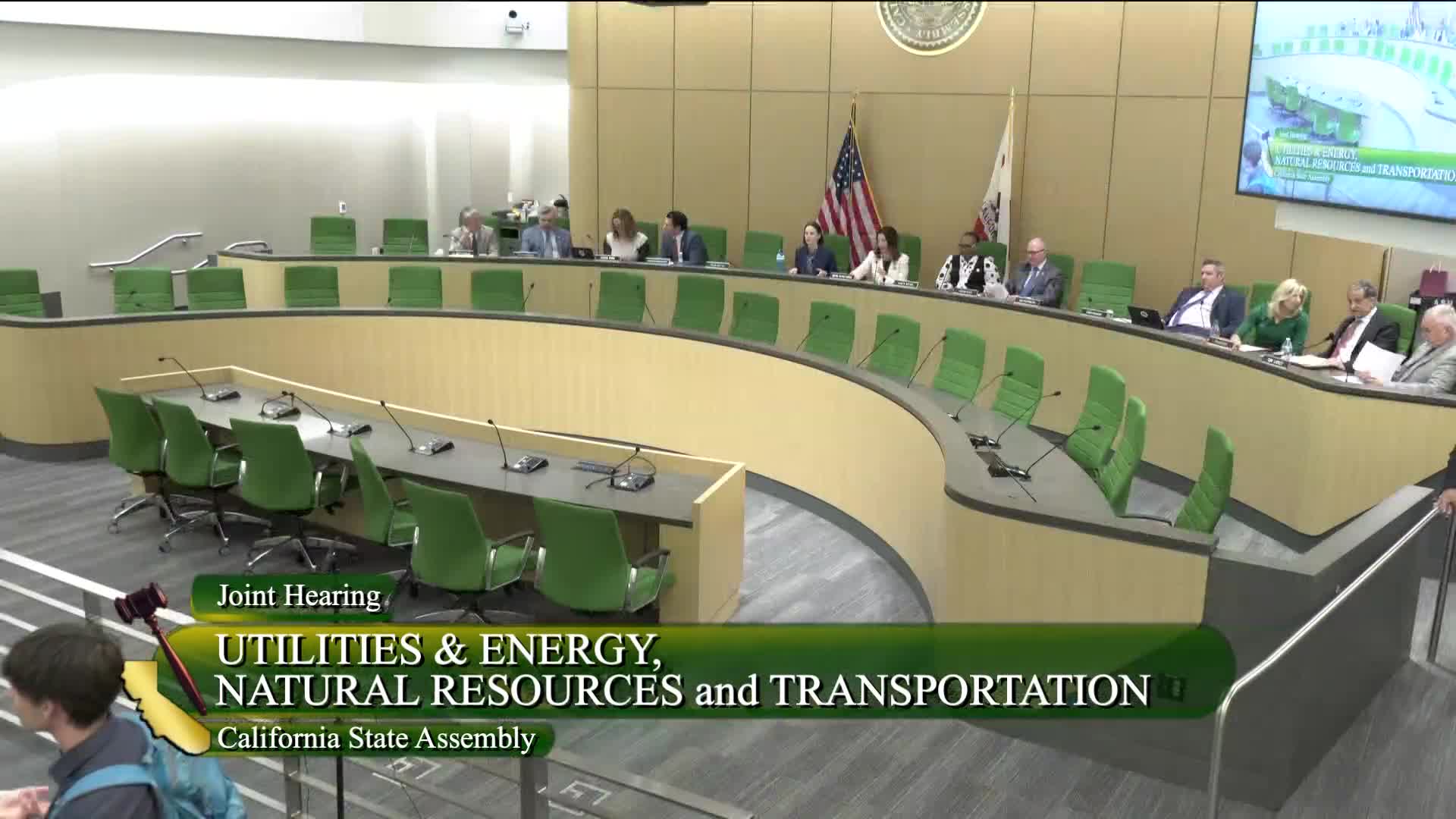
Assembly leaders and state energy officials presented a multi‑part Petroleum Market Stabilization Proposal at a June joint hearing that seeks to steady California’s gasoline and crude supply while the state transitions toward low‑carbon fuels.
Assembly leaders and state energy officials presented a multi-part Petroleum Market Stabilization Proposal at a June joint hearing that seeks to steady California’s gasoline and crude supply while the state transitions toward low‑carbon fuels. The administration said the package is intended as a temporary, mid‑transition measure to avoid short‑term supply shocks as refinery capacity declines.
The California Energy Commission (CEC) vice chair Siva Gunda and the Department of Conservation director Jennifer Lucchese told lawmakers the plan bundles four main elements: (1) codification of the state regulation prohibiting well stimulation treatments (hydraulic fracturing); (2) statutory validation of Kern County’s oil permitting ordinance and its environmental impact report; (3) a narrowly tailored, temporary CEQA exemption for some new well permits paired with a 2-for-1 plug‑and‑abandon framework requiring two wells to be sealed for every new well drilled; and (4) strengthened spill‑prevention, financial‑responsibility and pipeline safety measures. Director Lucchese said the “central objective of this proposal is to return California crude production to 125,000,000 barrels a year stabilization target.”
Why it matters: state officials told the committees that in‑state crude production and refining capacity have been declining faster than demand for refined fuels, and that pipeline arteries and regional refinery networks can become “brittle” at low throughput. Gunda showed charts the administration used to argue that preserving a baseline of in‑state crude — and preventing rapid investor withdrawal from the sector — reduces the risk of sudden outages and price spikes at the pump. Gunda told the panel, “we get about 10 to 20% of our demand being met by imports,” and argued the state should plan for a greater reliance on imports while avoiding destabilizing mismatches between supply and demand.
Key features and limits: Lucchese described eligibility rules for the 2‑for‑1 program intended to limit new drilling to historically established oil fields and to avoid new exploration. Under the proposal, a new well eligible for the program must be within an existing onshore oil field, outside legislated health protection setbacks, not require an incidental take permit for protected species, and not be sited where cultural or historic resources exist. The proposal also specifies that one of the two sealed wells must be in the same oil field as the new well and the other within a health protection zone; sealed wells may not be used to meet other regulatory plugging commitments. The administration said the CEQA exemption would be temporary and would sunset after a 10‑year period.
Contested trade‑offs and next steps: Legislators and multiple witnesses pressed for more detail about the proposal’s environmental protections, the concrete production gains expected from new permits, how the state will verify pipeline throughput, and whether the CEQA exemption would eliminate the public processes that typically identify impacts to species, waterways and tribal resources. Several lawmakers asked whether the CEQA exemption could be replaced with a faster but still public permitting streamlining, rather than an outright exemption.
Other items: the CEC reported it is pursuing a potential pause on the LCFS margin‑cap/penalty mechanism (a tool industry says depresses investor confidence) and is using new transparency tools and confidential industry data collection to inform decisions. The agencies said they intend a cross‑agency task force to coordinate state, regional and local rules and to avoid contradictory requirements. The administration characterized the package as intended to preserve supply resilience while continuing progress on the state's statutory air‑quality and climate goals.
What lawmakers asked for: multiple members asked for more data on the assumptions behind the 125,000,000 barrels/year target, county‑level permit‑to‑production timelines, the number of new wells the 2‑for‑1 program would enable, reporting schedules and enforceable guarantees tied to any CEQA validation. Several members also asked for stronger disclosure about long‑term site remediation costs and whether taxpayers could be held liable for cleanup if owners disband operations.
Where this goes next: agency staff said the components are under active consideration and that some items (such as a possible margin‑cap pause) may return to the CEC for formal staff action soon. The administration conveyed the proposals are intended as temporary, targeted mid‑transition measures and that final legislative language and regulatory design were still being refined.
Ending note: lawmakers expressed widespread interest in short‑term steps to avoid price shocks but emphasized the need for transparent guardrails to protect public health, tribal and cultural resources, and local land‑use decision making as the state balances supply stability against long‑term decarbonization goals.