Get Full Government Meeting Transcripts, Videos, & Alerts Forever!
Get email alerts on the Homelessness Mental Health topic
No spam. Unsubscribe anytime.
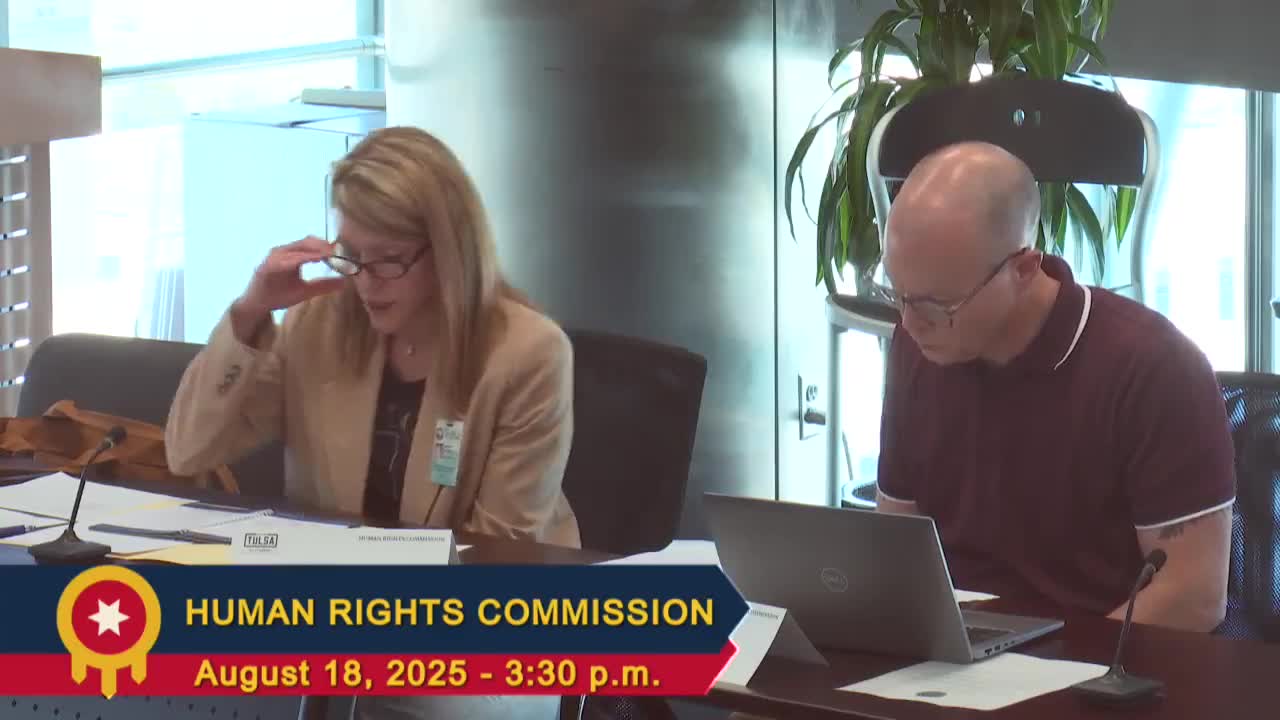
HRC vice chair outlines Safe Move Tulsa plan and local mental-health crisis response
Summary
Vice Chair Commissioner France briefed the Human Rights Commission on local homelessness estimates, a proposed Safe Move Tulsa plan to house 300 people, and recent crisis-response expansions including COPES and the Tulsa sobering/urgent recovery center.
Vice Chair Commissioner France used the August 18 meeting of the Tulsa Human Rights Commission to summarize recent local work on homelessness and mental-health crisis response and to flag a pending City Council vote on a program called Safe Move Tulsa.
France said the city estimates roughly 1,500 people experiencing homelessness in Tulsa — about 1,000 in shelters and 500 living on the street. The Safe Move Tulsa proposal discussed at City Council would aim to house 150 people who are unsheltered and 150 people currently in shelters, pay each household’s rent for one year, and provide help connecting participants with employment and addiction or recovery services.
France provided a preliminary funding outline discussed in council materials: a total program cost of about $6 million, with roughly $2 million identified from COVID‑19 relief funds and the remaining $4 million proposed to come from opioid-settlement funds. Commissioners noted those funding sources were described in the council discussion and that final allocations remain the City Council’s decision.
Commissioners also heard summaries of local crisis‑response capabilities: Family and Children’s Services’ COPES clinicians have been embedded in the 911 dispatch center and, since March, helped divert calls that otherwise would have gone to police, fire or EMS — France cited roughly 560 diverted calls. COPES mobile-crisis teams responded to more than 4,500 calls in 2024, and the Tulsa sobering center was integrated into services at the Tulsa Urgent Recovery Center through Grand Mental Health, a development France described as an important addition to downtown crisis care.
France framed community needs around three priorities: “having someone to call, having someone to respond, and having somewhere to go.” Commissioners said ongoing work includes modernizing the complaint and service referral systems so residents in crisis can access help without unnecessary barriers.
Why it matters Commissioners said the Safe Move proposal and expanded crisis teams represent operational steps the city is taking to address homelessness and behavioral-health crises. The HRC highlighted that codifying nondiscrimination protections and improving complaint processes are complementary efforts: legal protections without access to services and complaint mechanisms may not produce outcomes for affected residents.
What’s next France and other commissioners said City Council will likely revisit Safe Move Tulsa and related funding decisions in the weeks following the meeting. Commissioners also plan continued work with city staff to modernize complaint filing and access to human‑rights and social‑service pathways.
Ending Commissioners described the recent crisis-response expansions as encouraging but said they will monitor Council funding decisions and remain focused on improving access to services and complaint filing for residents affected by discrimination, homelessness and behavioral-health crises.