Get Full Government Meeting Transcripts, Videos, & Alerts Forever!
Get email alerts on the Human Rights Ordinance topic
No spam. Unsubscribe anytime.
Tulsa Human Rights Commission approves letter urging council to unify nondiscrimination language
Summary
The Human Rights Commission voted to send a letter to Tulsa City Council urging adoption of a unified human-rights ordinance that would align protections across public accommodations, housing and other city codes; commissioners approved minor amendments to clarify complaint access and offer the commission as a resource to council.
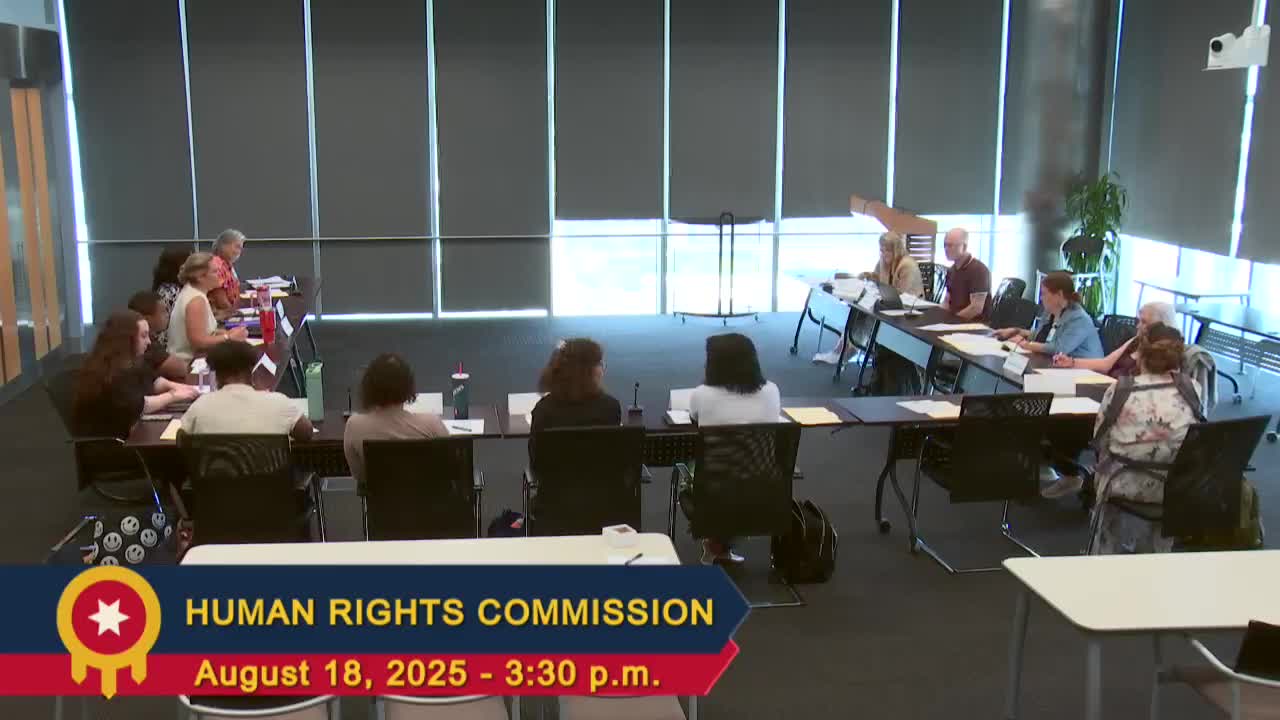
The Tulsa Human Rights Commission voted August 18 to approve a letter to the Tulsa City Council backing a proposed ordinance that would unify nondiscrimination language across public accommodations, housing and other city codes.
The motion to approve the draft — which commissioners said reflects the consensus in the commission's June discussion and the working group's recommendations — passed with a friendly set of amendments. Commissioners agreed to add brief factual language about how the commission oversees the local human-rights complaint process, and a short line saying the commission is available as a resource to councilors as they consider the ordinance.
Commissioners framed the letter as a measured step to inform council debate. Vice Chair Commissioner France described the goal as aligning “the anti-discrimination language that’s in the housing and employment and public accommodations and other city services” so protections across different city codes are consistent. Commissioners noted the draft aims to be concise and nonconfrontational while signaling the commission’s support.
Discussion focused on three themes: (1) the substance of the ordinance (adding gender identity and sexual orientation to public-accommodation protections while veteran status would be added for housing and public accommodations), (2) whether to include statistics or examples in the one-page letter, and (3) making the letter concrete about complaint access. Commissioners stressed that a short letter that signals unified, expert backing may be more effective than a lengthy document. Several commissioners said they expect advocates to also appear in person at the council hearing to provide detailed testimony.
Commissioners agreed to the amendments described in the meeting: add a sentence in the first paragraph offering the commission’s help as a resource to councilors, and add one sentence in the final paragraph that the commission — as the body that oversees the human-rights complaint process — “envisions a community in which every person has an equal opportunity to live without fear of discrimination,” and that passing the ordinance would ensure Tulsa residents can file complaints of discrimination based on gender identity, sexual orientation and veteran status. The commission voted to send the letter, as amended, to city council.
Votes at a glance - Motion: Approve draft letter to Tulsa City Council supporting the proposed unified human-rights ordinance, with amendments as described. Outcome: approved (vote passed; recorded abstention). - Related: commissioners encouraged members to sign up to speak at the council meeting on Sept. 10 when the ordinance is scheduled for consideration.
Why it matters Commissioners said the change is largely procedural — aligning language so protections in housing, employment and public accommodations are consistent — but that codifying consistent language gives residents an explicit route to file complaints at the city level. Commissioners also discussed the limits of an ordinance without a streamlined complaint process and said modernizing complaint access will be a parallel, continuing project for the commission.
What’s next The commission’s working group plans to finalize statistics and community examples for advocates and to make additional outreach to council members. Commissioners also discussed speaking in person at the City Council meeting when the ordinance appears on the September calendar.
Ending The vote signals formal HRC support for the ordinance and commits the commission to serve as a resource to City Council as it considers the measure.