Get Full Government Meeting Transcripts, Videos, & Alerts Forever!
Get email alerts on the Public Safety topic
No spam. Unsubscribe anytime.
Hallandale Beach receives community risk assessment showing EMS drives call volume, response gaps
Summary
A consultant study presented to the Hallandale Beach City Commission finds emergency medical service calls make up roughly two-thirds of the city's incidents and recommends quarterly performance reporting, review of turnout and dispatch procedures, and consideration of added personnel or reconfigured deployment to address rising demand.
A consultant study presented to the Hallandale Beach City Commission on Aug. 20 found emergency medical service calls comprised about 65% of the city's incidents from 2020'2023 and said rising call volumes and current staffing patterns have created response-time pressure.
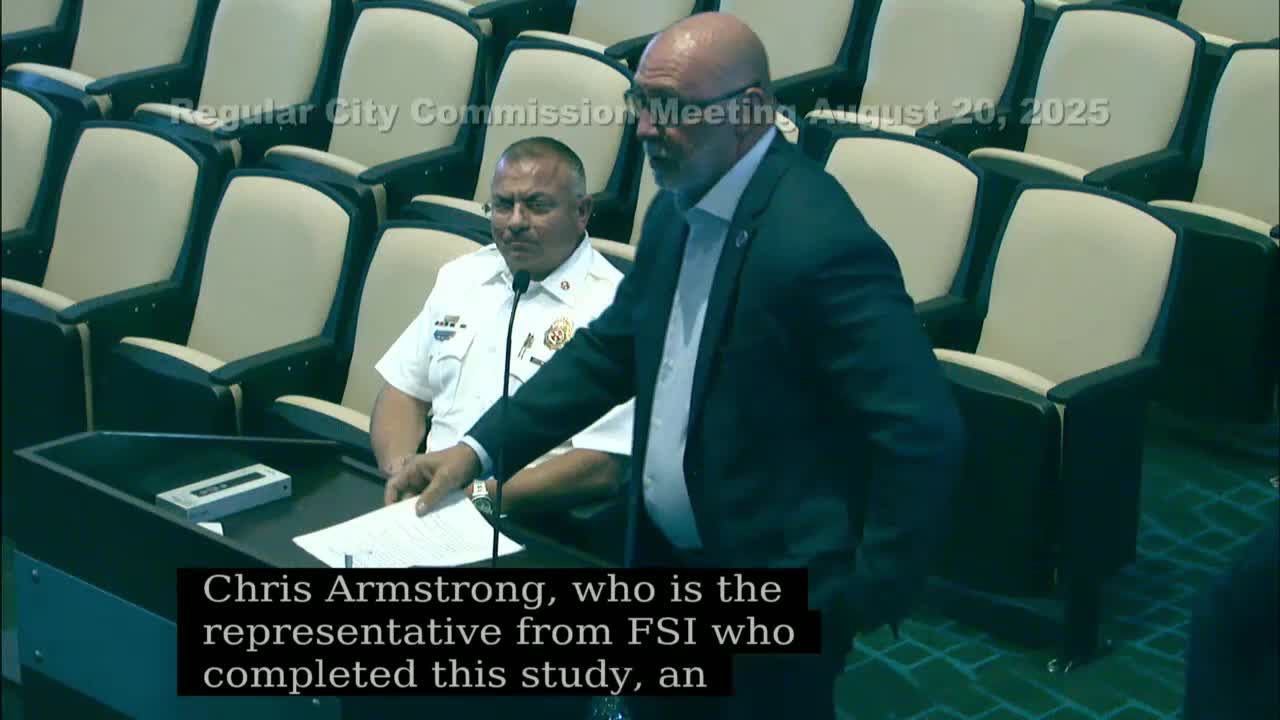
The community risk assessment and standards-of-cover report, prepared by Emergency Services Consulting International (ESCI), was summarized at the dais by ESCI project manager Chris Armstrong and introduced by human resources director Radu Dodia. The study used National Fire Protection Association (NFPA) 1710 and Commission on Fire Accreditation International criteria, ESCI said, and analyzed the city's hazards, demographics and operational deployment.
ESCI's nut graf: the city has about 42,000 residents, a high population density and an aging population (about 26% over 65). From 2020 through 2023 the consultant counted roughly 29,000 incidents (about 10,000 per year), with an 18% increase over the four-year period driven by population and tourism growth. The city's three modern fire stations provide engines, ladder/quint, ambulances and a battalion chief; minimum daily shift staffing was listed at 16 personnel.
The report measured travel-time coverage and effective response force (ERF). ESCI found roughly 64% of the service area was within a four-minute travel-time threshold, and about 98% within eight minutes. Because response time is the sum of call-processing, turnout and travel times, the study recommended targeted improvements across all three components. ESCI said Broward Sheriff's Office (BSO) dispatch numbers exceeded some NFPA benchmarks for alarm-handling and turnout, but travel-time performance showed that only 15% of responses arrived in less than four minutes in 2023, with 56% arriving between four and eight minutes.
ESCI recommended: (1) investigate and reduce delays in fire response by reviewing dispatch protocols and turnout procedures; (2) institute regular public reporting (ESCI suggested quarterly operational performance reports from BSO to the city covering staffing, resource allocation, mutual aid and financial overviews); (3) evaluate staffing and deployment, including the costs and benefits of increasing unit staffing from two to three personnel on transport units or adding additional units; and (4) continue monitoring station placement and overlapping coverage to address ERF gaps.
Chris Armstrong told commissioners that while most of the city had effective coverage, some areas had limited multi-station overlap and mutual or automatic aid would be necessary to meet ERF benchmarks in denser zones. He noted the data used covered 2020'2023 and that some measures have already improved in 2024 due to operational changes.
Commission discussion focused on data access, traffic-related travel delays and whether additional staffing or different apparatus mixes (for example, more ALS transport units rather than additional engines) would be the best corrective step. Mayor Joy Cooper and other commissioners pressed on the difficulty of getting CAD and mutual-aid data from the county-level provider and said that reliable monthly mutual-aid and response-time data should be produced by BSO at the press of a button. ESCI responded that the two biggest drivers of response time are call volume and number of resources available; if demand rises but resources do not, response times lengthen. ESCI said adding personnel can help but the operational use of any added staff determines the benefit.
Hallandale Beach Battalion Chief Bill Fucci and the police/fire chief reported improvements in turnout tied to replacement apparatus and local changes, and they said they would provide the commission updated, daily and cumulative mutual-aid reports and a 10-year apparatus and station plan that ESCI recommended be used to guide budgeting and replacement schedules.
Why it matters: The study gives Hallandale Beach a data-driven map of current coverage, clear short-term recommendations (dispatch/turnout reporting and review) and a path to evaluate longer-term budget choices about whether to add med units, change staffing models, or invest in more stations or apparatus.
Ending: The commission asked staff to work with BSO and ESCI on follow-up items including quarterly performance reporting, a review of dispatch practices, and a more detailed cost-benefit study of adding personnel or changing deployment. ESCI's full report will be retained in the city record.