Get Full Government Meeting Transcripts, Videos, & Alerts Forever!
Get email alerts on the Mckinney Vento Subgrant topic
No spam. Unsubscribe anytime.
Tennessee issues FY26 McKinney‑Vento subgrant guidance, sets budget, reporting and monitoring deadlines
Summary
State McKinney‑Vento liaison reviewed FY26 subgrant budget rules, allowable uses, and a schedule of deadlines including initial budgets by Aug. 30, FY25 final expenditure reports (FER) due Oct. 1, 2025, midyear reviews and June 30 closeouts; monitoring, dispute resolution and poster requirements were also detailed.
Vanessa, the state McKinney‑Vento liaison (Tennessee Department of Education), told returning and new subgrantees during a virtual webinar that the McKinney‑Vento subgrant is intended “to facilitate the enrollment, attendance, and success in schools of homeless children and youth,” and reviewed allowable uses, required documentation and a calendar of deadlines for FY26 funding.
The guidance matters because subgrantee budgets, staffing and program decisions for services to students experiencing homelessness must conform to federal allowability and state monitoring requirements to receive and retain funds. Vanessa emphasized the need for detailed budget narratives and for LEAs to remove barriers to enrollment, and she outlined when reports and reviews must be submitted in ePlan.
Vanessa told participants that subgrantees must submit an initial FY26 budget and narrative in ePlan by Aug. 30, and that final expenditures for FY25 (the FER) must be completed in ePlan by Oct. 1, 2025 to allow any FY25 carryover into FY26. The FER should record expenditures incurred between the date funds were awarded and June 30, 2025. Midyear performance reviews will open Nov. 21 and are due in January, and the closeout report for FY26 will open June 1 and is due June 30; tentative award notifications for FY26 are planned for July 18 pending U.S. Department of Education award notices.
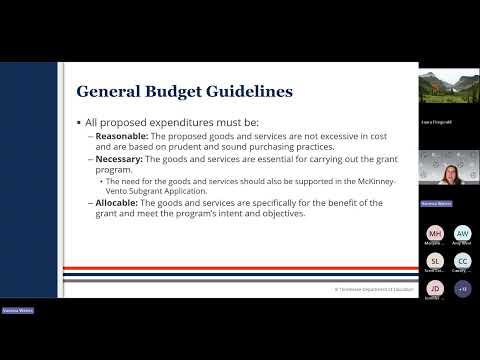
On budgeting and allowability, Vanessa said narratives must show items are allowable, reasonable, necessary and allocable to the McKinney‑Vento program. Examples she gave include: - Tutoring and academic supports are allowable only where they are supplemental (for example, paying for an afternoon tutoring session if the LEA does not provide that service broadly). - Stipends must be for work done outside of regular contracted hours (before or after school). - Professional development may be charged when sessions clearly address McKinney‑Vento needs; reviewers may request conference agendas to determine the proportion of cost allocable to the grant. - Funds may pay for glasses and hearing aids and for referrals to medical or mental health services, but not for direct medical treatment.
Vanessa explained transportation rules: McKinney‑Vento funds can cover “excess” transportation costs created by ensuring a student remains in their school of origin (for example, the added cost of rerouting a yellow school bus). If there is no additional cost to existing routes, McKinney‑Vento funds cannot be used. Use of ride‑share or taxi services depends on LEA policy; some LEAs prohibit those options. Vehicle purchases are allowable only if permitted by the LEA and in compliance with state rules (for instance, passenger vans with seating larger than nine are not permitted to transport students). Vanessa recommended consulting the LEA board attorney on liability and insurance before purchasing vehicles.
On services for younger children and Head Start: McKinney‑Vento funds may support developmentally appropriate early childhood education and transportation only when those services are beyond what existing federal, state or local funds provide. Vanessa urged coordination with local Head Start and pre‑K programs.
She reiterated that emergency or extraordinary assistance (for example, one‑off needs such as sheltering or supplies in unique situations) requires pre‑approval by the state on a case‑by‑case basis and must be emailed to the liaison for review.
Vanessa reviewed documentation and monitoring expectations: subgrantees must remove administrative barriers that interfere with enrollment (for example, making Social Security numbers and birth certificates optional on enrollment forms); maintain dispute resolution procedures aligned with state guidance; keep written MOUs for transportation and partner services; post updated McKinney‑Vento contact posters in central offices and each school; and include McKinney‑Vento information and liaison contact details on LEA websites and handbooks. She warned that missing posters or an inadequate dispute process can become monitoring findings of noncompliance.
A subgrantee participant, Christie, asked about partial conference funding when only part of a conference addresses homelessness. Christie said: “On the conference approvals, like, let's just say half of the conference pertains to the homeless population and the other half doesn't…do we need to send in an individual approval for each one of those conferences?” Vanessa answered that subgrantees should retain agendas and, when asked for additional documentation, provide conference materials showing homeless‑focused tracks; reviewers will decide what percentage of costs is allowable.
Vanessa closed by reminding subgrantees to document all expenditures, agreements and decisions to support audits and dispute determinations: “Don't ever hesitate to reach out. We are a team, and we're here to work through any cases that you may have,” she said. She also noted quarterly calls and monthly office hours (first Thursday, except January) are required for subgrantees; recordings will be posted in ePlan.
The webinar included several practical checklist items: include full job titles and FTEs in personnel narratives so budget pages align; specify quantities and intended use for supplies and materials; explain how rented or purchased equipment will meet needs that cannot be met by existing school inventory; and track use of cards (gift or fuel cards) when used for transportation supports. Vanessa also directed attendees to federal non‑regulatory guidance, the National Center for Homeless Education (NCHE) materials, and SchoolHouse Connection resources.
The liaison encouraged collaboration among subgrantees across regions and said posters printed by the state would be distributed at the statewide conference in October; otherwise, LEAs must print updated posters and ensure contact information is current. She cautioned that the state does not permit certain AI transcription tools on state systems and reminded participants to follow state policy on meeting documentation.
The presentation combined timeline, budget review and monitoring guidance that subgrantees must follow to preserve eligibility and funding; it emphasized documentation, alignment between narratives and budget pages, and prior approval for emergency expenditures.