Get Full Government Meeting Transcripts, Videos, & Alerts Forever!
Get email alerts on the Housing topic
No spam. Unsubscribe anytime.
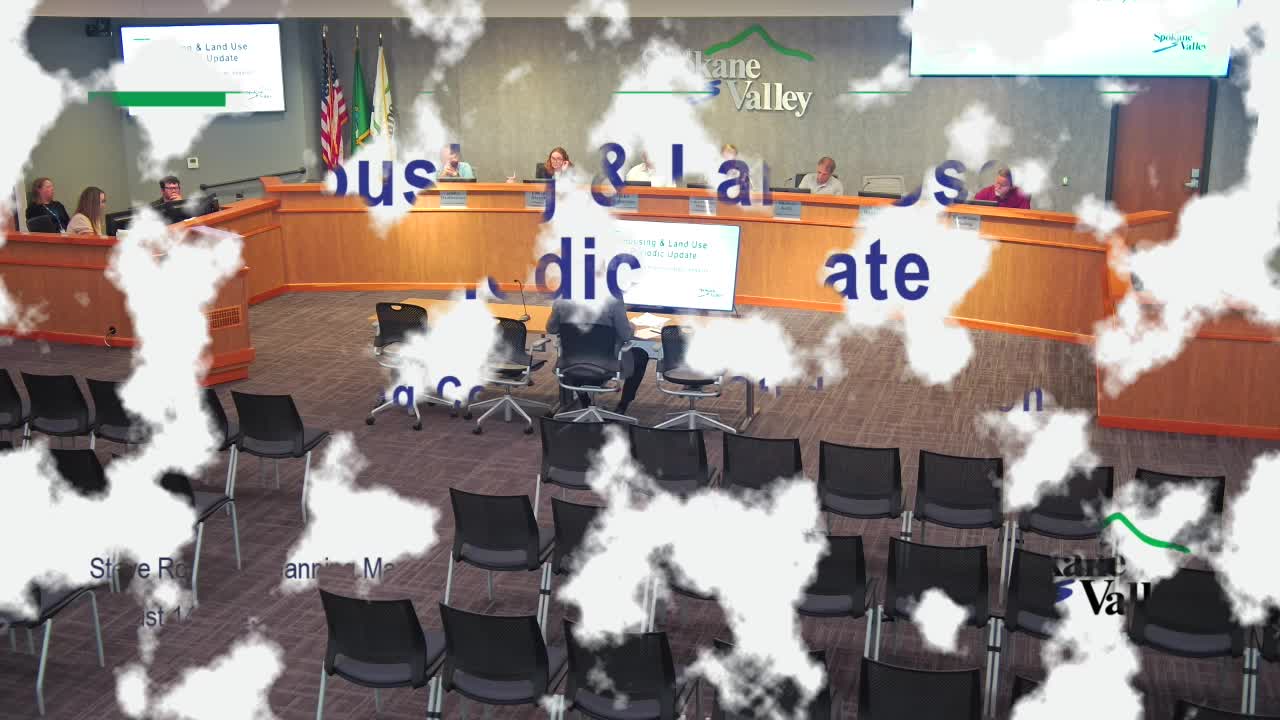
Spokane Valley planning commission reviews comprehensive plan updates and three new state housing laws
Summary
City planning staff briefed the Spokane Valley Planning Commission on the comprehensive plan update, land-capacity analysis and three recently enacted state housing bills that will require changes to local code, including accessory dwelling unit (ADU) rules, middle-housing allowances and housing-capacity planning.
The Spokane Valley Planning Commission heard a staff briefing Thursday on updates to the city’s comprehensive plan and on three state housing laws that staff said will require changes to local land-use rules and zoning.
The presentation, delivered by staff member Steve Roberge, outlined the update schedule, recent technical work on land capacity and the specific provisions of three bills staff said will change how the city regulates housing: House Bill 13137 on accessory dwelling units (ADUs), House Bill 1120 on planning to ensure sufficient land capacity for housing, and House Bill 1110 (the “middle housing” bill).
Why it matters: the Growth Management Act and new state laws set deadlines and minimum requirements that cities must incorporate into their comprehensive plans and development regulations. Roberge told the commission the city’s periodic update is due by December 2026 and that the city’s consultant contract currently targets a finish in June 2026, giving staff additional time to prepare code changes.
Key facts and numbers
- Land-capacity analysis: staff reported about 134 acres available for commercial development, about 101 acres for industrial development and about 681 acres of residential capacity. Under current zoning, that residential capacity equates to roughly 6,000 additional dwelling units, Roberge said.
- Population and housing allocations: Roberge said the county steering committee’s allocation gives Spokane Valley about a 20,000–21,000 population increase to plan for over the next 20 years. He also cited a housing allocation figure for the city of 16,601 housing units (the commission asked staff to provide the detailed breakdowns by income band at a later meeting).
- Timing: the periodic update is due December 2026; consultants are working on analyses and staff expects to present more detailed housing numbers at the commission’s Aug. 28 meeting and continue housing and land-use topics at the Sept. 11 meeting.
Bills that will require local code changes
Accessory dwelling units (ADUs) — House Bill 13137: Roberge summarized the bill’s main effects. "It will require us to allow up to two accessory dwelling units per lot, and they can be attached or detached," he said. He added the law requires jurisdictions to allow ADUs of at least 1,000 square feet, removes any local owner‑occupancy requirement, and allows ADUs to be sold separately (for example by condominiumization or subdivision). Roberge also told the commission that the bill contains a preemption or default clause: "If we don't do something then the statute still ... comes into effect," meaning the state's default standards will apply if the city does not adopt its own ordinance within the statutory bounds.
Commissioners asked about parking, infrastructure capacity (water, sewer, electricity and natural gas), and the potential for investors to buy multiple lots and rent or resell ADUs. Roberge said capital facilities (sewer, water, etc.) are a required element of the comp plan update and will be considered in the analysis; he said recent state parking legislation will also limit how much the city may require in off-street parking.
Middle housing — House Bill 1110: Roberge described the middle-housing bill’s definition and the obligation for Spokane Valley as a “tier 1” city. "Because we're a tier 1 city, we are required to allow up to four units per lot," he said, and noted that development standards such as setbacks, building height, coverage, emergency access and other life-safety requirements remain applicable. The bill defines middle housing to include duplexes, triplexes, fourplexes, cottage housing, townhomes and similar forms "compatible in scale, form and character with single-family houses," Roberge added.
Planning for sufficient housing capacity — House Bill 1220: Roberge summarized the state requirement to plan for housing across specified income bands. He said staff will produce the detailed counts of how many units must be planned for each income bracket, including targets for affordable and supportive housing, and that the Department of Commerce’s guidance and models are being used by the city and its consultant to prepare those figures.
Staff work and next steps
Roberge said the city’s consultant team is still completing the numbers and will present draft analyses to the commission. Staff intends to:
- Provide the commission a detailed breakdown of the housing allocation (the commission asked for counts by income band and the number of units required in each category, including supportive housing).
- Present a study session on the home-occupation code Aug. 28 and continue housing and land-use discussions on Sept. 11; the emergency wireless tower-height ordinance enacted by the council will also come to the commission for regular rulemaking, Roberge said.
- Evaluate comp-plan strategies and annotate which actions have been completed or remain in progress as part of the update process.
Commission discussion and concerns
Commissioners raised concerns about neighborhood character, investor ownership and enforcement if owner-occupancy requirements are removed. One commissioner said ADUs could provide housing options for multigenerational families but also warned that investors purchasing multiple homes and converting properties could change established neighborhoods. Another commissioner noted cost barriers (construction financing and interest rates) that may limit widespread ADU construction.
Several commissioners requested more information on: the number of plats or subdivisions that include deed restrictions prohibiting multiple dwelling structures on a lot; legal guidance on the interaction between plat/HOA restrictions and the new state laws; and a clearer estimate of how many property owners might add ADUs (staff said the Department of Commerce had previously estimated roughly 10% of eligible properties might convert over a 20‑year period, though staff said it would verify that figure).
What the commission directed or decided
The commission did not take policy votes on the state bills at Thursday’s meeting. Instead, members requested follow-up materials from staff and the consultant, including:
- Detailed housing-unit counts by income band and the supportive-housing target. - A mapped inventory (or an approach for developing one) of plats/HOA restrictions that could block ADU and middle-housing deployment. - An analysis of capital facilities capacity (water, sewer, electrical) relevant to additional residential units.
Votes at a glance (procedural)
- Motion to excuse Commissioner Winkler: approved (no recorded dissent). - Motion to approve the meeting agenda: approved (no recorded dissent). - Motion to approve minutes for 07/10/2025 with a minor amendment: approved (no recorded dissent). - Motion to adjourn: approved (no recorded dissent).
Ending note
Staff told the commission that this update is among the most complex the city has faced under the Growth Management Act and that staff and consultants will provide sequential, element-by-element briefings to support commission recommendations. The commission expects to return to housing and related code questions at the Aug. 28 and Sept. 11 meetings.