Get Full Government Meeting Transcripts, Videos, & Alerts Forever!
Get email alerts on the City Budget topic
No spam. Unsubscribe anytime.
San Antonio manager unveils $4.04 billion FY2026 budget; council keeps tax rate unchanged
Summary
City Manager Eric Walsh presented a $4.04 billion proposed operating and capital budget on Aug. 14. The City Council set the proposed maintenance and debt tax rates that keep the combined rate unchanged and heard requests from council members for higher employee pay and more police officers.
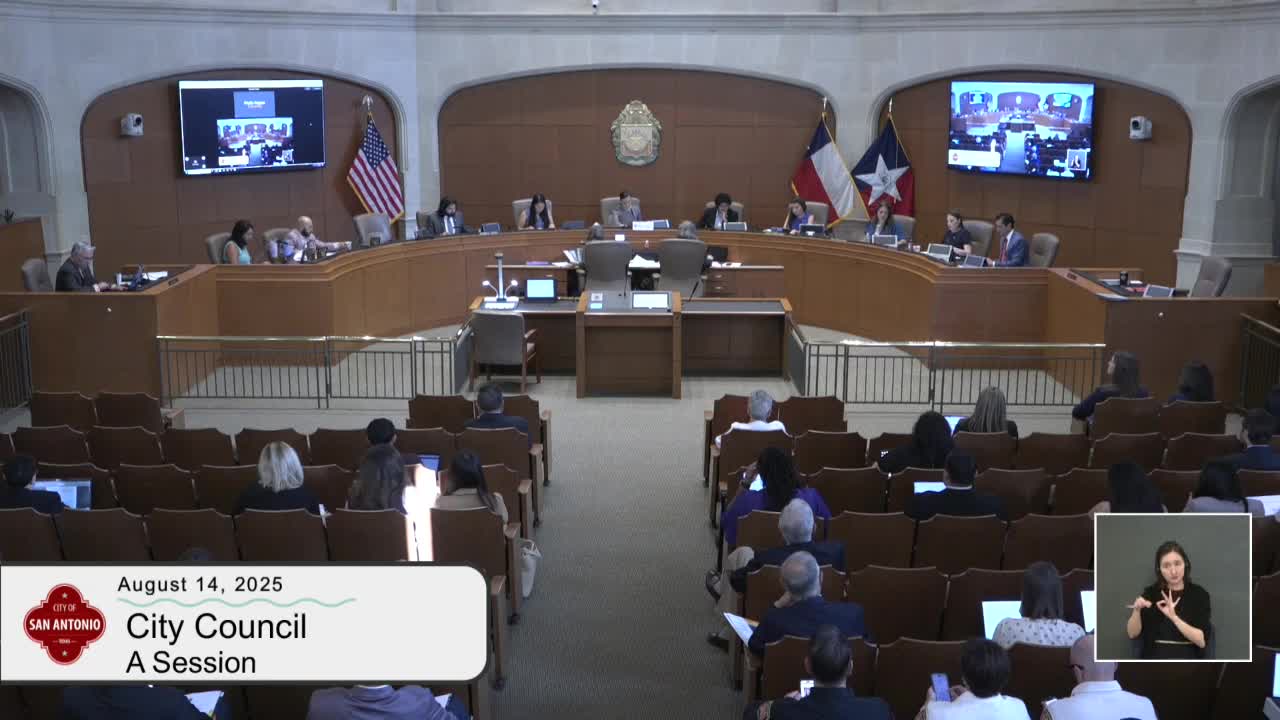
City Manager Eric Walsh presented the City of San Antonio’s proposed fiscal year 2026 operating and capital budget — a $4.04 billion plan that would hold the city’s property tax rate steady — at a City Council meeting on Aug. 14.
“The tax rate is not changing and is staying the same,” City Manager Eric Walsh said as he opened the presentation, which begins the council’s 30-day review process ahead of a scheduled Sept. 18 adoption vote.
The proposal covers the city’s combined funds, including a $1.69 billion general fund (a 1.6% increase from FY2025) and a $1.1 billion capital budget. The council formally set the proposed maintenance tax rate at 33.009 cents per $100 of taxable value and the proposed debt-service rate at 21.15 cents per $100 (a combined 54.159 cents per $100), and scheduled the statutorily required public hearings on the budget and tax rate.
Why it matters: the plan balances slower revenue growth with targeted investments in public safety, homelessness services and infrastructure while proposing workforce adjustments and department reorganizations designed to limit cuts to core services.
Major figures and program highlights - Total proposed city budget (all funds): $4,040,000,000 (2.2% increase). - General fund: $1,690,000,000 (1.6% increase). - Authorized city positions: 13,723 (net decrease of 116 positions overall; 68 civilian positions proposed for reduction; 73 net additions in police and fire accounted mainly by new sworn positions and reallocations). - Compensation: a proposed 2% across-the-board increase for civilian employees; a 4% police increase (per collective bargaining agreement); an 8% firefighter increase (per collective bargaining agreement). The proposal also includes a 5% increase in civilian health premiums and a 10% premium increase for police and fire consistent with their agreements. - Public safety: the proposed budget includes 53 new police officers (28 identified as supervisory hires to staff a South Flores substation opening in 2027, plus 25 patrol officers) and funding for additional fire “enhanced squads” and assessments of fire staffing, equipment and facilities. The police plan budgets for six academy classes next year to yield an estimated 270 graduates. - Homelessness and housing: the package creates a Homeless Services and Strategy department under the chief housing officer, includes $4.8 million to continue a low‑barrier shelter (budget documents estimate capacity to serve about 450 individuals with an objective of roughly 250 “positive exits”), and a total City investment of roughly $30.4 million for housing initiatives in FY2026 (general fund and grants). The city also plans an expected 1,300 encampment abatements next year and a target to shelter 600 unsheltered individuals. - Capital/infrastructure: $1.1 billion capital budget with roughly $650 million directed to airport terminal work; $122 million proposed for street maintenance (covering nearly 1,416 miles of work over many projects in the plan), $17 million proposed for sidewalks (estimated 21 miles of new sidewalks and 11 miles repaired), and $11.4 million set aside for flood-damaged roads. The manager also proposed a new capital delivery department drawn from existing public works staff to improve project delivery and communications. - Delegate agencies and grants: $28.9 million for contracted nonprofit (delegate) agencies; $162.7 million in federal and state grants reflected in the proposed budget; staff noted recent and potential federal grant volatility that could affect future budgets. - Property tax relief measures (foregone revenue): staff highlighted $75.8 million in homestead exemptions, $48.8 million in over‑65 exemptions, $24.3 million for the senior tax freeze, $2.3 million for disabled persons exemptions and $600,000 for the childcare exemption adopted last year.
Council reaction and issues raised Council members broadly thanked the budget team for the work but expressed differing priorities during a lengthy question-and-answer session. Several common themes emerged: - Employee pay: multiple council members asked staff to model alternative compensation packages, and several urged a larger cost-of-living adjustment than the proposed 2% (members asked staff to show what a 3% COLA or targeted increases for lower-paid employees would cost). - Public safety: some council members urged the council to fund more sworn officers than the 25-patrol-officer increase in the manager’s proposal; Councilman Mark White said, “I don’t think we have a revenue problem. I think we have a spending problem,” and argued for prioritizing more officers to meet the department’s 60/40 proactive/on-call goal. Other members emphasized complementary, non‑police responses and investments in integrated community safety and homeless outreach. - Homeless services: several council members welcomed the new homelessness strategy office but pressed for more detail on outreach staffing, case-management capacity and the long-term plan for the low-barrier shelter. Council members also asked staff to provide the average cost-per-encampment cleanup and to clarify how encampment cleanup funding relates to investments in permanent supportive housing. - Infrastructure delivery and communication: council members repeatedly raised project delivery, street maintenance, and streetlight funding (including concern that some flashing stop sign and radar feedback sign funding had been reduced) and asked for clearer mapping and timelines for sidewalk and street projects.
Direct quotes from the meeting - “The tax rate is not changing and is staying the same,” City Manager Eric Walsh said during his presentation. - “I don’t, I don’t think we have a revenue problem. I think we have a spending problem,” said Councilman Mark White. - Councilmember Castillo Anguiano and several colleagues asked staff to model a 3% COLA and to show alternatives that prioritize lower-paid employees.
Votes at a glance - Item 4 (Ordinance setting the proposed maintenance tax rate at 33.009¢ per $100 and proposed debt-service tax rate at 21.15¢ per $100; no change to the combined rate): approved by voice vote. (Caption read at the meeting; no roll-call tally recorded in the transcript.) - Item 5 (Ordinance setting dates, times and places for required budget and tax‑rate public hearings): approved by voice vote. - Item 9 (Consent/ordinance extending a one‑year lease renewal with Be Link, term 09/01/2025–08/31/2026; revenue $9,348.45 to general fund): passed after being pulled for recusal reasons; motion and second recorded and approved by voice vote.
Next steps Budget work sessions begin the week after the meeting and run through mid-September, with public town halls scheduled for each council district. The council is scheduled to adopt the FY2026 budget on Sept. 18, subject to any amendments made during the review period.
The council meeting transcript and the city’s budget documents (the manager referenced the online OpenGov upload) provide line‑item detail and cost breakdowns for items council members asked staff to return with in upcoming work sessions and presentations.