Get Full Government Meeting Transcripts, Videos, & Alerts Forever!
Get email alerts on the Court Records And Budget topic
No spam. Unsubscribe anytime.
Denton County hears staffing appeals from tax assessor and district clerk; district clerk presses for shared AI records tool
Summary
At a Aug. 12, 2025 Denton County Commissioners Court session, the tax assessor-collector appealed for two processing clerk positions and the district clerk sought two deputy clerk positions or a shared Tyler Technologies records-automation system; the court took no action.
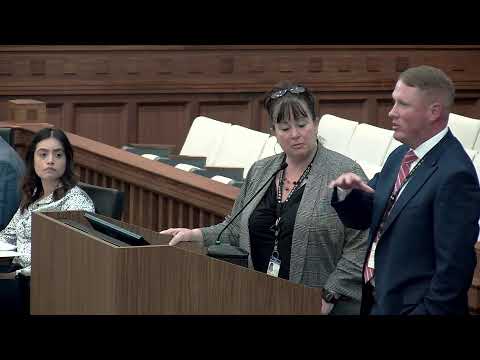
DENTON COUNTY, Texas — The Denton County Commissioners Court on Aug. 12, 2025, heard budget appeals from the tax assessor-collector and the district clerk seeking additional staff to handle heavy workloads and, in the district clerk’s case, a shared records-automation system with the county clerk.
Alejandro, a county budget staff member, opened the appeals segment and summarized the financial impacts. The tax assessor-collector requested two “clerk two” positions with a combined first-year financial impact of $138,830 to process mail and other backlog in the motor vehicle and licensing division. The tax assessor-collector told the court the office processed 91,830 motor vehicle transactions in July and has handled 856,000 transactions so far in the fiscal year; the office also reported an average of 58 new residents seeking services each day.
District Clerk David Trantham appealed for two deputy clerk 3 positions with a combined first-year cost of $147,408. Trantham also presented an alternative: partnering with the county clerk to purchase a records-automation product from Tyler Technologies to automate routine e‑filing and docket-code processing. Trantham said his office receives roughly 17,000–21,000 electronic filing envelopes a month across nine courts and that Tarrant County’s deployment of a similar system has handled an estimated 20% of its office workload.
On costs, Trantham told the court he initially budgeted $644,680 for the joint project. After meeting a Tyler Technologies representative, he reported a revised breakdown: a software-as-a-service (SaaS) subscription in year one of about $248,000 (after a reported $20,000 ‘‘ramp’’ discount) plus an implementation/professional-services charge of $121,040. He said the year-two SaaS fee would be about $250,400 with $35,000 in professional-services charges and that the vendor anticipates 5% annual increases thereafter.
Commissioners raised operational and budget questions. One commissioner noted that the subscription pricing could be comparable to hiring roughly nine clerks in salary-and-benefits costs, and another expressed hesitation about adding another system while the county continues an enterprise financial-technology rollout. County Clerk Julie (noted as present in discussion) supported exploring the automation but said a detailed ROI and implementation plan should be provided; Trantham said he would supply a spreadsheet on return-on-investment at the next meeting.
Trantham and other speakers emphasized that automated processing could be a 24/7 stopgap that reduces backlog, helps meet state reporting mandates and lowers risk of errors in dispositions and registry reporting. Trantham said that one common event code — proposed orders — yields roughly 32,000 items annually and that, at an estimated 4 minutes per item, that code alone represents about 2,162 staff hours (roughly 54 weeks of full-time work) that automation could absorb.
The court did not take action on the appeals during the meeting. The county judge said, "There'll be no action on that today," and the appeals remained for later consideration.