Get Full Government Meeting Transcripts, Videos, & Alerts Forever!
Get email alerts on the Emergency Management topic
No spam. Unsubscribe anytime.
Abilene emergency management outlines preparedness upgrades, urges residents to sign up for Code Red
Summary
Emergency Management Coordinator Vincent Cantu told the City Council the Office of Emergency Management is updating its hazard mitigation plan, pursuing IPAWS certification and encouraging residents to register for Code Red alerts as part of efforts to improve warning and response capabilities.
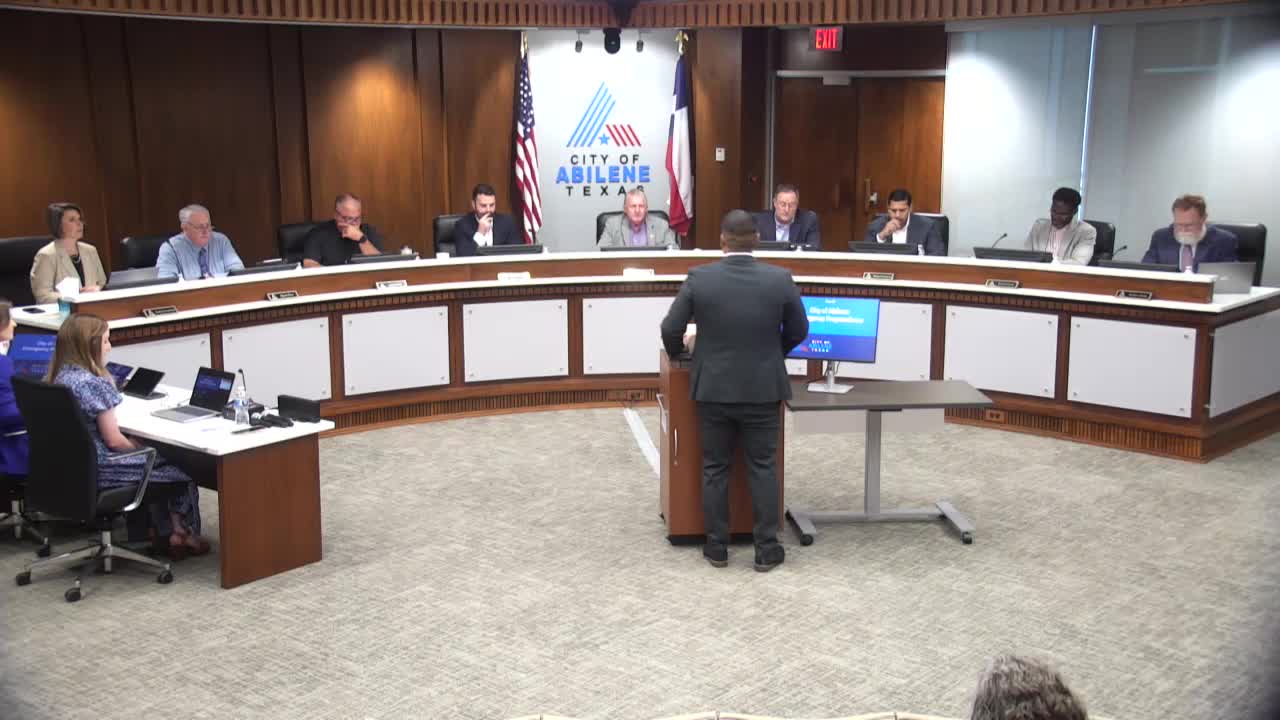
Vincent Cantu, emergency management coordinator for the City of Abilene, told the City Council on Aug. 11 that the city is updating its hazard mitigation plan, pursuing federal alert capabilities and expanding training to keep Abilene prepared for disasters.
Cantu said the city’s Office of Emergency Management is staffed by two full‑time emergency managers and has used lessons from recent incidents to push changes in planning, public education and exercises. "We keep Abilene ready, and we're here to ensure that Abilene is able to recover, post disaster and post incident," Cantu said.
The presentation laid out several ongoing actions: a hazard mitigation plan update that adds identified projects to improve resilience; regular updates to the city’s emergency operations plan to clarify departmental roles; continued evaluation of notification systems; and both discussion‑based and operations‑based exercises to test response plans. Cantu said the office also seeks training and grant funding to position identified projects for future mitigation grants.
Cantu urged residents to register for Code Red alerts, a sign‑up mass notification system, and explained the city is working toward IPAWS (Integrated Public Alert and Warning System) certification so it can push Wireless Emergency Alerts without relying on users to register. "We do not as a city currently have that ability to push [government messages] ourselves. We're not an IPAWS certified city, but it is something we're currently working towards," he told council members.
Council members asked about lead times, coordination with neighboring San Angelo after that city’s recent incident and how two emergency managers integrate with other city departments during events. Cantu said the office leverages public‑private partnerships and works with police, fire, public works, hospitals and NGOs such as the Red Cross and Salvation Army during incidents. He also described the ISTAT (Individual State of Texas assessment tool) program for collecting field damage reports to inform response and mapping.
Cantu asked department heads, nonprofits and community leaders to meet with his office to identify needs and potential mitigation projects so Abilene can be ready to apply quickly for funding when grants open. He closed by inviting questions and by encouraging residents to build basic preparedness kits and plans and to sign up for city resources on the City of Abilene website.
No formal council action was taken on the presentation; Cantu's talk was presented as an informational item and the public hearing on the item closed with no speakers.
The council then moved on to other agenda items.