Get Full Government Meeting Transcripts, Videos, & Alerts Forever!
Get email alerts on the Police Station Construction topic
No spam. Unsubscribe anytime.
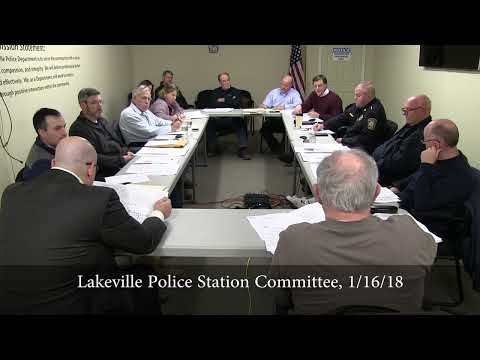
Lakeville committee keeps Feb. 7 bid date while flagging planning-board, civil and tech items
Summary
The Police Station Building Committee on Jan. 16 approved moving forward with the projectbid schedule — targeting a Feb. 7 issue date and a five-week bid period — while noting outstanding civil drawings, a potential planning-board peer review, separate bidding for a waterline and $190,000 in integrated-technology allowances.
The Police Station Building Committee of the Town of Lakeville voted Jan. 16 to proceed with the construction bid schedule for the new police station, targeting a Feb. 7 date to put bid documents on the street and a five-week bid period (three weeks for filed subbids, two weeks for general contractors), contingent on the outcome of an upcoming planning-board review.
Committee members said the schedule keeps the project on track while flagging several outstanding items that must be coordinated before bids are due: final civil drawings and grading information, potential planning-board comments or a peer review, the water-line bid strategy, and owner-procured radio and security equipment.
Dean Badley, who presented the design update, told the committee the architectural, mechanical, electrical and fire-protection drawings are advancing but that civil engineering work has lagged because the civil consultant did not begin full design until after health-department and natural-heritage clearances were granted in December. "I don't have a clear confidence level that we're all set to go" without seeing the civil drawings, Badley said, adding that he had seen January 11 and Dec. 8 drawing sets used for internal coordination.
Brian Humes, listed on the meeting invoices as "Brian Humes, Humes Architect LLC," described a recent full MEP (mechanical, electrical, plumbing) coordination session and said the MEP team had largely resolved layout and coordination questions. Humes also urged accuracy over speed in issuing bid documents: "I'd rather be two weeks late and right than two days early and wrong," he said, arguing that a cleaner bid package would reduce the number and size of addenda during the bidding period.
The committee discussed the civil consultant's planning-board submission and a curb-cut permit from MassDOT. Badley said the planning board hearing is scheduled for Jan. 25, and that MassDOT will not consider a curb-cut application until the town has acted on the planning-board submission. Committee members treated a possible peer review as an uncertain "wild card" that could extend the schedule if required.
On procurement strategy for some owner items, the committee directed that integrated technology and security equipment (access control, cameras, intercoms, radio equipment and console furniture) be bid as a supplemental package or procured separately from the general-contractor work. The committee noted an allowance of $190,000 for integrated technology currently included in the construction estimate; members agreed that figure should be moved from the construction line into soft costs and that the town would obtain more detailed vendor quotes before bids are returned. One participant estimated the likely range for security and technology at roughly $150,000to$200,000.
Radio equipment was discussed separately. Attendees said a consultant (identified in the meeting as Langone and a separate radio specialist, Cheick/Chick) reported that no freestanding antenna tower is required; roof-mounted antennas and a new repeater at the water tower should meet coverage needs for police and fire. Committee members said the committee will seek final radio cost estimates and that those owner items would be finalized before the bids were returned to allow an informed award decision.
The committee also discussed a water-line extension needed to serve the site. Kenny (site consultant) had prepared drawings but had not produced a full set of bidding specifications; the group agreed to bid the water-line as a separate package to avoid GC markup and to reduce coordination risks. Brian Humes offered to prepare and coordinate a separate water-line bid package at no additional cost if the town wished.
Geotechnical testing returned verbally favorable results, participants said; a formal report is expected for inclusion in the bid documents. Committee members also reviewed commissioning proposals for MEP systems and received a $14,002.50 proposal from WSP, which the committee asked to circulate for review before contract approval.
On schedule mechanics, the committee settled on a five-week bid window with the project advertised Feb. 7, filed subbids due Feb. 28 and general-contractor bids due March 14. Members emphasized timing to avoid competing projects and to attract contractor interest in late winter. The committee instructed staff to place public notices consistent with Central Register and local newspaper timing requirements.
Before adjourning, the committee approved invoices for owner-representative and consultant work (Pomeroy OPM services, Humes Architect balance for design work, field engineering expenses, and Israel Land Sciences testing charges) per the meeting agenda. The committee then made and seconded a motion to proceed with the bid schedule "as discussed," with the understanding that if planning-board review or other issues created an insurmountable problem the committee would reconvene and reconsider the schedule. The motion carried unanimously.
The committee left several items to finalize before bids are issued: receipt of the civil drawings and any planning-board conditions or peer-review comments, formal geotechnical and radio equipment reports, and final owner-procured pricing for integrated technology and radios. If planning-board review produces only minor revisions, the committee indicated it would proceed and issue clarifications or an addendum as needed; if the review yields major conditions the committee said it would delay the advertisement and reconvene.
Notes: Committee members agreed the security and integrated-technology equipment would not be included in the base general-contractor bid; wiring infrastructure is included so that low-voltage vendors may be competitively procured after a general contractor is selected. The meeting record shows a $190,000 allowance in the construction estimate for integrated technology; the committee directed staff to reclassify that allowance to soft costs and to obtain vendor quotes prior to award.