Get Full Government Meeting Transcripts, Videos, & Alerts Forever!
Get email alerts on the State Legislation topic
No spam. Unsubscribe anytime.
Dallas committee reviews 2025 Texas session: wins on housing credits, concerns about revenue cap and land-use limits
Summary
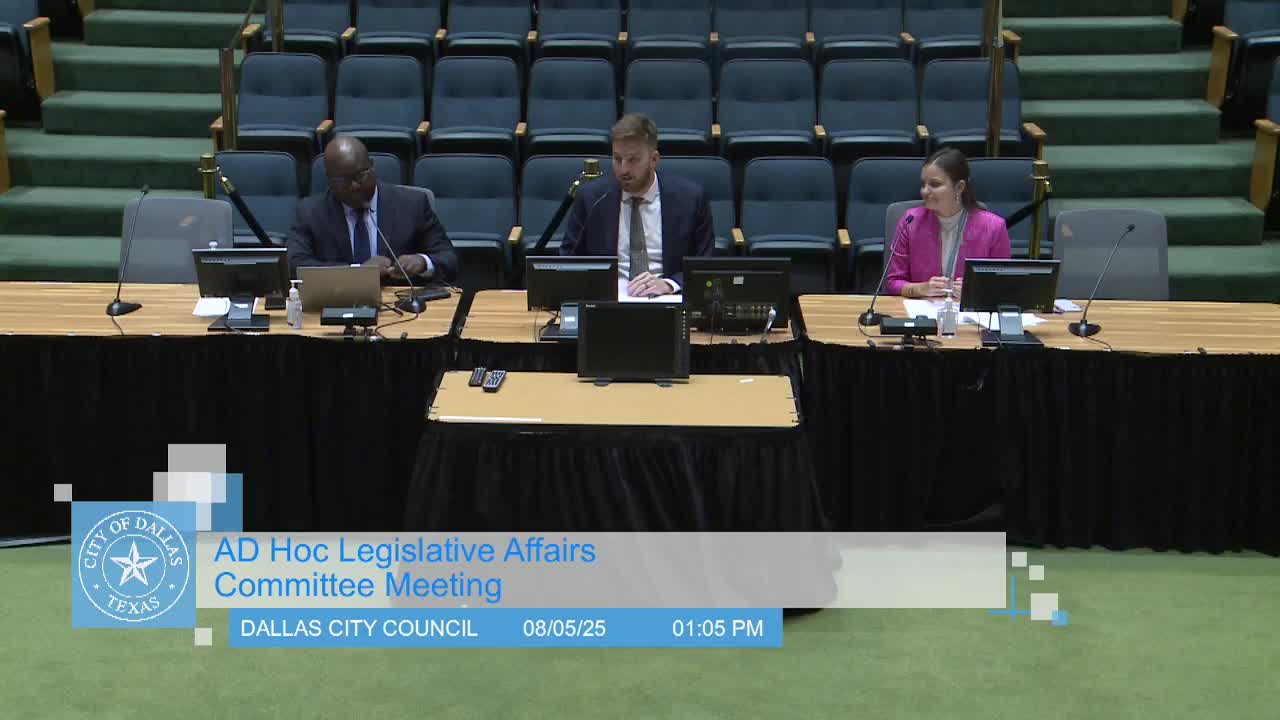
The Ad Hoc Committee on Legislative Affairs met Aug. 5 and received a post‑session review of the 89th Texas Legislature and the special session underway.
The Ad Hoc Committee on Legislative Affairs met Aug. 5 and received a post‑session review of the 89th Texas Legislature and the special session underway. Jake, Clifford Sparks and Lynn Lou Darian of the city’s Office of Government Affairs briefed the committee on bills that affected Dallas and on items the city had pursued, supported or monitored.
The presentation said more than 9,000 bills were filed in the regular session; about 1,500 of those would have affected Dallas operations, roughly 1,200 bills reached the governor and 137 enacted laws were judged to have an impact on the city. Committee members were told five of the city’s top 10 pursued priorities were signed into law.
Why it matters: City staff said the actions in Austin carry immediate budget and land‑use implications for Dallas, from changes in available grant funding to new limits the state imposes on local zoning choices.
Clifford Sparks, a member of the city’s legislative team, said the city registered a mix of outcomes: “If you combine what happened last session, we probably had over 50 pieces of legislation that we passed overall from the city of Dallas standpoint,” Sparks said. He called HB 21 a major win that “helps make sure that no other jurisdictions could come in and take things off of our tax roll.”
The committee heard staff describe two categories of concern: state bills that limit local authority over land use and zoning, and a revenue‑cap proposal introduced in the special session. On land use, staff described SB 15 as a measure that restricts development on large, unplatted tracts: once effective, parcels of five acres or more that are undeveloped would be limited to small‑lot residential development (lots limited to about 3,000 square feet), with narrow carve‑outs. Sparks said Dallas secured a carve‑out around the UNT Dallas area but that other proposed protections were not obtained.
Committee members also discussed SB 40 (referred to in the presentation as SBA 40), which staff said limits some local land‑use authorities but had been modified after negotiations. “This bill could have been a lot more unfavorable, but it actually came out in ways that allowed us still some breathing room,” Sparks said.
The special session item that drew the most worry from members was SB 9, a proposal to lower the local revenue cap (previously set at 3.5 percent) to 2.5 percent. City staff explained the cap limits how much a city may raise its maintenance and operations tax rate without going to voters and that an immediate effective date would jeopardize budgets being prepared now. Committee members were given a staff calculation that Dallas could lose roughly $22 million in revenue if SB 9 passed in its then‑proposed form.
The presentation also covered budget and grant developments the city viewed as wins. Staff noted increases in several grant programs and described a restored and increased veterans treatment court grant that staff said was tripled after advocacy. Committee members heard operational metrics from the Office of Government Affairs: 41 council updates distributed, testimony provided on 45 bills, 27 letters submitted, 45 “dropped cards,” and 48 staff trips to Austin during the session.
Members discussed strategy going forward. Chair Mendelson framed local control as the body’s guiding philosophy and encouraged continued, early engagement for the next session. Mayor Pro Tem Moreno and other council members said assigning council members to “own” topics in advance helped the city’s testimony and outreach in Austin. Clifford Sparks urged beginning preparations earlier for the 2027 session so council members and staff can shape bills before filing.
The committee did not vote on state policy changes during the meeting; staff said they will continue monitoring special‑session activity and will return to the council with implementation steps and requested clarifications for items that passed.
Looking ahead, staff said Dallas will continue to press the city’s priorities in Austin, focus on protecting budget flexibility, and seek amendments where state policy encroaches on local zoning and land‑use authority.