Get Full Government Meeting Transcripts, Videos, & Alerts Forever!
Get email alerts on the Housing Rental Inspections topic
No spam. Unsubscribe anytime.
Council continues debate on residential rental inspection ordinance after hours of public testimony
Summary
After hours of public comment from tenants, landlords and housing advocates, the Land Use, Housing and Transportation Standing Committee voted to continue an ordinance that would establish a residential rental inspection program so staff and council can craft amendments.
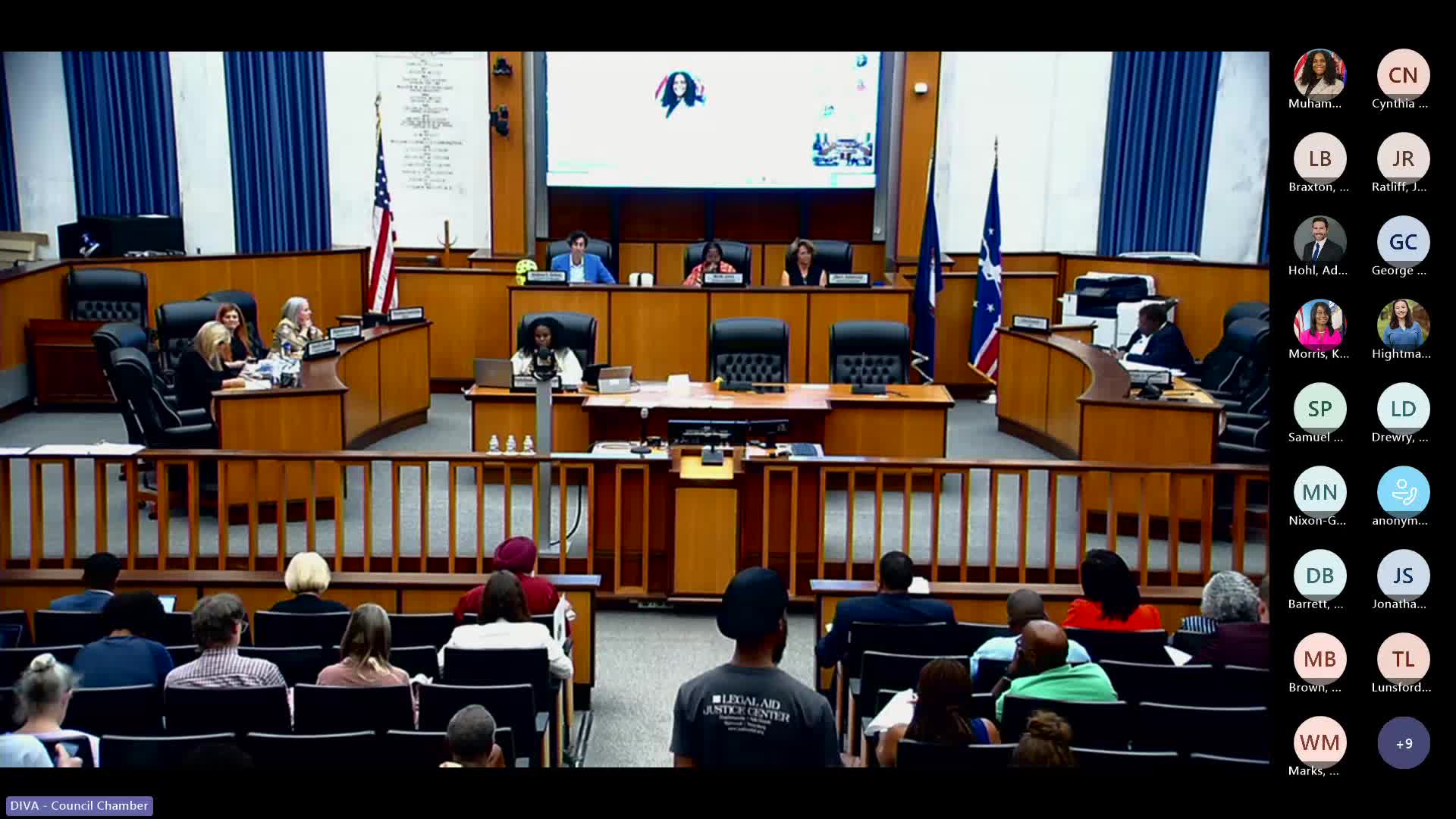
The Land Use, Housing and Transportation Standing Committee continued consideration of an ordinance to establish a residential rental inspection program after more than two hours of public testimony and detailed staff discussion.
The ordinance before the committee (ordinance 2025-161) would create a Residential Rental Inspection Program, known in presentations as RRIP, and authorize proactive and periodic inspections of rental dwelling units consistent with the Code of Virginia. Kevin J. Bonk, director of Planning and Development Review, told the committee the ordinance would allow the city to perform initial inspections, periodic inspections (no more than once per calendar year), transfer inspections after property sale, and follow-up inspections until code compliance is achieved. For properties with 10 or more units, inspectors would select 10% of units for the initial inspection; a violation in one unit could trigger inspection of all units in a complex. New construction or units that pass an initial inspection would be exempt from periodic and transfer inspections for 48 months.
Bonk said the Code of Virginia sets prescriptive limits on what municipalities may do when creating inspection programs and that any decision to add units into the program would be by separate council ordinance. He recommended a targeted, bottom-up approach that adds individual complexes or small clusters rather than a citywide district, and told the committee that current staff capacity could handle “a few dozen, maybe a few hundred” units before additional staffing would be needed.
Speakers were sharply split. Tenants, tenant organizers and housing advocates urged adoption of the ordinance and said the city’s existing complaint-driven enforcement fails to hold many landlords accountable. Rachel Hefner, a tenant organizer and former municipal housing staffer, described cases she had handled in other cities and cited research showing reduced residential fires and lead levels following inspection programs. Several residents described unsafe and unhealthy conditions, including long-unaddressed mold and failing building systems.
Opponents—small landlords, property managers and industry groups including the Homebuilding Association of Richmond and the Virginia Apartment Management Association—said the ordinance as drafted would be overly broad, might stigmatize neighborhoods, could impose disproportionate costs on “mom-and-pop” landlords, and risk unintended consequences such as displacement. Speakers proposed narrowing triggers for districts, exempting well-managed properties (for example those with certain certifications), and changing language in the draft ordinance: several asked the city to replace the term “blighted” with “deteriorating.” Industry representatives also questioned whether police and fire calls should be part of the criteria for adding properties to a district, arguing that emergency calls do not always indicate a building code violation.
Staff and councilors discussed several technical points raised in testimony. Bonk said the administration can supply historic police, fire and building-inspection call data, but matching individual calls to building-code violations would be “a pretty intensive effort.” He emphasized that tenant petitions to be included in the program would be an important criterion because tenants may be reluctant to call for service for fear of retaliation.
Council members and staff agreed more work was needed to tighten definitions, confirm data availability, and add tenant-notification and tenant-rights education components. Committee Chair Tara Jones and members said they wanted amendments to clarify criteria for creating inspection districts, tenant notification requirements, and implementation steps, including how the city would handle temporary relocation if units were placarded as unsafe.
The committee voted to continue consideration so staff could draft amendments and return in September. The motion to continue item 1, ordinance 2025-161, to the September Land Use, Housing and Transportation meeting passed without recorded opposition: Mister Burton, Vice Chair Robertson and Chair Jones recorded “Aye.”
The committee did not adopt a rental-inspection district at the meeting; as presented the ordinance would establish the program but would add no properties until council separately enacts district ordinances. Staff repeatedly emphasized that adding units would require a separate council action and that the administration recommended adding individual complexes rather than large, pre-identified swaths of the city.
The committee asked for an implementation plan with staffing estimates, data analyses that would support any proposed district, and a tenant-education and notification plan before the ordinance returns for further action.
Ending: The committee set a target to return amended language at its September meeting and directed staff to prepare the requested data and a draft implementation plan for council review.