Get Full Government Meeting Transcripts, Videos, & Alerts Forever!
Get email alerts on the Immigration Truth Act topic
No spam. Unsubscribe anytime.
Contra Costa Truth Act forum spotlights ICE notifications; sheriff defends narrow policy
Summary
Contra Costa County supervisors held a Truth Act forum July 22 after community members and immigrant‑rights advocates urged the county to stop voluntarily providing ICE with inmate release‑notification information; Sheriff David Livingston defended a policy of honoring notification requests only in narrow, SB 54‑specified cases.
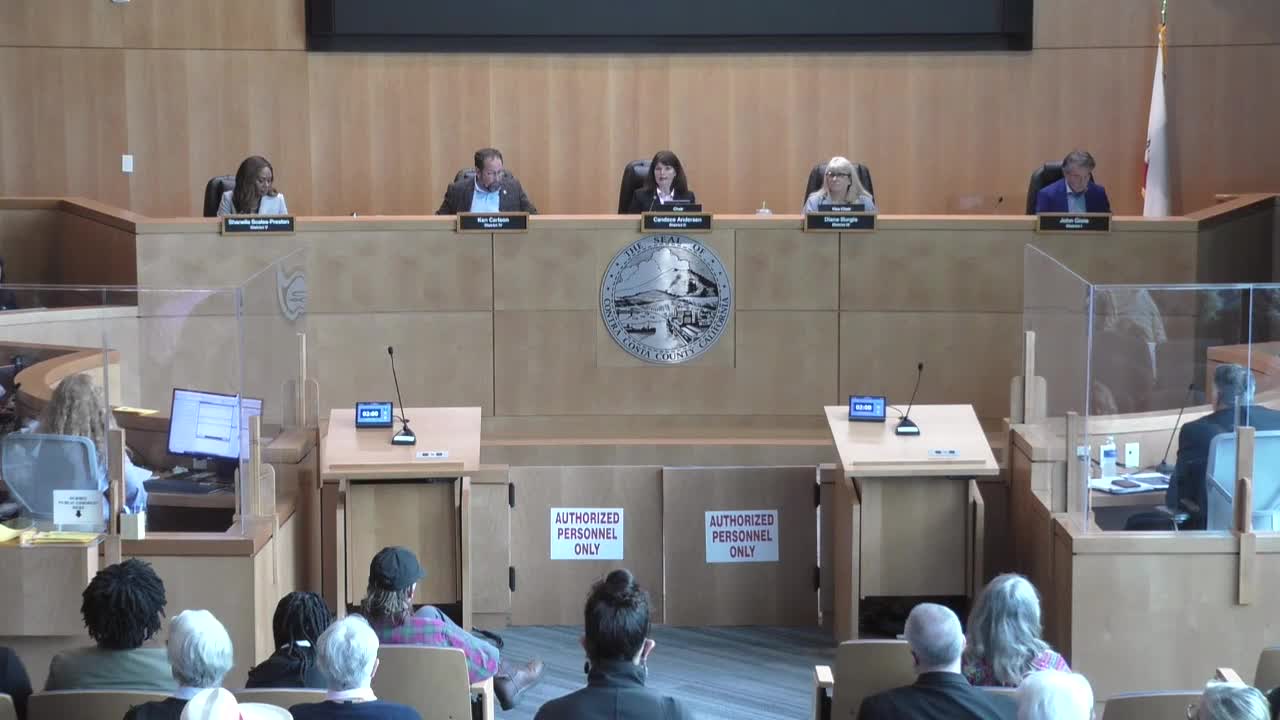
Contra Costa County supervisors held a Truth Act community forum on July 22 where immigrant-rights advocates called on county officials to stop voluntarily providing release-notification information to U.S. Immigration and Customs Enforcement (ICE). The sheriff told the board his office follows state law and provides notification only in narrow cases tied to serious or violent felony convictions.
The forum brought presentations from county staff and outside advocates, followed by more than two hours of public comment. Anid Mendoza of the county administrator’s office outlined the Truth Act’s requirements under Government Code section 7283.1 and said the county had asked agency heads to certify whether they provided ICE access in 2024. Mendoza said only the sheriff’s office reported such access for that year.
Veil Tanecora, a staff attorney at the Immigrant Legal Resource Center, urged the board to stop any voluntary cooperation with ICE. “Continuing to collaborate with ICE, Contra Costa is setting itself up for legal liability,” Tanecora told supervisors, arguing that cooperation chills reporting of crimes and separates families.
Sheriff David Livingston described the department’s long-standing policy that “no person shall be contacted, detained or arrested solely on the basis of his or her immigration status,” and said the office does not honor detainers but will respond to ICE notification requests only in compliance with SB 54 (the California Values Act). Livingston told the forum his office received more than 578 ICE requests for notification in 2024 and that supervisors or staff ultimately honored 132 of those requests; when duplicate or repeat inquiries are removed, he said, 96 notifications were made in 2024. Livingston said ICE interview requests in custody had been zero and that interviews are not facilitated in-justice facility custody areas; he said ICE agents are asked to remain in public lobbies.
Supervisors pressed the sheriff and outside presenters on how the county determines which cases qualify for notification, especially “wobbler” offenses that can be charged as felonies or misdemeanors. Tanecora and Ellen (Public Defender) said the legal analysis can be complex and urged clearer county policy or an ordinance to end voluntary cooperation unless ICE presents a judicial warrant. Livingston said the sheriff’s office has revised procedures and instituted supervisory review of notification decisions after a prior error and that county counsel has reviewed his office’s policies.
Dozens of community members urged the board to pass a local “non‑cooperation” ordinance, citing national ICE raids, interior enforcement trends and a July 2025 federal policy push the speakers said increases urgency. Several speakers, including representatives of the Contra Costa Immigrant Rights Alliance and Safe Return Project, described county investments — for example, a recently funded immigrant “safe center” — that they said are undermined if the county shares release data with ICE. Others, including community members working in law enforcement or health care, said they support limited notification for people convicted of violent felonies and sought clarity on the sheriff’s implementation.
Board members asked the sheriff to return with more granular quarterly data and asked county counsel to review possible local policy options and operational responses for county facilities (for example, Head Start and health centers) if federal agents present themselves without warrants. The forum included a reminder that the Truth Act requires public notification and reporting; Mendoza said the county had provided statutory notice for the meeting and would accept the presentations and public comment for the record.
The board did not take formal policy action at the forum. Several supervisors asked staff to pursue further briefings and to return to the board with options, and the sheriff agreed to continue quarterly reporting and to meet with community groups that offered to help refine procedures. Public commenters and advocacy organizations requested a countywide ordinance to end voluntary notifications unless ICE presents a judicial warrant.
Why it matters: The county’s handling of ICE notification requests affects immigrant families, public‑safety reporting and potential legal risk to local government. The forum continued a statewide conversation about the scope of SB 54 and whether counties should adopt stronger local limits.
What’s next: Staff and the sheriff agreed to follow up with more detailed reporting and to continue discussions with community partners and county counsel on possible policy changes or clarifications. The board did not vote but asked staff to bring options back for committee or board consideration.