Get Full Government Meeting Transcripts, Videos, & Alerts Forever!
Get email alerts on the Higher Education Strategy topic
No spam. Unsubscribe anytime.
THECB reviews progress on 'Building a Talent Strong Texas,' highlights MyTexasFuture growth and targets for credentials and research doctorates
Summary
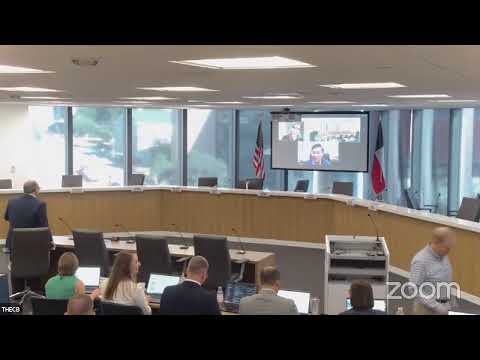
The Texas Higher Education Coordinating Board on July 24 received an update on progress toward its Building a Talent Strong Texas strategic plan and on implementation of MyTexasFuture, direct admissions and other initiatives designed to expand access, affordability, and workforce-aligned credentialing.
The Texas Higher Education Coordinating Board on July 24 received an update on progress toward its Building a Talent Strong Texas strategic plan and on implementation of tools intended to increase college access and credential attainment.
Deputy Commissioner David Trautman and agency staff presented results on the plan’s three headline goals: raising postsecondary attainment to 60% of working-age Texans by 2030, awarding 550,000 “credentials of value” annually, and increasing private and federal research and development spending by $1 billion while growing research doctorates to 7,500 per year.
The agency reported progress on all three metrics but said more work is needed. Assistant Commissioner Melissa Humphreys showed that attainment for both the 25–34 and 35–64 age groups has increased since the 2019 baseline and that, at current average annual growth rates (about 1–1.5%), the state would reach the 60% target by 2030. Humphreys cautioned that the 60% goal is aspirational and that many national forecasts suggest workforce demand closer to 70% of jobs requiring education beyond high school.
On credentials of value — which the agency calculates by comparing net cost (tuition and fees less aid) with expected earnings 10 years after graduation — the board heard that Texas awarded just over 403,000 such credentials in 2024. The count now includes short-term workforce credentials (institutional credentials leading to licensure or certification, “ICLCs”) collected under the community college funding model. With those additions, staff said year-to-year credential awards rose 5% from 2023 to 2024; staff estimated that sustaining roughly a 5.5% annual increase would reach the 550,000 goal by 2030.
On affordability, staff reported that 97% of recent postsecondary graduates have either no debt or a level of undergraduate debt judged “manageable” by the agency’s definition (a debt-to-income ratio at or below 10% in the first year after graduation). Agency presenters noted that 50% of graduates have no debt at all and said the metric is measured at first-year wages; they emphasized the need to monitor cost of living factors such as housing and food as those affect sustainability of the result.
Research and doctoral production figures drew attention. The agency said it has met its R&D expenditure target, reporting roughly $4.5 billion in private and federal R&D at public institutions — exceeding the 2030 interim target. But production of research doctorates remains well below the 7,500 target: Texas public institutions awarded just under 4,500 research doctorates in 2024. Staff told the board that meeting the doctorate target would require roughly an 11% annual increase in completions.
Trautman and his team also reviewed student-pipeline data and the so-called enrollment cliff. The presentation highlighted differences between recent high school cohorts and adult learners (Texans 25 and older). Staff reported roughly 4.8 million Texans with a high school diploma only and about 3.9 million with some college but no credential — a population the agency said represents a high-priority reengagement opportunity.
Implementation updates: MyTexasFuture, Direct Admissions and ApplyTexas
Agency staff detailed implementation and usage of MyTexasFuture, the MyTexasFuture direct admissions tool, and the ApplyTexas application system. Assistant Deputy Commissioner Daniel Perez said MyTexasFuture has had more than 1,000,000 unique visitors to date and that more than 10,000 students have opted into direct admissions. Perez said the system now supports single sign-on between MyTexasFuture and ApplyTexas and that students may begin using direct admissions on August 1. He added that ApplyTexas transmitted about 1.5 million applications to institutions last year and that 850,000 students registered on ApplyTexas, producing 1.5 million completed applications (with 2.5 million applications started but not finished).
Perez and other staff discussed free college application week, set for the second week of October (October 13–19 in 2025). The agency estimates that in 2024 about 44,000 applications were submitted during that week; at a typical $75 application fee, staff used that as a baseline to note potential family savings but acknowledged that some institutions rely on application-fee revenue and that waiver weeks can create operational impacts for admissions offices.
Legislative and funding context
Chief of Staff Melissa Henderson and others summarized results of the 89th Texas Legislature relevant to the coordinating board. Staff highlighted three categories of legislative outcomes: expanded financial aid ($320 million cited in the staff presentation), $400 million for research and innovation, and $15 million for data modernization and systems. Henderson also noted three bills that support agency priorities: SB 2314 (expanding MyTexasFuture/direct admissions), SB 2231 (supporting free college application week) and SB 1786 (refinements to community college finance). Staff said transfer of state need‑based financial aid for students who transfer from a community college to a university now has stronger protections under recent legislation.
Board questions and next steps
Board members asked for more disaggregated data — for example, by region, county or demographic group — and staff agreed to bring additional analyses, including preliminary fall enrollment results in October. The agency said it will bring forward a deeper affordability policy discussion at a future meeting and will continue working with philanthropic partners through the Texas Higher Education Foundation to accelerate implementation.
Why it matters
Agency staff said their analysis of labor-market data shows Texas has a large and growing number of job openings (staff cited an estimate of about 650,000 current openings) and argued that aligning credentials and postsecondary pathways to workforce demand is central to state economic and workforce strategy. The board directed staff to continue refining data disaggregation, monitor progress toward doctorate and credential goals, and report back on enrollment patterns and MyTexasFuture outcomes in the fall.
Provenance: The board discussion and presentations summarized here began with the meeting’s major policy discussion (agenda item 6) and continued through the implementation and outreach updates on MyTexasFuture, ApplyTexas, and free college application week (transcript segments beginning at the major policy discussion and continuing through the staff implementation remarks).