Sumner staff recommend modest water, sewer and stormwater rate increases and updated SDCs
Loading...
Summary
City staff presented a 2025 utility rate study on Oct. 20 recommending 2026–27 increases for water, sewer and stormwater, updates to system development charges and a funding plan relying on grants and some borrowing; council will consider the proposals Nov. 17.
Sumner City staff recommended increasing water, sewer and stormwater rates for 2026 and 2027 and adopting updated system development charges (SDCs) during a special study session Oct. 20, 2025.
Officials said the proposed changes are intended to fund capital projects including White River restoration work, biosolids modernization and wastewater plant improvements, cover planned staffing additions tied to a new operations facility, and preserve minimum operating and capital reserves.
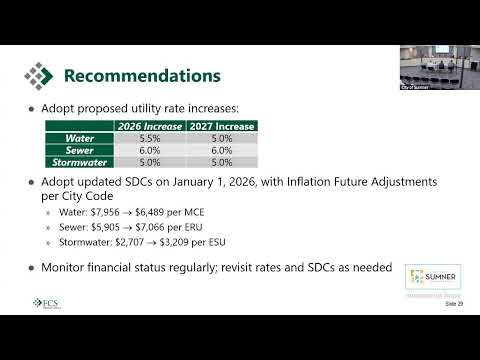
Consultant Chris Gonzalez of FCS Group and Public Works Director Michael Acosta presented the study. Gonzalez summarized the staff recommendation: “We’re proposing that you increase water rates by 5½ percent in ’26 and 5 percent in ’27,” and recommended 6 percent annual increases for sewer and 5 percent for stormwater in 2026–27 (with slightly lower rates projected thereafter). Acosta said positions budgeted for 2026 would need to be appropriated through the city’s mid‑biennial budget adjustment, which will be part of the November package for council consideration.
Why it matters: city leaders and staff said Sumner faces a combination of firmed-up capital costs, ongoing maintenance needs and projected growth that require predictable revenue. Staff presented multi-year capital plans and a financial forecast that staff said covers most water work with cash but shows the sewer program will need borrowing and the stormwater program will rely heavily on grants.
Key details
- Projected capital spending (2025–2031): water approximately $27.8 million; sewer approximately $58 million; stormwater just under $87 million. - Funding mix presented: water cash resources expected to cover about 94 percent of its plan with about 6 percent expected from grants; sewer cash and partner contributions estimated to cover about 81 percent with borrowing of roughly $11 million (about $976,000 annual debt service) projected to fund the remainder; stormwater was shown with roughly 65 percent grant support and about 35 percent utility-funded cost (about $30.2 million). - Rate proposals presented for council consideration (staff recommendation): water +5.5% in 2026 and +5% in 2027; sewer +6% each year in the near term; stormwater +5% in 2026–27 then about +4.5% thereafter. Staff said those figures reflect project reprioritization, delays where possible and updated inflation assumptions. - Typical residential bill impact shown in the presentation: the combined monthly bill for a representative single‑family household was shown rising from $154.12 (2025) to $162.94 in 2026 under the proposal, with further increases projected in 2027. - System development charges (SDCs): staff explained the methodology (water by meter‑capacity equivalents, sewer by equivalent residential units, stormwater by ESUs based on impervious area). The consultant reported the water SDC calculation decreased from the previously used amount to about $64.90 per meter capacity equivalent after updated demand data reduced the average maximum‑day demand per MCE. Staff recommended adopting updated SDCs effective Jan. 1, 2026. Counsel on other SDC dollar changes for sewer and stormwater was discussed in the presentation; specific implementation amounts for some SDC line items were characterized as updated in staff materials and will be part of the formal adoption package.
Discussion highlights and constraints
- Staffing and timing: staff proposed adding 5 full‑time equivalents in 2026 (primarily an additional operations crew) and programming one FTE in operations every two years thereafter and one wastewater treatment plant FTE every four years; positions beyond 2026 are modeled but not appropriated. Acosta noted the 2026 positions would be included in the mid‑biennial budget adjustment for council action. - Project timing tradeoffs: presenters said they shifted or delayed some non‑critical projects to smooth rates while keeping higher‑priority projects on schedule (notably White River restoration and several grant‑funded stormwater projects). They said some projects were pushed outside the near‑term window to reduce rate pressure but remain on the capital list for future years. - Metering and conservation: staff discussed a proposed $500,000 automated metering infrastructure investment to move from vehicle reads to a fixed network; consultants and staff noted that automated meters could enable customer portals and better conservation messaging but that the city currently lacks automated customer notification tools. - Grant dependence and borrowing: presenters emphasized that stormwater funding depends heavily on state and county grants (examples cited included Pierce County Flood Control Zone District, PSAR and Floodplains by Design). Sewer capital would require borrowing under the presented plan; the consultant said that borrowing was included in the financial model and would produce roughly $976,000 in annual payments. - Equity and discounts: staff confirmed Sumner’s existing senior/low‑income discount (25 percent) is applied when residents qualify through Pierce County property tax relief programs; 172 customers were noted as receiving the discount.
Next steps and council action
Staff recommended that the council consider the proposed rate increases and adopt the updated SDCs; the presentation indicated formal consideration will come back to council during the mid‑biennial budget package and a scheduled Nov. 17 meeting. Presenters recommended monitoring financial status regularly and reopening the discussion if circumstances change (for example, grant awards, major cost shifts or changes in growth forecasts).
Ending
Council members asked about supply capacity, the relationship between SDCs and rates, and scenarios if larger grant awards were received. Presenters said system planning work addresses long‑term water rights and supply needs and that the rate/SDC package would be revisited if revenues or external funding changed materially. Formal adoption, if pursued, will require a future council action and any appropriations for 2026 positions will be part of the November package.