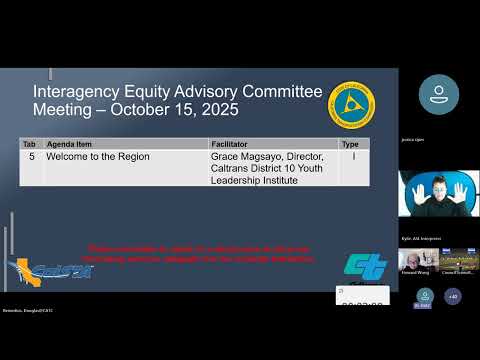
Caltrans briefs Equity Advisory Committee on Complete Streets policies, manuals and implementation challenges
Loading...
Summary
Caltrans staff told the Equity Advisory Committee that the agency has embedded Complete Streets work across planning, project delivery and maintenance and reviewed agency policy, guidance manuals and funding sources that shape bike/pedestrian projects statewide.
Caltrans staff told the Equity Advisory Committee that the agency has integrated Complete Streets work across planning, project delivery, maintenance and the director’s office and summarized policies, manuals and funding sources that guide bicycle and pedestrian projects.
Why it matters: Caltrans’ Complete Streets policies and guidance shape how state highways and local projects accommodate walking, biking and transit; the agency’s approach affects safety, equity and project delivery across California.
Susan Linde, acting lead advisor on Complete Streets at Caltrans headquarters, briefed the committee on the agency’s governance, district coordinators and major guidance documents. Linde said Caltrans now has at least one Complete Streets coordinator in each district, and she explained that districts prepare "complete streets decision documents" that will be posted to headquarters later this year to explain why certain projects can or cannot include bicycle and pedestrian facilities.
Linde walked the committee through key policies and plans that inform implementation: the agency’s context‑sensitive design policy, the road safety policy (with a Vision Zero‑style goal to eliminate fatal and serious injuries), and Director’s Policy 37 on Complete Streets, which states projects funded or overseen by Caltrans should provide comfortable, convenient and connected facilities unless an exception is documented.
She highlighted technical guidance used by Caltrans: the Manual on Uniform Traffic Control Devices (MUTCD) for signs and striping; the Highway Design Manual (HDM) for geometry and bikeway guidance; and a Design Information Bulletin (DIB 94) that expands bikeway options in places with posted speeds of 45 mph or less. Linde also described Caltrans’ state bicycle and pedestrian plan, district active transportation plans and road safety action plans as tools districts use to prioritize work.
Linde reviewed legislative and federal context: the California Complete Streets Act (2008), CEQA vehicle‑miles‑traveled reforms begun in 2013, AB 43 (traffic safety/speed limit flexibility) and more recent state reporting and complete streets bills that require transparency on constructed sidewalks, bikeways and transit infrastructure. She outlined federal programs that have supplied recent one‑time funding, including infrastructure law funds administered through Caltrans and state competitive programs for active transportation.
Committee members pressed on accessibility and operational coordination. Member Peggy Martinez, who represents blindness and accessibility perspectives, said she plans to submit a written list of detailed questions about curb ramp design, accessible pedestrian signals, pole placement and other ADA‑related implementation matters. Linde and staff said Caltrans manages ADA curb‑ramp and level‑change infrastructure as a related but distinct program from the bicycle and pedestrian program, and that some features are handled by traffic operations or other divisions.
Other members asked about the pace of project delivery; Linde said the agency’s construction‑completion reporting under a recent transparency law shows the average Caltrans project development timeline (from planning to construction) is around nine years.
Members asked Caltrans to return with deeper engagement opportunities; staff said they will work with EAC and subcommittees on follow‑up briefings, suggested topic outlines and potential special meetings to dive into policy and design detail, including options to present visuals or site visits for in‑person meetings.
Linde closed with links to Caltrans resources and offered to coordinate follow‑up answers to written questions and to return to the committee with more detailed briefings on technical or ADA coordination topics.
What the committee asked staff to do next: gather written questions from members (Peggy Martinez and others); coordinate a follow‑up session (potentially a dedicated Complete Streets meeting or subcommittee briefing); and circulate specific guidance and resource links in advance of additional discussion.