Get Full Government Meeting Transcripts, Videos, & Alerts Forever!
Get email alerts on the County‑operations topic
No spam. Unsubscribe anytime.
Burke County commissioners hear emergency-response review, approve lake‑lot rezoning and several grants; foster‑care nonprofit urges county support
Summary
Burke County commissioners on July 21 received a detailed account of the county’s response to the July 13 Grace Heights nursing‑home fire, approved a Lake James parcel rezoning and a slate of grant and administrative actions, and heard public pleas from a foster‑care nonprofit and an equine‑therapy farm seeking county assistance.
Burke County commissioners on Monday received a detailed emergency‑services briefing about the county’s response to the July 13 fire at Grace Heights Health and Rehabilitation, heard a public‑transportation update and a request for local support for fare‑free service, and voted 5‑0 to rezone a 4.5‑acre lot at Lake James from conservation to residential R‑1. The board also approved several budget and grant actions, created a task force to advise on the county’s next revaluation cycle, and heard public comment urging quicker action on tax‑exempt status for a local equine therapy nonprofit.
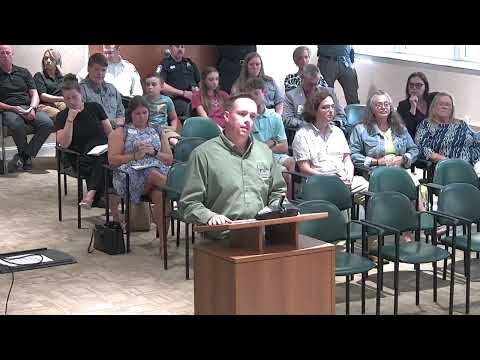
The meeting opened with a presentation from James Robinson, Burke County EMS director, who described the county’s unified response to the Grace Heights fire on July 13 and outlined emergency‑management changes since the county moved emergency management functions from the fire marshal’s office into Emergency Services. Robinson said crews established unified command with the City of Morganton, evacuated residents and set up temporary sheltering at the Foothills Higher Education Center. He told commissioners that 91 residents were moved to the shelter site and that 20 residents required transport to UNC Blue Ridge; all residents were placed in longer‑term solutions by 10 p.m. that night. Robinson said the county used local partners and mutual‑aid units from neighboring counties and that search‑and‑rescue and special‑operations teams responded to multiple incidents countywide the same day.
Robinson gave the commissioners an overview of the county’s emergency‑services organization and training programs, including a paramedic academy run in cooperation with Western Piedmont. He said Burke County meets most North Carolina Emergency Management training standards for special operations but lacks NC Heart Team members locally. Robinson also reported growing search‑and‑rescue call volumes — projecting roughly 200 SARs this year — and estimated overtime and response costs of about $202,000 so far this year for SAR operations; he and county staff said that number may rise toward $300,000 because of higher call volume and operational demands. Robinson also said the county is rolling out geotagged trail markers tied to SAR Topo to speed location of lost hikers and reduce search time.
In related business, the board approved two grant‑funding amendments tied to emergency preparedness and economic development. The board accepted a $177,000 North Carolina public‑safety shelter capacity grant to buy a generator and transfer switch for designated shelters and to add three‑phase power at key shelter locations; commissioners voted to budget the grant. The board also approved accepting a $200,000 building‑reuse grant awarded after a company met state job targets; staff will pass the grant through to the company after processing.
Greenway Public Transportation executive director Michael Bowman briefed commissioners on regional transit service that covers Burke and several neighboring counties, including demand‑response service, a Morganton flex (loop) route and a growing microtransit same‑day door‑to‑door service. Bowman said Greenway averaged more than 13,000 trips a year in Burke County across flex and microtransit services, and described a recent fare‑free pilot on the flex route that more than doubled monthly ridership (from 363 to 788 in February and rising to 1,115 in May). Bowman said the agency typically covers about 50% of operating costs with federal and state grants, uses CARES Act and other funds to address backlogged reimbursements, and asks local governments for an annual local match that typically covers about 25% of costs for services beyond demand‑response. The board voted to accept Bowman’s report.
The board also heard a presentation from Amber Vess, executive founder and director of the Live Like Meagan Foundation and its Next Place / Meg’s Place program. Vess described a foster‑care resource home in McDowell County that the foundation operates to provide temporary beds, clothing, supplies and a resource center for children awaiting placement and for kinship and foster families in need. She said Burke County DSS reported 160 nights with children sleeping at the county’s DSS office from June 2024 through June 2025 and 109 nights from January through June 2025. Vess said Meg’s Place would reduce trauma and improve options for families and foster parents; commissioners and staff discussed upcoming faith‑leader outreach to support foster‑care recruitment and resources.
Representatives of the Overmountain Victory State Trail presented a check and paperwork for a matching‑funds award. The trail’s friends group gave the county $160,130 in state funds approved by the North Carolina Department of Natural and Cultural Resources for a Canal Bridge pedestrian walkway segment; presenters said the funds connect to broader America250 (semiretirement) programming through mid‑2026 and thanked county staff for assistance.
Alan Gines, the county’s planning director, presented a map amendment request from property owners to rezone a 4.5‑acre parcel at 3594 North Powerhouse Road from conservation to R‑1 so the owners can subdivide and create one additional single‑family lot. Gines said lakefront buffer rules would still apply and that the county’s comprehensive plan (Lake James Scenic future‑land‑use category) supports single‑family use. The Planning Board had unanimously recommended approval. Commissioner motioned to adopt ordinance 2025‑59 (ZMA‑2025‑4); the board voted 5‑0 to approve the rezoning.
The board also moved forward on administrative and civic‑engagement items: commissioners approved a new Burke County Citizens Academy (six‑week, interactive sessions to begin in September, initially limited to 10 participants), approved a county contract to provide planning and zoning services to the Town of Glen Alpine, reappointed and appointed a slate of volunteers to advisory boards and committees, and ratified bylaws for the county opioid advisory committee. The board created a seven‑member task force to advise staff and commissioners on the county’s revaluation schedule and the standard schedule of values for the 2027 revaluation cycle. County managers and staff told the board the Department of Revenue’s sales‑ratio monitoring shows Burke County’s assessed values diverging from market; staff proposed an in‑house revaluation rather than a contractor‑led mass appraisal (potential savings estimated at roughly $1 million) and asked the commission to create a short‑term advisory task force to review valuation principles, schedules and outreach steps. The commissioners adopted the resolution establishing the revaluation task force.
On routine financial and administrative votes, the board approved a sheriff’s resolution to surplus and donate selected surplus law‑enforcement equipment to nearby police agencies; adopted the Home and Community Care Block Grant allocations for fiscal year 2025‑26 (Burke County allocation $669,313; total program including local matches $743,681); designated the chairman as the county’s NCACC voting delegate and vice chair as alternate for the August conference; and approved multiple board appointments to local advisory bodies. The board rejected — by motion — a private offer of $1,500 to buy a 0.45‑acre county parcel in the Eichard area near the Hickory airport, citing the county’s cost exposure and neighborhood comparables; staff will re‑advertise or solicit higher offers.
Public comment: several speakers addressed a long‑running dispute between Burke County and Hechoka (Hachoka) Retreat Center, an equine‑therapy nonprofit that said it has federal 501(c)(3) status but has waited nearly three years for county tax‑exempt recognition. Stakeholders, including Kimberly Clark (founder of Healing with Horses), Joseph Tate (Hechoka board member), and Marsha Love (board member), urged the commissioners to resolve the organization’s county tax‑exempt status and to correct valuation errors they say were applied to farm equipment and other assets. The speakers said the county had not responded to multiple communications and that Hechoka has engaged counsel and filed a lawsuit; they asked for an expedited county decision so the nonprofit can pursue planned tiny‑home or transitional housing projects for people in need.
The board accepted routine reports (tax collection and release reports, DSS monthly report) and adjourned after about three hours of public meeting time.
Votes at a glance
- Zoning map amendment (ZMA‑2025‑4 / Ordinance 2025‑59) — rezone 3594 North Powerhouse Road from Conservation to R‑1; motion adopted; vote: 5‑0. - Budget amendment (shelter capacity grant) — accept $177,000 NC public‑safety grant for shelter generators and upgrades; motion adopted; vote: 5‑0. - Budget amendment (building reuse grant) — accept $200,000 NC building reuse grant tied to job performance; motion adopted; vote: 5‑0. - Resolution establishing Revaluation Task Force — adopted; vote: 5‑0. - Donation/surplus resolution (sheriff) — approved; vote: 5‑0. - Rejection of county property offer (REID 372610 Westview Trail) — motion to reject $1,500 offer adopted; vote: 5‑0. - HCCBG allocations and AAoA agreement (FY 25‑26) — approved; vote: 5‑0. - VETIC funding (county allocation $5,000) — approved after recusals; recorded vote by remaining commissioners: 3‑0. - Citizens Academy program — approved; vote: 5‑0. - Contract to provide planning/zoning services to Glen Alpine — approved; vote: 5‑0. - Bylaws for Opioid Advisory Committee — ratified; vote: 5‑0.
What it means
Commissioners moved quickly on operational and administrative measures that staff said were time‑sensitive: accepting grant funding for shelter hardening and planning to pass a state building reuse award through to a company that met performance requirements. The revaluation task force is intended as a short‑term, citizen advisory group to provide subject‑matter review and public outreach before staff files a schedule of values for a likely 1/1/2027 revaluation mandated by state sales‑ratio guidance.
The County’s emergency‑management presentation highlighted capacity and cost pressures stemming from rising SAR call volumes and a high‑profile long‑duration extrication that relied on helicopter support. Commissioners asked staff to continue outreach with federal land managers and the state about search‑and‑rescue costs and trail signage in federally designated wilderness areas.
Public comment drew attention to Hechoka Retreat Center’s unresolved county tax‑exempt status and a pending lawsuit. Commissioners and county staff did not take an immediate action on the nonprofit’s request at the meeting; speakers urged a faster administrative resolution.
Ending
Commissioners scheduled the next regular meeting and noted the NCACC annual conference the week of Aug. 21–23. Several members said they plan to attend. The board announced no closed session was required and adjourned after receiving routine departmental reports.