Get Full Government Meeting Transcripts, Videos, & Alerts Forever!
Get email alerts on the Front Setback Variance topic
No spam. Unsubscribe anytime.
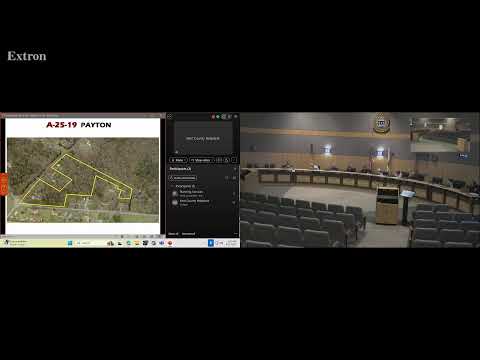
Owner seeks front‑setback variance on Peyton Lane to legalize dwelling and enable subdivision
Summary
William J. Peyton requested a variance to legalize a dwelling 22.3 feet from Peyton Lane (30‑foot front setback required) so the owner can subdivide three existing homes on a single parcel into separate lots; public testimony and staff discussion focused on a 2001 agreement that the structure would be moved but was not.
William J. Peyton sought a variance on Aug. 21 to reduce the 30‑foot front setback to 22.3 feet for an existing manufactured dwelling on Peyton Lane so that three existing homes on one tax parcel can be subdivided into separate lots.
"We want to do the variance to give us the 7 foot," Peyton said during the public hearing, explaining that the property contains three homes and that the dwelling has been in place for 39 years. Peyton said a contractor told him the unit could not practically be moved and would likely need demolition because of its age and an addition on the back. "It would have to be demolished and replaced," he said.
Staff and board members reviewed a 2001 minor subdivision plan that created the private access lane (Peyton Lane) and said that plan included a condition requiring the dwelling to be moved to meet the 30‑foot setback; the road was constructed after the house. Board members noted the prior agreement and described the current situation as a ‘‘self‑imposed’’ practical difficulty arising from the earlier subdivision approval, but also recognized the applicant said he lacked personal knowledge of the 2001 arrangements because the prior owner (his mother) handled them.
Board members asked whether the dwelling is occupied (the applicant said his nephew lives there), whether the structure could be physically moved (the applicant said relocation would be difficult because of trees, well and septic locations), and whether shortening the private lane or recording a revised subdivision plan could resolve the setback without a variance. Staff told the board shortening the road or revising the subdivision might be possible but would require meeting frontage and other technical requirements.
Public testimony closed at the end of the hearing. No final decision on the A‑25‑19 variance appears in the recorded business meeting excerpt; staff told the audience that decisions on applications would be made during the business meeting following the public hearing. The applicant was advised to provide further documentation regarding feasibility of moving the dwelling and to discuss alternatives such as revised lot lines with staff.