Get Full Government Meeting Transcripts, Videos, & Alerts Forever!
Get email alerts on the Regional Transportation Plan topic
No spam. Unsubscribe anytime.
CAMPO board adopts weighted project-prioritization method for 2050 regional plan after revisions
Summary
The Carson Area Metropolitan Planning Organization on Sept. 10 approved a scored, weighted project-prioritization methodology for its CAMPO 2050 Regional Transportation Plan, adjusting weights to raise preservation and altering preservation scoring after public comment and board discussion. The vote was unanimous.
Carson Area Metropolitan Planning Organization board members voted Sept. 10 in Carson City to approve a scored and weighted project-prioritization criteria and methodology to guide the CAMPO 2050 Regional Transportation Plan (RTP). The board adopted the framework with an amendment that raises the preservation weight and revises several preservation scoring measures; the motion passed unanimously.
The methodology assigns numeric scores to candidate projects drawn from partner agencies and uses goal-area weights to produce a prioritized list. Chair Greg Novak said the board received the proposal after multiple prior meetings and public input. Transportation Manager Chris Martinovich said the framework was built from six goal areas—safety, mobility, preservation, quality of life, adaptability and prosperity—and the proposal reflected public-survey responses and alignment with Nevada Department of Transportation planning.
Why it matters: the RTP process will rank projects that CAMPO anticipates must be allocated from an estimated $865,000,000 available for transportation-related projects through 2050. The scoring system is intended to make tradeoffs transparent when funding limits prevent all high-scoring projects from being built.
How the board changed the proposal: staff presented initial weights of 22.5% each for safety and mobility, 20% for preservation, 15% for quality of life and 10% each for adaptability and prosperity. Following board discussion, the body approved an amendment that changes preservation to 22.5% and reduces quality of life to 12.5%, leaving safety and mobility at 22.5% each and adaptability and prosperity at 10% each. The board also approved a change to preservation scoring that moves five points to a measure that rewards maintaining existing transportation infrastructure and eliminates a separate enhancement question that staff and members found confusing.
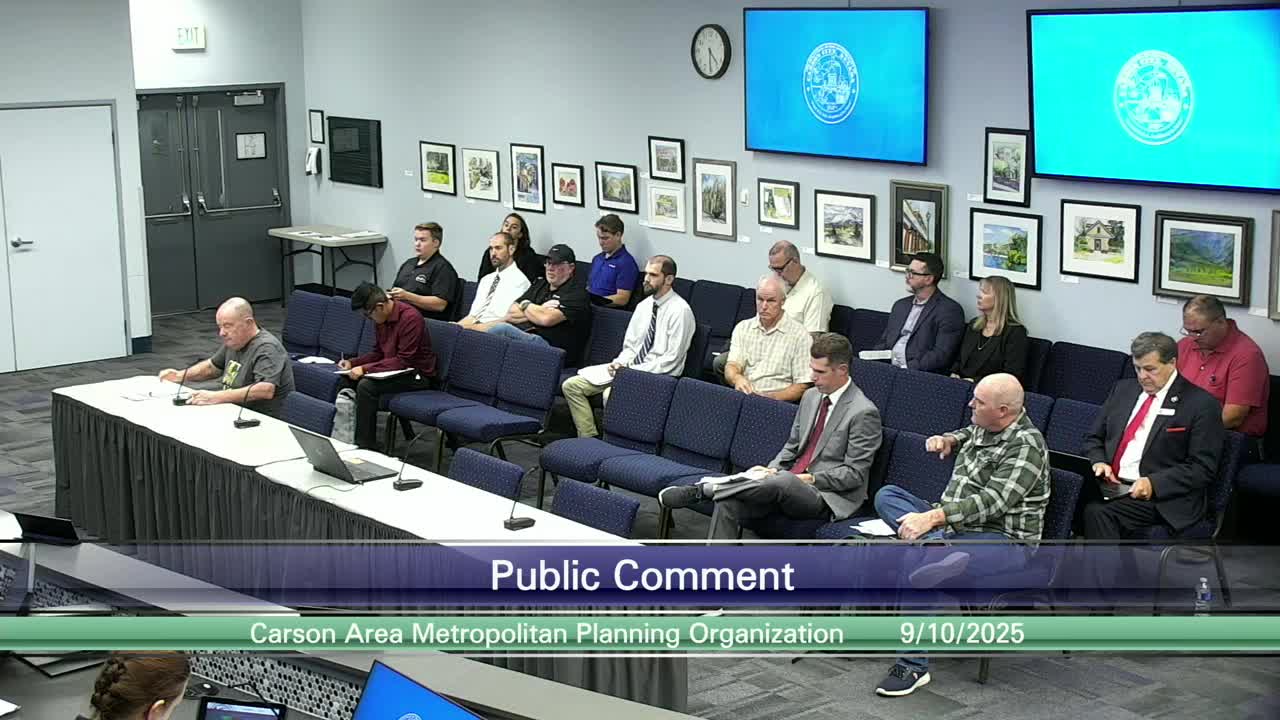
Public comment and examples: Mark Costa, a Carson City resident, urged transparency and said a published scoring matrix allows the public to see tradeoffs when politically driven adjustments are made. "There should be a process where we can go ahead and remediate or adjust the ranking based on political and other measures," Costa said during public comment. Martinovich showed an example scoring of the North Carson Street Complete Streets project; the unweighted total was 70 and the weighted score 12.425 as a demonstration of how staff will apply the framework.
Discussion highlights: board members questioned how the criteria would treat new construction, expansions and preservation projects. Member Jim Dodson said, "it's hard for me to envision that we're gonna rank every project with this number... and that's how we're gonna fund these projects because it's not gonna work that way." Dodson and others pressed staff to ensure the system is repeatable across projects submitted by different agencies and asked that cost and agency asset-management priorities be clearly considered in practice.
Staff response and adjustments: Martinovich said the criteria were crafted to be a relatively simple, largely yes/no scoring approach supplemented by readiness, available funding and agency priority. He recommended, and the board accepted, removing a preservation sub-question that asked whether a project "enhances existing roadway" and reallocating those points to preserving existing infrastructure. He also offered a second option—moving 2.5 percentage points from quality-of-life to preservation— which the board adopted as the amendment.
Scope, next steps and public engagement: Martinovich said projects will come from NDOT, Carson City, Lyon County, Douglas County and completed corridor studies; CAMPO expects to score roughly 70 candidate projects. A public meeting focused on project lists (not on the scoring weights) is scheduled for Sept. 24 in the Bonanza Room at the Carson City Community Center. Public input from that meeting will be considered as staff finalizes the scored project lists for future board presentations.
Limitations and dependencies: Martinovich and board members noted the RTP scoring does not replace Carson City’s district-based prioritization process; it is intended to allow comparison across jurisdictions and project types for regional funding decisions. Board members also cautioned that project funding decisions will incorporate practical constraints—project cost, funding source eligibility and asset-management priorities—and that high scores alone will not guarantee funding.
Ending: With the amendment adopted and the scoring framework approved, CAMPO staff will continue collecting project submissions from partner agencies, run the projects through the updated scoring tool and return with scored project lists for future board review and prioritization decisions.