Get Full Government Meeting Transcripts, Videos, & Alerts Forever!
Get email alerts on the Capital Punishment Competency topic
No spam. Unsubscribe anytime.
Utah Supreme Court weighs whether dementia, phone calls and statutes justify new competency review for condemned inmate
Summary
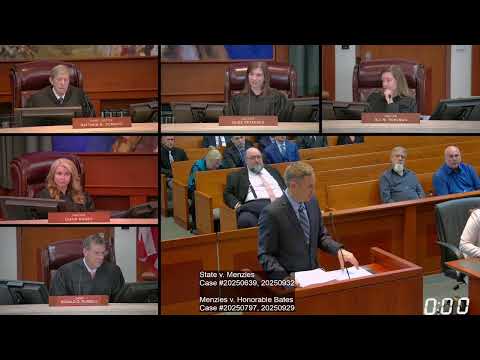
SALT LAKE CITY — The Utah Supreme Court on Tuesday heard argument over whether the state may schedule the execution of Thomas Menzies while defense lawyers press for a new competency evaluation after what they say is a substantial, recent decline from dementia.
SALT LAKE CITY — The Utah Supreme Court on Tuesday heard argument over whether the state may schedule the execution of Thomas Menzies while defense lawyers press for a new competency evaluation after what they say is a substantial, recent decline from dementia.
Lindsay Lair, counsel for Mr. Menzies, told the court that "the Eighth Amendment does not permit the State of Utah to execute a person who, because of advancing dementia, cannot rationally understand the meaning and purpose of his execution," and that new expert evaluations and a corrections employee declaration show such a decline. The state, represented by Daniel Boyer, said the rules for reopening competency proceedings are stricter for a second petition and the district court did not err in denying further relief.
Why it matters: The case raises whether the statutory test for a successive competency petition — that the petitioner "allege with specificity a substantial change in circumstances" and that the petition be "sufficient to raise a significant question" as to competency — permits reopening after a district court found Menzies competent on June 6. If the court orders new evaluations it could delay any warrant for execution; if it declines, the execution timeline could proceed subject to other stays.
Defense argument and evidence
Lindsay Lair said defense counsel submitted two recent expert reports, medical records, and a declaration from corrections case manager Stephanie Callahan documenting decline. Lair said two evaluators in late June found that Menzies "could not even articulate his charges," and that Callahan described a July 8 interaction in which Menzies "was just staring blankly" and "not really there." Lair told the justices the district court "required Mr. Menzies to prove his entire case rather than establishing a prima facie case" and applied an incorrect legal standard by demanding sustained rational understanding rather than allowing an independent DHS evaluation when a prima facie showing is made.
Defense counsel also pointed to longitudinal evaluation notes prepared by Dr. Abrams Silva and another expert (Dr. Hyde) showing progressively briefer, less coherent answers when examiners asked about the charges against him, and to recent phone records the defense argues show he is increasingly unable to complete calls: of 32 recent phone attempts, counsel said, only 13 resulted in actual calls and many attempts reflected confusion dialing and following prompts.
State position and statutory interpretation
Daniel Boyer, arguing for the State, said Utah law disfavors repeated reopening of competency proceedings and urged the court to give deference to the district court's factfinding. Boyer argued the statutory text creates a presumption against further competency hearings and requires a stricter showing on a successive petition than the initial Ford threshold. He urged that the court treat the district court's June 6 determination as the operative decision and assess whether the successive petition supplies evidence sufficient to raise a significant question about current competency.
Boyer told the justices that phone calls are "the best evidence of his cognitive function" outside a clinical setting and urged that the calls alone are dispositive under the statute because they show Menzies can engage in basic conversation, identify callers and solve simple problems like dialing.
Disputed legal points and justices' questions
The court's questioning focused on several recurring disagreements: (1) whether the phrase "allege with specificity a substantial change in circumstances" requires only detailed allegations or also attached proof at the time of filing; (2) whether the required "substantial change" must occur after the district court's formal competency determination (the parties debated whether that determination is the court's June 6 order or the date evidence closed in earlier proceedings); and (3) whether evidence that a defendant can carry on rudimentary phone conversations rebuts a prima facie showing of incompetency.
Justices asked whether the statutory gatekeeping stage permits the State to present rebuttal evidence (the defense argued it does not, calling the threshold primarily an allegation-based test; the State argued the text and context imply an evidentiary sufficiency requirement and pointed to post-order phone calls as permissible rebuttal). Lair said that even if some calls show brief lucidity, Madison v. Alabama and Panetti require a defendant be able to "sustain a rational understanding" of the reasons for execution, not merely show isolated moments of awareness. Boyer countered that the Supreme Court decisions do not require a sophisticated grasp of penal policy and emphasized that awareness that one is to be executed as punishment for murder can be sufficient in many cases.
Separately, counsel for the defense addressing warrant and stay issues (identified in argument as the lawyer handling warrant questions) told the court that automatic stays attach when an appeal or a petition for other relief is filed in the criminal case and that, absent a showing otherwise, Utah Code §77-19-9 requires issuance of a warrant only when there are no legal reasons to delay. State counsel responded that Gardner and other precedent limit the definition of "challenge to the judgment" that suspends warrant issuance and argued that a competency claim that never invalidated the judgment does not always bar a warrant.
Timeline and procedural details discussed
Counsel and the justices referenced specific dates and timelines the statute contemplates for Department of Human Services (DHS) evaluations (defense noted the statutory timeline—60 days for DHS evaluations and 15 days for a hearing—was far shorter than the months that elapsed here). Counsel said the district court's competency determination was issued June 6; defense witnesses reported new observations in late June and a July 8 declaration describing a marked decline. Defense asked the court to order a single DHS evaluator and a shortened evaluation timeline if the court grants relief.
Where things stand
After extended questioning, the court took the case under advisement. The justices said they would consider the briefing, the record and the arguments before issuing an opinion. Counsel for Mr. Menzies asked for a stay given an execution date the defense described as effectively the night of Sept. 4; the court did not immediately rule from the bench.
Ending
The court recessed after the parties completed argument and reserved decision. No order was announced at argument; the justices said they would issue a written decision after review of the record and briefs.