Denton Municipal Electric reviews 2018 renewable goal, urges clearer policy and an integrated resource plan
Loading...
Summary
Denton Municipal Electric staff reviewed the city's 2018 Renewable Resource Plan, explained accounting for renewable energy and RECs, outlined a pending integrated resource plan (IRP) and warned of short-term generation shortages and risks from large speculative data-center loads.
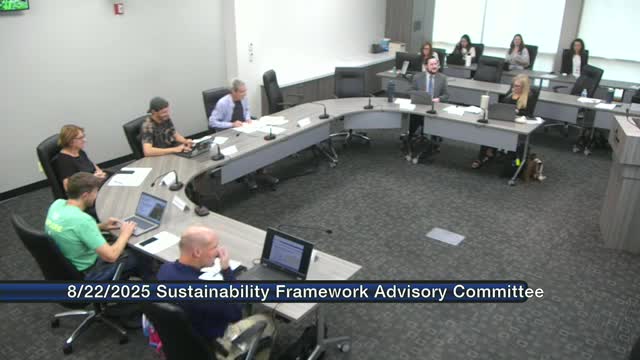
Denton Municipal Electric general manager Tony Fuente told the Sustainability Framework Advisory Committee on Aug. 22 that the utility's 2018 Renewable Resource Plan set a 100% renewable-energy goal for DME's service territory and that the utility must clarify how that goal is calculated and accounted for.
Fuente said the city's renewable target, as written in 2018, applied only to the service territory served by Denton Municipal Electric and not to customers served by other utilities in Denton. He summarized recent accounting decisions the city used to reach its stated 100% renewable figure and the market and reliability concerns driving a proposed integrated resource plan.
Why it matters: The committee was presented with a draft renewable-energy policy and the outline of an IRP process that staff said could take 18–24 months and would guide long-term choices about generation mix, reliability and cost. Staff warned that without clearer policy, double-counting of renewable energy credits (RECs) or exposure to volatile market prices could raise costs for ratepayers.
DME's accounting and market context Tony Fuente, general manager for Denton Municipal Electric (DME), told the committee that the 2018 plan called for a 100% renewable target for DME's customers. He said that in 2021 the utility's accounting — counting generation associated with owned PPAs plus additional REC purchases and certain REC-only contracts — resulted in a reported 100% renewable year.
"That plan called for a 100% renewable energy for the city," Fuente said, adding that DME counts RECs from its PPAs and has bought RECs on the market to cover shortfalls. He said the utility's recent Whitetail contract included 30 megawatts of RECs without the energy and that DME purchased roughly 400,000 RECs in 2024 to round out compliance under the plan.
Fuente described operational limits of variable resources, noting typical output factors: about 30% effective capacity for wind and roughly 40% for solar when converted from nameplate megawatts to average megawatt-hours. He also noted the Yellow Viking solar PPA for about 100 MW is not yet online and that DME has an RFP for up to 300 MW of additional solar, wind and/or battery storage under consideration.
Reliability, short-term exposure and large loads Fuente said DME now operates a single dispatchable generating plant (the "deck") with roughly 225 MW of dispatchable capacity, while peak load in 2023 reached about 408 MW, leaving a dispatchable shortfall of about 183 MW. He warned that during high-demand events the utility has to buy power in the real-time market, exposing ratepayers to price spikes that in 2023 led to tens of millions of dollars in additional costs.
He also flagged the rise of large prospective data-center loads statewide and locally, telling the committee that speculative, long-term PPAs tied to large new load interconnections can create financial risk if the load does not materialize. "Entering into a very long term contract for something that's speculative, I think, puts a lot of risk on our rate payers," Fuente said, and recommended negotiating protections such as shorter contract terms or stronger financial assurances for speculative large loads.
Policy recommendations and next steps Staff recommended two parallel efforts for the council: 1) a clear city renewable-energy policy that defines which resources count toward the goal, how RECs are treated (staff recommended retiring RECs counted toward the goal), and how excess RECs may be monetized; and 2) a formal integrated resource plan (IRP) to evaluate generation options across a 15–30 year horizon with public and stakeholder engagement and an outside consultant.
Fuente said the IRP would examine a wide range of options (natural gas quick-start generation, battery storage, geothermal, hydrogen or nuclear concepts) and include an annual update cadence. He estimated the IRP development and stakeholder process would require 18–24 months and suggested that any new dispatchable generation procurement should be evaluated carefully because of procurement lead times and permitting constraints.
Committee questions and clarifications Committee members asked for clarification about the difference between renewable energy, RECs and REC-only purchases; Fuente explained RECs represent proof that renewable generation was produced and that DME has been purchasing RECs to meet the environmental goal rather than always buying the energy itself. Members also pressed on whether batteries are considered dispatchable (Fuente said regulatory rules currently generally exclude batteries from the definition of dispatchable generation used in some legislative proposals) and on whether DME anticipated asking council for additional rate authority to pay for new generation.
No formal action requested This item was presented as a report for discussion; staff said further formal direction to pursue procurement or acquisition would require a separate public posting. Fuente said he would return with a formal plan and vendor solicitations for council consideration.
Looking ahead: An IRP with stakeholder input Source materials and staff said the IRP would include stakeholder engagement, outside consultants and regular updates to council. The committee asked to be included in future policy and IRP briefings so it can provide feedback to staff during development.
Ending note: The presentation covered accounting, market and reliability trade-offs behind Denton's renewable goal and the utility's push for clearer policy and a multi-year IRP process that balances environmental goals with reliability and rate impacts.