Get Full Government Meeting Transcripts, Videos, & Alerts Forever!
Get email alerts on the Solid Waste topic
No spam. Unsubscribe anytime.
Residents urge clearer trash pickup, stronger code enforcement and staffing focus during Temple City Council public comments
Summary
At a Temple City Council meeting, residents raised concerns about a new bulky/brush pickup schedule, unclear collection timing, code enforcement in alleys, and public access for an upcoming budget hearing; council and staff responded with clarifications and next steps.
Several Temple residents used the council’s public-comment period to press for clearer solid-waste procedures, improved code enforcement in alleys, and attention to staffing and accessibility as the city prepares a new fiscal-year budget.
The comments came during the council’s regular meeting, where callers and in-person attendees described confusion about a recent change to bulky and brush pickup and urged the council to prioritize first responders and clearer service delivery.
Matthew Morovic, a resident, said he supports changing bulky/brush collection from quarterly to monthly and called the change “a great compromise” between twice-monthly and quarterly pickup. “It’s sufficient,” Morovic said, adding that monthly pickup will give some homeowners—particularly those on larger lots and septic systems—needed flexibility.
Gail Peek, a resident of Mayor Walker’s district, said she favors pilot testing but criticized unclear scheduling and customer communication. “I called [the city] and was told put your trash out on Sunday night. We will pick it up anywhere from Monday to Thursday,” Peek said, describing uncertainty about when and how long debris would remain at the curb.
Willie Cash urged the council to keep driver-based checks and recordkeeping in mind when evaluating solid-waste operations, and other commenters described on-the-ground effects of the new schedule on neighborhoods.
Dorothy (last name not specified), a recent transplant to Temple, described uneven code-enforcement outcomes in alleys behind residences. She said some alleys appear well maintained while others are overgrown and suggested the city consider stepped-up maintenance or clearer responsibility for alley upkeep.
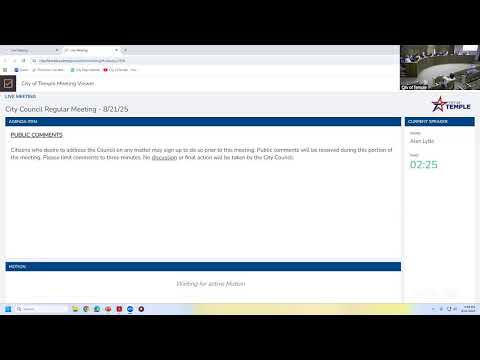
Alan Lydall, a longtime resident, spoke about accessibility for the public hearing on the budget and tax items scheduled next week. Lydall asked that the elevator remain available to members of the public during the hearing; the mayor’s office responded that the city expects the elevator to be accessible for public attendees and advised Lydall to follow up with staff if he encounters problems.
On staffing and budget priorities, Peek urged the council to prioritize first responders as officials prepare the new fiscal-year budget. A city representative stated the city currently has about 950 employees supporting a population the speaker described as roughly 103,000, equating to just under one municipal employee per 100 residents—figures offered to contextualize staffing levels.
Council members and staff responded to the comments by offering to collect contact information from residents with specific service complaints, to follow up on code-enforcement reports, and to confirm logistics for the upcoming budget public hearing. No formal action or vote was taken during the public-comment period.
Council members did not decide policy changes during the remarks; the comments were recorded for council consideration as staff continue planning for implementation and community outreach.