Get Full Government Meeting Transcripts, Videos, & Alerts Forever!
Get email alerts on the Trust Fund Finances topic
No spam. Unsubscribe anytime.
Land for Maine’s Future board hears fund balances, warns unallocated pools are low
Summary
Board staff reported the Land for Maine's Future (LMF) trust has roughly $21 million in cash and about $2.4 million in interest earned to date; members discussed low unallocated balances for several program categories and the need for new state funding or bonds.
At a Land for Maine's Future Board meeting, staff reported the trust fund has a little under $21,000,000 in cash and has earned about $2,400,000 in interest to date. Laura Graham, director, told the board the account includes restricted gifts earmarked for land acquisition and unrestricted gifts used for administration, and that the interest earnings have been allocated to program purposes.
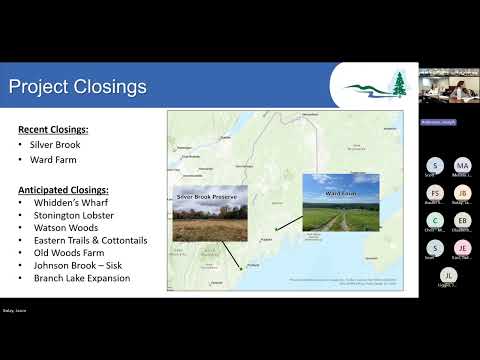
Board members spent the bulk of the discussion on how much of that money is already encumbered. Graham said the fund shows active allocations for 45 projects with slightly more than $17,000,000 earmarked for those projects and two closings completed since the last board meeting. She also noted several program set‑asides—working waterfront, working farmland and water access—are constrained by prior legislative direction tied to an earlier $40,000,000 appropriation.
Members asked for historical context and alternative ways to present the totals. Graham said the trust fund has cumulative inflows from bonds and appropriations dating to a 1987 bond and subsequent grants and bonds, and that staff can present the aggregate in inflation‑adjusted (current) dollars on request. Members discussed whether to show matching funds alongside the state investments to reflect total leveraged conservation impact.
Board members repeatedly raised that the Conservation and Recreation (CNR) unallocated balance is particularly low and that, without new funding, the board will be limited in issuing a future request for proposals for CNR projects. Several commissioners said they expect additional bond measures or appropriations could appear in the next legislative cycle but cautioned that bonds require legislative passage, the governor's signature and voter approval when applicable, which makes timing uncertain.
Graham and commissioners discussed potential sources and timing. Staff said there are bond bills carried over and the board may seek an update from legislative partners; commissioners said pursuing a stable, non‑bond funding source would reduce the program's boom‑and‑bust planning cycles. The board asked staff to prepare more detailed, inflation‑adjusted summaries and a clearer breakout of unrestricted versus restricted gift balances for a future meeting.
Ending: Board members set the next full meeting for September; staff were asked to return updated, inflation‑adjusted impact numbers and a clearer breakdown of allocated versus unallocated funds for agenda discussion.