Get Full Government Meeting Transcripts, Videos, & Alerts Forever!
Get email alerts on the Land Use Variance topic
No spam. Unsubscribe anytime.
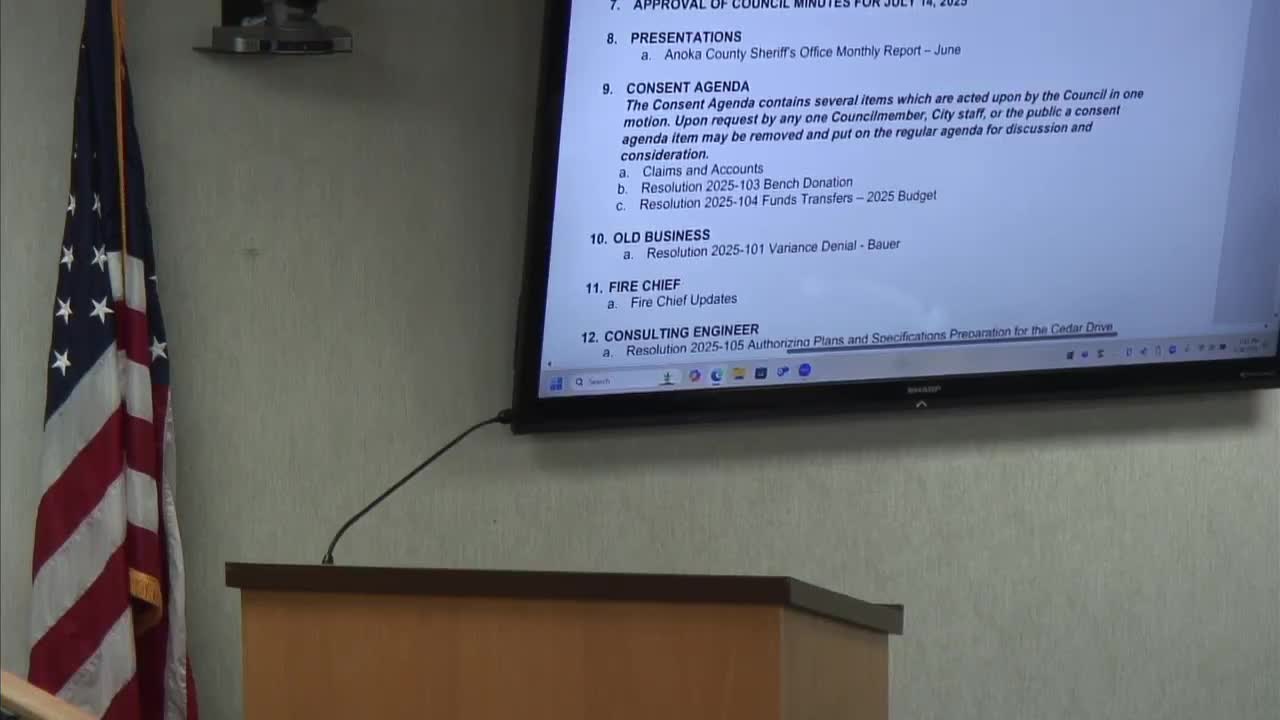
Oak Grove council denies developer’s variance for short cul‑de‑sac, 3‑1
Summary
The Oak Grove City Council voted 3‑1 to deny a variance that would have allowed a cul‑de‑sac shorter than city minimums after the DNR established ordinary high water marks that changed the applicant’s lot layout.
The Oak Grove City Council voted 3‑1 on July 28 to deny a variance request from a local developer that would have allowed a short cul‑de‑sac and a modified lot layout for a subdivision adjacent to State Highway 47.
The measure concerned a plat the applicant said lost lots after the Minnesota Department of Natural Resources surveyed nearby public water bodies and established ordinary high water marks that changed the development setbacks. The developer proposed adding a cul‑de‑sac that does not meet the city’s minimum block‑length and road‑design requirements to regain lots removed by the DNR setbacks.
Council members spent more than an hour discussing alternatives and the project’s history. Planner staff, represented remotely by Chris Jansen of MSA, said the planning commission had recommended denial at its June public hearing. Council members said the preliminary plat file showed a right‑of‑way that once extended to the property line but was recorded differently on the final plat, which created the present access and design constraints.
Developer testimony said a southern access through an existing cul‑de‑sac approved years earlier could, if available, support more lots and avoid the short cul‑de‑sac now proposed. Council members and an attendee said attempts to reach the adjacent landowners had failed; the property owners declined to engage, according to the developer’s representative.
Council members also raised public‑safety and technical concerns. One member said a fire official advised that the proposed cul‑de‑sac and short approach would make it difficult to position two fire trucks in an emergency. The council discussed whether reducing the number or size of lots would make the design workable, and some members noted the city previously allowed exceptions in other subdivisions but expressed reluctance to set a new precedent.
After discussion, Council member Wiley moved to deny the variance. Council member West seconded. The motion passed 3‑1. The planning commission’s recommendation of denial and the council’s final vote were recorded in the meeting minutes.
The developer did not receive the variance; council members said the decision reflected both land‑use standards (minimum block length and road design) and unresolved access and property‑owner issues tied to a plat recorded years earlier. No new permit or variance was approved at the meeting; council members suggested the developer could pursue other design changes, additional outreach to neighboring landowners, or city staff review of alternate lot configurations.
The council’s action was taken after a public hearing and staff presentations during the meeting’s “old business” agenda item. No appeal or follow‑up schedule was announced at the meeting.