Get Full Government Meeting Transcripts, Videos, & Alerts Forever!
Get email alerts on the Lead Service Replacement topic
No spam. Unsubscribe anytime.
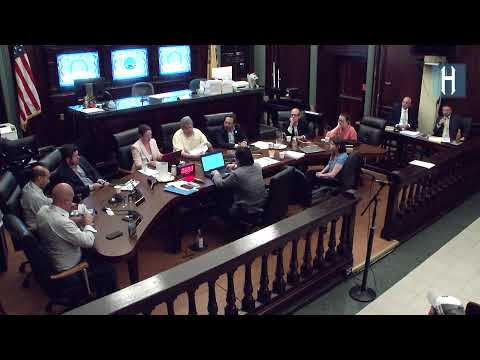
Hoboken council adopts ordinance to inventory and replace lead service lines; residents raise cost concerns
Summary
The Hoboken City Council adopted an ordinance establishing a program to identify and replace lead service lines, prompting questions from residents about who will pay, how replacements will be scheduled and how many properties are affected.
The Hoboken City Council on Monday adopted an ordinance adding Article 4 to Chapter 193 of the city code to create a Lead Service Replacement program and a section titled “Mandatory Replacement of Lead Service Lines.”
The measure directs the city to inventory and replace lead service lines as part of a program designed to comply with state law and related guidance. Council members and staff said the work will be coordinated with ongoing water-system upgrades and will be funded through the city water utility rather than general tax revenue.
Why it matters: Lead in service lines is a public-health concern cited by residents during the hearing. Several speakers asked whether property owners would carry replacement costs and whether the city can afford to accelerate work during a period of other capital needs.
Residents pressed the council during the public hearing for clearer answers about cost and timing. Cheryl Falick, a resident who said she researched the issue, asked directly: “What I don't understand… Asking the residents to pay for this?”
Council members and staff sought to clarify funding and program mechanics. A council member speaking for administration staff said the replacement program will be financed through the water utility and water rates, not the city’s general fund, and that the work will be phased to avoid opening many streets at once. “This will be the projects that we will spend our water rates on over the next few years,” the council member said.
Council members described a multi-step rollout: the city will inventory known replacements, then test and identify additional lead service lines and schedule work in a programmatic way, often replacing all services on a block at once when feasible. Staff said the city currently estimates roughly 1,000 potentially affected service lines but that number is a working estimate based on historical records and past replacements.
Several speakers warned the ordinance could place burdens on small landlords and tenants and urged the council to provide clear information about financing and protections. “This could have a huge financial impact on a great many people,” Eric Volpe told the council.
Council deliberations emphasized the city’s limited discretion under state law and the logistics of sequencing replacements around other street and utility projects. The council said the state set an overall deadline for replacing all lead service lines by 2031 and that Hoboken is building an inventory and registration system to coordinate property-level participation and avoid unnecessary rework.
The council called for follow-up actions and additional ordinances to flesh out the programmatic details and the public-notification process. Council members said the city has an online map and registry that residents can use to check whether a property’s service has already been replaced or to report prior replacements so the city will not schedule redundant work.
The ordinance passed on a recorded vote. Supporters said the ordinance aligns the city’s capital projects with state requirements and targets a real public-health risk; opponents and some residents said the council must be clearer about costs and protections for renters and small-property owners.
Looking ahead: Council members said they expect additional implementing rules and supplementary ordinances that will define timelines, testing, signage and registration procedures, and that they will discuss the financial and operational details in subsequent committee meetings.